

Aeolian processes and erosive landforms
413
mobilization. This is the fluid threshold (or static). When entrainment of grains has begun,
ballistic impacts reduce required energy to keep the movement of particles. This is the
impact threshold (or dynamic), where slower speeds are required to move a stationary
grain by fluid pushing, and it is equivalent to 80% of the static threshold (Andersson and
Haft, 1988). These equations adjust correctly on flat, homogeneous, dry surfaces, with
isolated, loose clasts (Williams et al., 1994). The values of the movement thresholds,
however, are also affected by the variability of sediments, surface crusts, slope inclination,
humidity, and roughness.
4. Types of aeolian transport
When particles pass the mobilization threshold they can be transported in four different
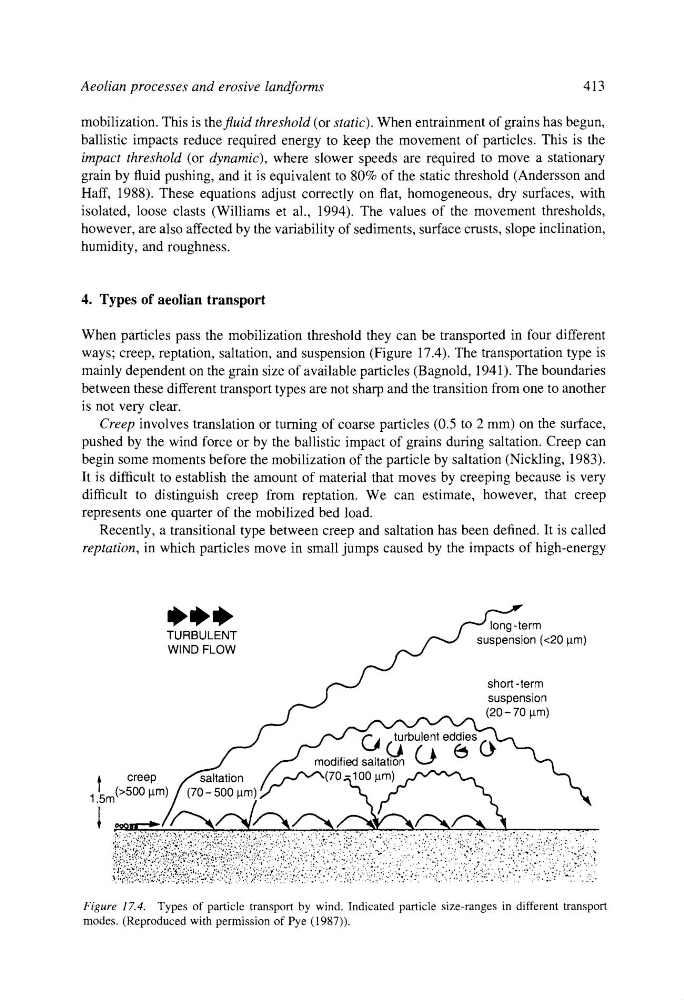
ways; creep, reptation, saltation, and suspension (Figure 17.4). The transportation type is
mainly dependent on the grain size of available particles (Bagnold, 1941). The boundaries
between these different transport types are not sharp and the transition from one to another
is not very clear.
Creep involves translation or turning of coarse particles (0.5 to 2 mm) on the surface,
pushed by the wind force or by the ballistic impact of grains during saltation. Creep can
begin some moments before the mobilization of the particle by saltation (Nickling, 1983).
It is difficult to establish the amount of material that moves by creeping because is very
difficult to distinguish creep from reptation. We can estimate, however, that creep
represents one quarter of the mobilized bed load.
Recently, a transitional type between creep and saltation has been defined. It is called
reptation, in which particles move in small jumps caused by the impacts of high-energy
~I~~
~long_term
TURBULENT
suspension (<20 ILtm)
WIND FLOW
A
creep
1 15m(>500 l~m)
9 .-..! "'":"'~i
. ~. . ~. ?,
short -term
suspension
/
(70- 500 lam)
~k,
Figure 17.4. Types of particle transport by wind. Indicated particle size-ranges in different transport
modes. (Reproduced with permission of Pye (1987)).
413
mobilization. This is the fluid threshold (or static). When entrainment of grains has begun,
ballistic impacts reduce required energy to keep the movement of particles. This is the
impact threshold (or dynamic), where slower speeds are required to move a stationary
grain by fluid pushing, and it is equivalent to 80% of the static threshold (Andersson and
Haft, 1988). These equations adjust correctly on flat, homogeneous, dry surfaces, with
isolated, loose clasts (Williams et al., 1994). The values of the movement thresholds,
however, are also affected by the variability of sediments, surface crusts, slope inclination,
humidity, and roughness.
4. Types of aeolian transport
When particles pass the mobilization threshold they can be transported in four different
ways; creep, reptation, saltation, and suspension (Figure 17.4). The transportation type is
mainly dependent on the grain size of available particles (Bagnold, 1941). The boundaries
between these different transport types are not sharp and the transition from one to another
is not very clear.
Creep involves translation or turning of coarse particles (0.5 to 2 mm) on the surface,
pushed by the wind force or by the ballistic impact of grains during saltation. Creep can
begin some moments before the mobilization of the particle by saltation (Nickling, 1983).
It is difficult to establish the amount of material that moves by creeping because is very
difficult to distinguish creep from reptation. We can estimate, however, that creep
represents one quarter of the mobilized bed load.
Recently, a transitional type between creep and saltation has been defined. It is called
reptation, in which particles move in small jumps caused by the impacts of high-energy
~I~~
~long_term
TURBULENT
suspension (<20 ILtm)
WIND FLOW
A
creep
1 15m(>500 l~m)
9 .-..! "'":"'~i
. ~. . ~. ?,
short -term
suspension
/
(70- 500 lam)
~k,
Figure 17.4. Types of particle transport by wind. Indicated particle size-ranges in different transport
modes. (Reproduced with permission of Pye (1987)).