

412
Climatic Geomorphology
gravity, friction, and cohesion (Iversen et al., 1987). Wind speed increases over any
ground protuberance, as pressure decreases, according to Bernouilli's equation. As a
consequence, a loose particle can undergo uplifting, and this force is much more intense in
the contact with the ground, where wind-speed is maximum (Cooke et al., 1993). The
lifting is much more important in dust turbulences (vortex and whirl-winds). Creeping
includes friction between the particle and the air, called surface creeping, that causes
rolling, and shape creeping, due to the difference of pressure between the stoss side and the
lee side of the particle (Livingstone and Warren, 1996). When grains are airborne,
bombardment against the substrate and collisions between grains begin. These processes
cause the possible creeping and lifting of other loose particles.
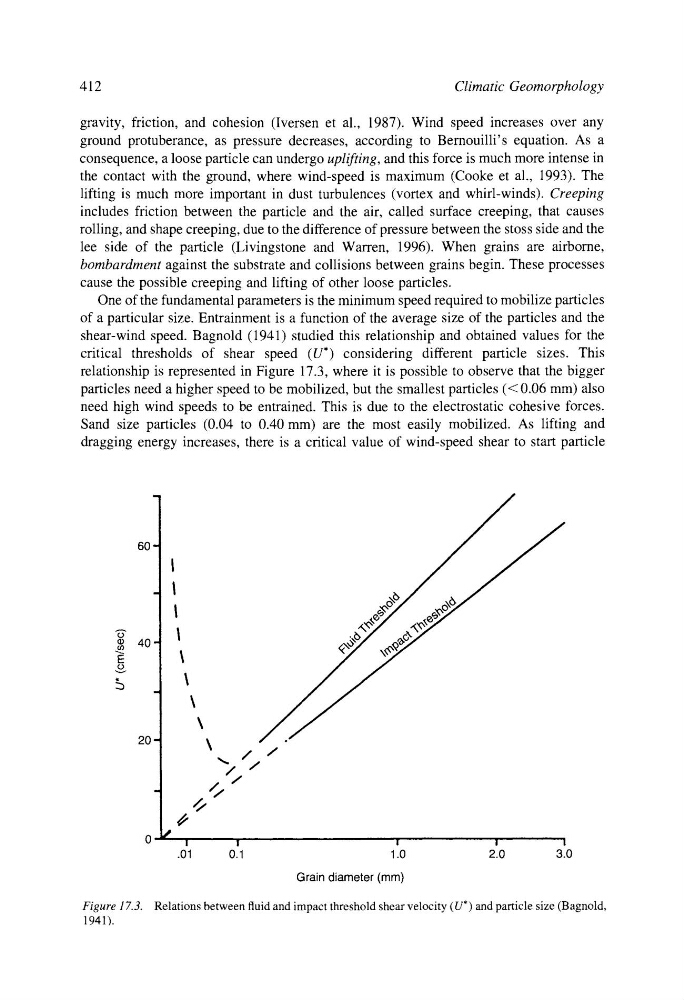
One of the fundamental parameters is the minimum speed required to mobilize particles
of a particular size. Entrainment is a function of the average size of the particles and the
shear-wind speed. Bagnold (1941) studied this relationship and obtained values for the
critical thresholds of shear speed (U*) considering different particle sizes. This
relationship is represented in Figure 17.3, where it is possible to observe that the bigger
particles need a higher speed to be mobilized, but the smallest particles (< 0.06 mm) also
need high wind speeds to be entrained. This is due to the electrostatic cohesive forces.
Sand size particles (0.04 to 0.40 mm) are the most easily mobilized. As lifting and
dragging energy increases, there is a critical value of wind-speed shear to start particle
40E
20l
l
\
0
.H
/
/
\
/
///
4,
I
I
.Ol
o.1
60I
I
I
1.0
2.0
3.0
Grain diameter (mm)
Figure 17.3. Relations between fluid and impact threshold shear velocity (U*) and particle size (Bagnold,
1941).
Climatic Geomorphology
gravity, friction, and cohesion (Iversen et al., 1987). Wind speed increases over any
ground protuberance, as pressure decreases, according to Bernouilli's equation. As a
consequence, a loose particle can undergo uplifting, and this force is much more intense in
the contact with the ground, where wind-speed is maximum (Cooke et al., 1993). The
lifting is much more important in dust turbulences (vortex and whirl-winds). Creeping
includes friction between the particle and the air, called surface creeping, that causes
rolling, and shape creeping, due to the difference of pressure between the stoss side and the
lee side of the particle (Livingstone and Warren, 1996). When grains are airborne,
bombardment against the substrate and collisions between grains begin. These processes
cause the possible creeping and lifting of other loose particles.
One of the fundamental parameters is the minimum speed required to mobilize particles
of a particular size. Entrainment is a function of the average size of the particles and the
shear-wind speed. Bagnold (1941) studied this relationship and obtained values for the
critical thresholds of shear speed (U*) considering different particle sizes. This
relationship is represented in Figure 17.3, where it is possible to observe that the bigger
particles need a higher speed to be mobilized, but the smallest particles (< 0.06 mm) also
need high wind speeds to be entrained. This is due to the electrostatic cohesive forces.
Sand size particles (0.04 to 0.40 mm) are the most easily mobilized. As lifting and
dragging energy increases, there is a critical value of wind-speed shear to start particle
40E
20l
l
\
0
.H
/
/
\
/
///
4,
I
I
.Ol
o.1
60I
I
I
1.0
2.0
3.0
Grain diameter (mm)
Figure 17.3. Relations between fluid and impact threshold shear velocity (U*) and particle size (Bagnold,
1941).