

Aeolian processes and erosive landforms
411
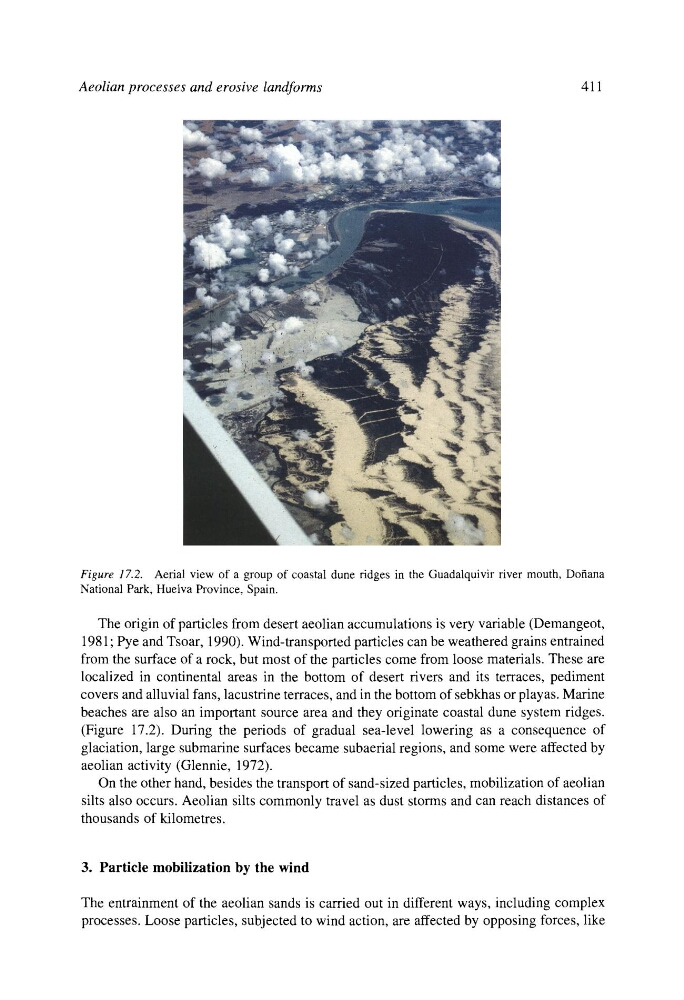
Figure 17.2. Aerial view of a group of coastal dune ridges in the Guadalquivir river mouth, Dofiana
National Park, Huelva Province, Spain.
The origin of particles from desert aeolian accumulations is very variable (Demangeot,
1981; Pye and Tsoar, 1990). Wind-transported particles can be weathered grains entrained
from the surface of a rock, but most of the particles come from loose materials. These are
localized in continental areas in the bottom of desert rivers and its terraces, pediment
covers and alluvial fans, lacustrine terraces, and in the bottom of sebkhas or playas. Marine
beaches are also an important source area and they originate coastal dune system ridges.
(Figure 17.2). During the periods of gradual sea-level lowering as a consequence of
glaciation, large submarine surfaces became subaerial regions, and some were affected by
aeolian activity (Glennie, 1972).
On the other hand, besides the transport of sand-sized particles, mobilization of aeolian
silts also occurs. Aeolian silts commonly travel as dust storms and can reach distances of
thousands of kilometres.
3. Particle mobilization by the wind
The entrainment of the aeolian sands is carried out in different ways, including complex
processes. Loose particles, subjected to wind action, are affected by opposing forces, like
411
Figure 17.2. Aerial view of a group of coastal dune ridges in the Guadalquivir river mouth, Dofiana
National Park, Huelva Province, Spain.
The origin of particles from desert aeolian accumulations is very variable (Demangeot,
1981; Pye and Tsoar, 1990). Wind-transported particles can be weathered grains entrained
from the surface of a rock, but most of the particles come from loose materials. These are
localized in continental areas in the bottom of desert rivers and its terraces, pediment
covers and alluvial fans, lacustrine terraces, and in the bottom of sebkhas or playas. Marine
beaches are also an important source area and they originate coastal dune system ridges.
(Figure 17.2). During the periods of gradual sea-level lowering as a consequence of
glaciation, large submarine surfaces became subaerial regions, and some were affected by
aeolian activity (Glennie, 1972).
On the other hand, besides the transport of sand-sized particles, mobilization of aeolian
silts also occurs. Aeolian silts commonly travel as dust storms and can reach distances of
thousands of kilometres.
3. Particle mobilization by the wind
The entrainment of the aeolian sands is carried out in different ways, including complex
processes. Loose particles, subjected to wind action, are affected by opposing forces, like