

Aeolian processes and erosive landforms
417
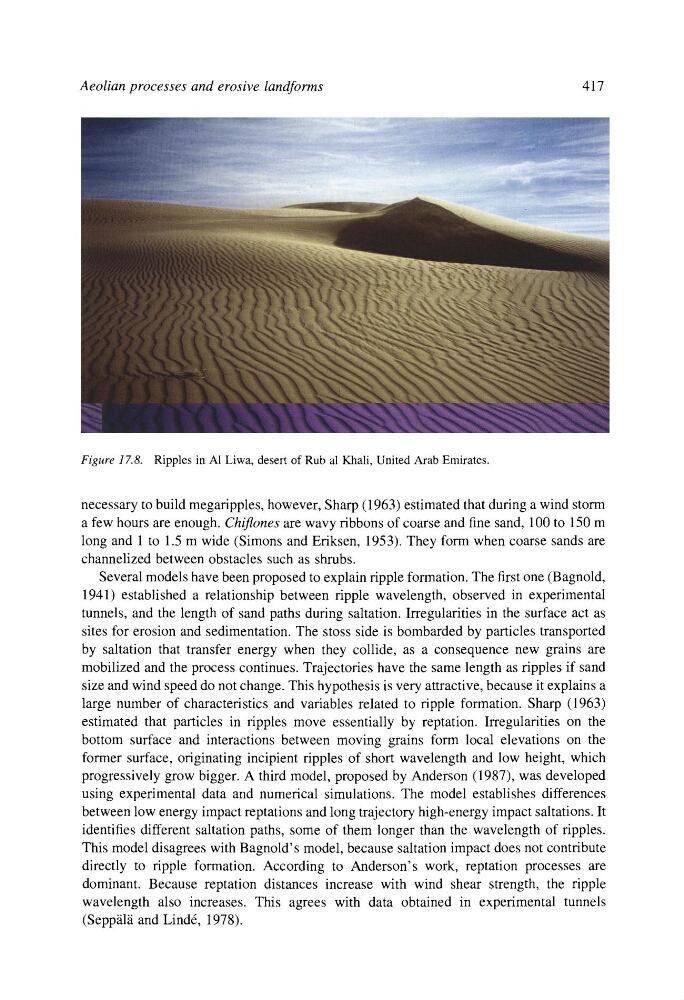
Figure 17.8. Ripples in A1 Liwa, desert of Rub al Khali, United Arab Emirates.
necessary to build megaripples, however, Sharp (1963) estimated that during a wind storm
a few hours are enough. Chiflones are wavy ribbons of coarse and fine sand, 100 to 150 m
long and 1 to 1.5 m wide (Simons and Eriksen, 1953). They form when coarse sands are
channelized between obstacles such as shrubs.
Several models have been proposed to explain tipple formation. The first one (Bagnold,
1941) established a relationship between tipple wavelength, observed in experimental
tunnels, and the length of sand paths during saltation. Irregularities in the surface act as
sites for erosion and sedimentation. The stoss side is bombarded by particles transported
by saltation that transfer energy when they collide, as a consequence new grains are
mobilized and the process continues. Trajectories have the same length as ripples if sand
size and wind speed do not change. This hypothesis is very attractive, because it explains a
large number of characteristics and variables related to tipple formation. Sharp (1963)
estimated that particles in tipples move essentially by reptation. Irregularities on the
bottom surface and interactions between moving grains form local elevations on the
former surface, originating incipient tipples of short wavelength and low height, which
progressively grow bigger. A third model, proposed by Anderson (1987), was developed
using experimental data and numerical simulations. The model establishes differences
between low energy impact reptations and long trajectory high-energy impact saltations. It
identifies different saltation paths, some of them longer than the wavelength of tipples.
This model disagrees with Bagnold's model, because saltation impact does not contribute
directly to tipple formation. According to Anderson's work, reptation processes are
dominant. Because reptation distances increase with wind shear strength, the tipple
wavelength also increases. This agrees with data obtained in experimental tunnels
(Sepp~il~i and Lindr, 1978).
417
Figure 17.8. Ripples in A1 Liwa, desert of Rub al Khali, United Arab Emirates.
necessary to build megaripples, however, Sharp (1963) estimated that during a wind storm
a few hours are enough. Chiflones are wavy ribbons of coarse and fine sand, 100 to 150 m
long and 1 to 1.5 m wide (Simons and Eriksen, 1953). They form when coarse sands are
channelized between obstacles such as shrubs.
Several models have been proposed to explain tipple formation. The first one (Bagnold,
1941) established a relationship between tipple wavelength, observed in experimental
tunnels, and the length of sand paths during saltation. Irregularities in the surface act as
sites for erosion and sedimentation. The stoss side is bombarded by particles transported
by saltation that transfer energy when they collide, as a consequence new grains are
mobilized and the process continues. Trajectories have the same length as ripples if sand
size and wind speed do not change. This hypothesis is very attractive, because it explains a
large number of characteristics and variables related to tipple formation. Sharp (1963)
estimated that particles in tipples move essentially by reptation. Irregularities on the
bottom surface and interactions between moving grains form local elevations on the
former surface, originating incipient tipples of short wavelength and low height, which
progressively grow bigger. A third model, proposed by Anderson (1987), was developed
using experimental data and numerical simulations. The model establishes differences
between low energy impact reptations and long trajectory high-energy impact saltations. It
identifies different saltation paths, some of them longer than the wavelength of tipples.
This model disagrees with Bagnold's model, because saltation impact does not contribute
directly to tipple formation. According to Anderson's work, reptation processes are
dominant. Because reptation distances increase with wind shear strength, the tipple
wavelength also increases. This agrees with data obtained in experimental tunnels
(Sepp~il~i and Lindr, 1978).