

The arid region piedmonts: glacis and alluvial fans
379
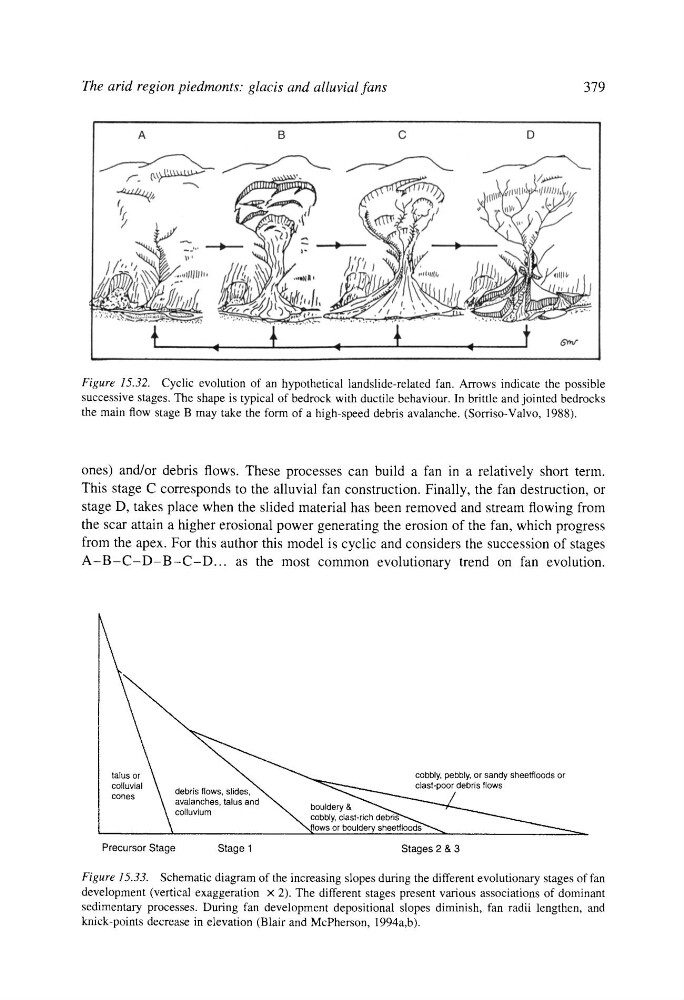
Figure 15.32. Cyclic evolution of an hypothetical landslide-related fan. Arrows indicate the possible
successive stages. The shape is typical of bedrock with ductile behaviour. In brittle and jointed bedrocks
the main flow stage B may take the form of a high-speed debris avalanche. (Sorriso-Valvo, 1988).
ones) and/or debris flows. These processes can build a fan in a relatively short term.
This stage C corresponds to the alluvial fan construction. Finally, the fan destruction, or
stage D, takes place when the slided material has been removed and stream flowing from
the scar attain a higher erosional power generating the erosion of the fan, which progress
from the apex. For this author this model is cyclic and considers the succession of stages
A-B-C-D-B-C-D...
as the most common evolutionary trend on fan evolution.
cobbly, pebbly, or sandy sheetfloods or
clast-poor debris flows
/
\co,,uv,u
....
Precursor Stage
Stage 1
Stages 2 & 3
Figure 15.33. Schematic diagram of the increasing slopes during the different evolutionary stages of fan
development (vertical exaggeration x 2). The different stages present various associations of dominant
sedimentary processes. During fan development depositional slopes diminish, fan radii lengthen, and
knick-points decrease in elevation (Blair and McPherson, 1994a,b).
379
Figure 15.32. Cyclic evolution of an hypothetical landslide-related fan. Arrows indicate the possible
successive stages. The shape is typical of bedrock with ductile behaviour. In brittle and jointed bedrocks
the main flow stage B may take the form of a high-speed debris avalanche. (Sorriso-Valvo, 1988).
ones) and/or debris flows. These processes can build a fan in a relatively short term.
This stage C corresponds to the alluvial fan construction. Finally, the fan destruction, or
stage D, takes place when the slided material has been removed and stream flowing from
the scar attain a higher erosional power generating the erosion of the fan, which progress
from the apex. For this author this model is cyclic and considers the succession of stages
A-B-C-D-B-C-D...
as the most common evolutionary trend on fan evolution.
cobbly, pebbly, or sandy sheetfloods or
clast-poor debris flows
/
\co,,uv,u
....
Precursor Stage
Stage 1
Stages 2 & 3
Figure 15.33. Schematic diagram of the increasing slopes during the different evolutionary stages of fan
development (vertical exaggeration x 2). The different stages present various associations of dominant
sedimentary processes. During fan development depositional slopes diminish, fan radii lengthen, and
knick-points decrease in elevation (Blair and McPherson, 1994a,b).