

378
Climatic Geomorphology
c
AGGRADING FAN
'AMERICAN' TYPE
LIMITED DISTAL
AGGRADATION
INTERSECTION POINT
D
SCOUR
~,~
INTERSECTION POINT
~
EADCUT DEVELOPMENT
E
DISTAL TRENCHING
F
TOTAL DISSECTION
~'~ Fan surface
Channel profile
BASE-LEVEL INDUCED
DISTAL DISSECTION
Intersection point
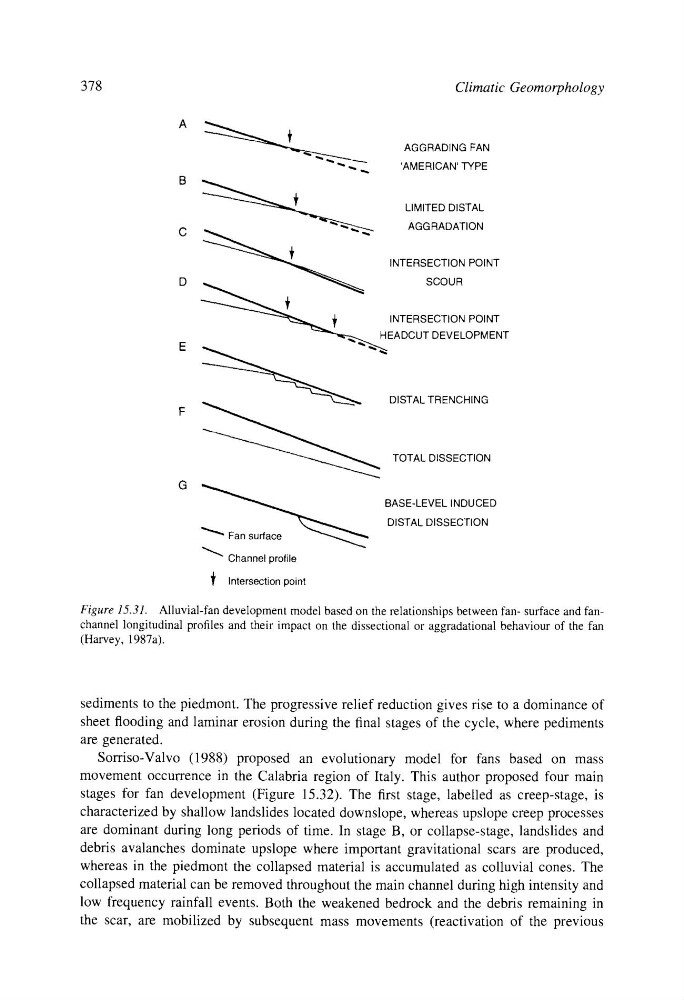
Figure 15.31. Alluvial-fan development model based on the relationships between fan- surface and fanchannel longitudinal profiles and their impact on the dissectional or aggradational behaviour of the fan
(Harvey, 1987a).
sediments to the piedmont. The progressive relief reduction gives rise to a dominance of
sheet flooding and laminar erosion during the final stages of the cycle, where pediments
are generated.
Sorriso-Valvo (1988) proposed an evolutionary model for fans based on mass
movement occurrence in the Calabria region of Italy. This author proposed four main
stages for fan development (Figure 15.32). The first stage, labelled as creep-stage, is
characterized by shallow landslides located downslope, whereas upslope creep processes
are dominant during long periods of time. In stage B, or collapse-stage, landslides and
debris avalanches dominate upslope where important gravitational scars are produced,
whereas in the piedmont the collapsed material is accumulated as colluvial cones. The
collapsed material can be removed throughout the main channel during high intensity and
low frequency rainfall events. Both the weakened bedrock and the debris remaining in
the scar, are mobilized by subsequent mass movements (reactivation of the previous
Climatic Geomorphology
c
AGGRADING FAN
'AMERICAN' TYPE
LIMITED DISTAL
AGGRADATION
INTERSECTION POINT
D
SCOUR
~,~
INTERSECTION POINT
~
EADCUT DEVELOPMENT
E
DISTAL TRENCHING
F
TOTAL DISSECTION
~'~ Fan surface
Channel profile
BASE-LEVEL INDUCED
DISTAL DISSECTION
Intersection point
Figure 15.31. Alluvial-fan development model based on the relationships between fan- surface and fanchannel longitudinal profiles and their impact on the dissectional or aggradational behaviour of the fan
(Harvey, 1987a).
sediments to the piedmont. The progressive relief reduction gives rise to a dominance of
sheet flooding and laminar erosion during the final stages of the cycle, where pediments
are generated.
Sorriso-Valvo (1988) proposed an evolutionary model for fans based on mass
movement occurrence in the Calabria region of Italy. This author proposed four main
stages for fan development (Figure 15.32). The first stage, labelled as creep-stage, is
characterized by shallow landslides located downslope, whereas upslope creep processes
are dominant during long periods of time. In stage B, or collapse-stage, landslides and
debris avalanches dominate upslope where important gravitational scars are produced,
whereas in the piedmont the collapsed material is accumulated as colluvial cones. The
collapsed material can be removed throughout the main channel during high intensity and
low frequency rainfall events. Both the weakened bedrock and the debris remaining in
the scar, are mobilized by subsequent mass movements (reactivation of the previous