

380
Climatic Geomorphology
However, the model of Sorriso-Valvo (1988) basically considers the contribution of mass
movements to the generation of alluvial fans, but undervalue the contribution of true
fluvial processes.
Blair and McPherson (1994a,b) proposed a similar model with a fourstage evolutionary scenario (Figure 15.33), initiated by mass movements and
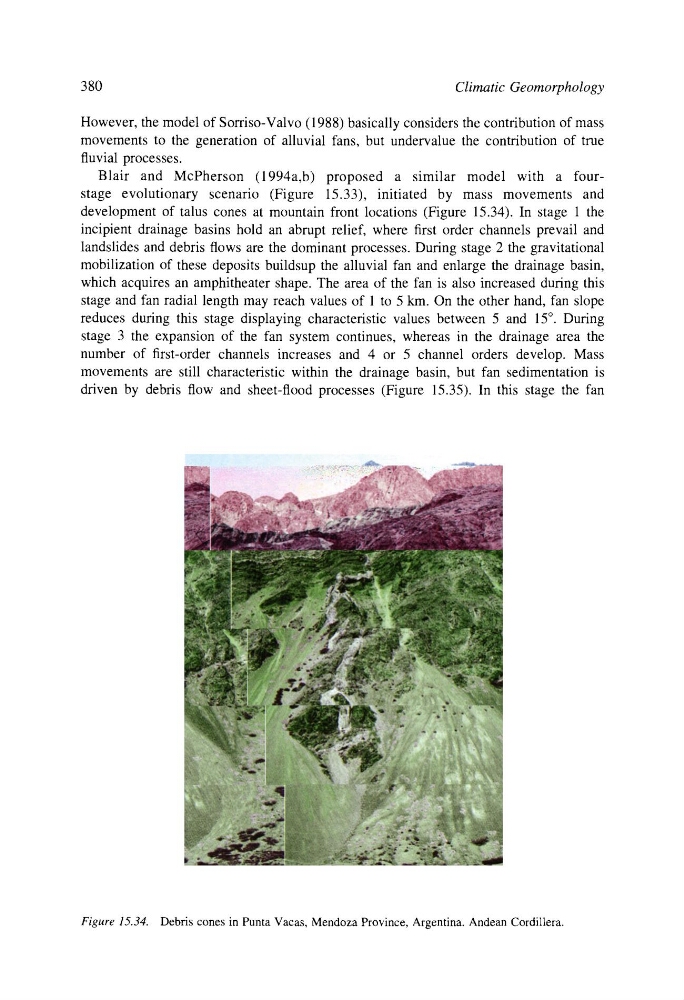
development of talus cones at mountain front locations (Figure 15.34). In stage 1 the
incipient drainage basins hold an abrupt relief, where first order channels prevail and
landslides and debris flows are the dominant processes. During stage 2 the gravitational
mobilization of these deposits buildsup the alluvial fan and enlarge the drainage basin,
which acquires an amphitheater shape. The area of the fan is also increased during this
stage and fan radial length may reach values of 1 to 5 km. On the other hand, fan slope
reduces during this stage displaying characteristic values between 5 and 15 ~ During
stage 3 the expansion of the fan system continues, whereas in the drainage area the
number of first-order channels increases and 4 or 5 channel orders develop. Mass
movements are still characteristic within the drainage basin, but fan sedimentation is
driven by debris flow and sheet-flood processes (Figure 15.35). In this stage the fan
Figure 15.34. Debris cones in Punta Vacas, Mendoza Province, Argentina. Andean Cordillera.
Climatic Geomorphology
However, the model of Sorriso-Valvo (1988) basically considers the contribution of mass
movements to the generation of alluvial fans, but undervalue the contribution of true
fluvial processes.
Blair and McPherson (1994a,b) proposed a similar model with a fourstage evolutionary scenario (Figure 15.33), initiated by mass movements and
development of talus cones at mountain front locations (Figure 15.34). In stage 1 the
incipient drainage basins hold an abrupt relief, where first order channels prevail and
landslides and debris flows are the dominant processes. During stage 2 the gravitational
mobilization of these deposits buildsup the alluvial fan and enlarge the drainage basin,
which acquires an amphitheater shape. The area of the fan is also increased during this
stage and fan radial length may reach values of 1 to 5 km. On the other hand, fan slope
reduces during this stage displaying characteristic values between 5 and 15 ~ During
stage 3 the expansion of the fan system continues, whereas in the drainage area the
number of first-order channels increases and 4 or 5 channel orders develop. Mass
movements are still characteristic within the drainage basin, but fan sedimentation is
driven by debris flow and sheet-flood processes (Figure 15.35). In this stage the fan
Figure 15.34. Debris cones in Punta Vacas, Mendoza Province, Argentina. Andean Cordillera.