

The arid region piedmonts: glacis and alluvial fans
359
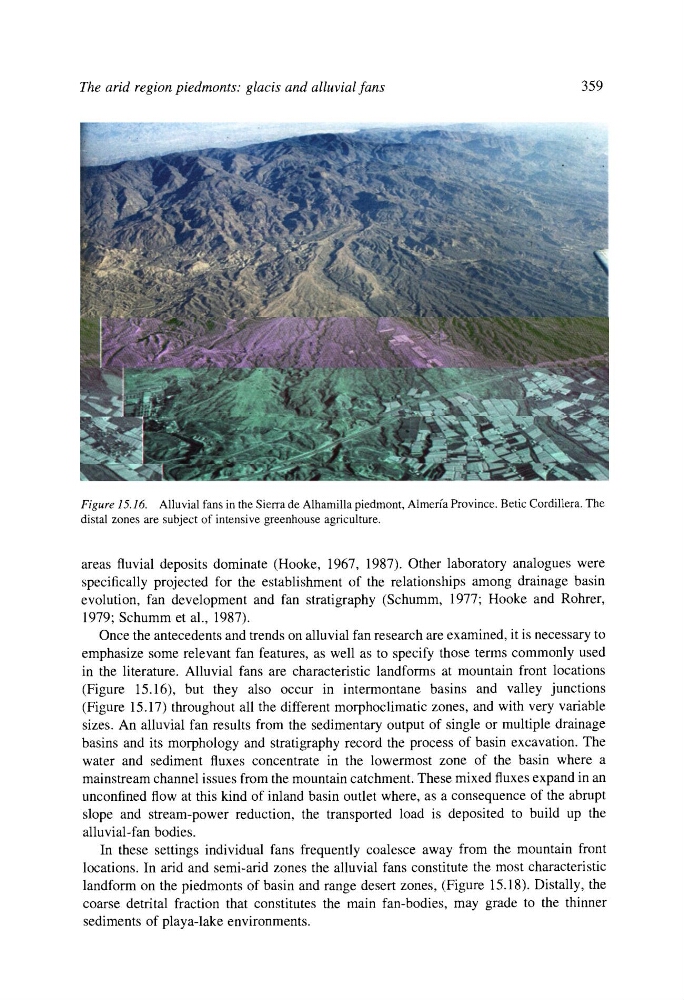
Figure 15.16. Alluvial fans in the Sierra de Alhamilla piedmont, Almer/a Province. Betic Cordillera. The
distal zones are subject of intensive greenhouse agriculture.
areas fluvial deposits dominate (Hooke, 1967, 1987). Other laboratory analogues were
specifically projected for the establishment of the relationships among drainage basin
evolution, fan development and fan stratigraphy (Schumm, 1977; Hooke and Rohrer,
1979; Schumm et al., 1987).
Once the antecedents and trends on alluvial fan research are examined, it is necessary to
emphasize some relevant fan features, as well as to specify those terms commonly used
in the literature. Alluvial fans are characteristic landforms at mountain front locations
(Figure 15.16), but they also occur in intermontane basins and valley junctions
(Figure 15.17) throughout all the different morphoclimatic zones, and with very variable
sizes. An alluvial fan results from the sedimentary output of single or multiple drainage
basins and its morphology and stratigraphy record the process of basin excavation. The
water and sediment fluxes concentrate in the lowermost zone of the basin where a
mainstream channel issues from the mountain catchment. These mixed fluxes expand in an
unconfined flow at this kind of inland basin outlet where, as a consequence of the abrupt
slope and stream-power reduction, the transported load is deposited to build up the
alluvial-fan bodies.
In these settings individual fans frequently coalesce away from the mountain front
locations. In arid and semi-arid zones the alluvial fans constitute the most characteristic
landform on the piedmonts of basin and range desert zones, (Figure 15.18). Distally, the
coarse detrital fraction that constitutes the main fan-bodies, may grade to the thinner
sediments of playa-lake environments.
359
Figure 15.16. Alluvial fans in the Sierra de Alhamilla piedmont, Almer/a Province. Betic Cordillera. The
distal zones are subject of intensive greenhouse agriculture.
areas fluvial deposits dominate (Hooke, 1967, 1987). Other laboratory analogues were
specifically projected for the establishment of the relationships among drainage basin
evolution, fan development and fan stratigraphy (Schumm, 1977; Hooke and Rohrer,
1979; Schumm et al., 1987).
Once the antecedents and trends on alluvial fan research are examined, it is necessary to
emphasize some relevant fan features, as well as to specify those terms commonly used
in the literature. Alluvial fans are characteristic landforms at mountain front locations
(Figure 15.16), but they also occur in intermontane basins and valley junctions
(Figure 15.17) throughout all the different morphoclimatic zones, and with very variable
sizes. An alluvial fan results from the sedimentary output of single or multiple drainage
basins and its morphology and stratigraphy record the process of basin excavation. The
water and sediment fluxes concentrate in the lowermost zone of the basin where a
mainstream channel issues from the mountain catchment. These mixed fluxes expand in an
unconfined flow at this kind of inland basin outlet where, as a consequence of the abrupt
slope and stream-power reduction, the transported load is deposited to build up the
alluvial-fan bodies.
In these settings individual fans frequently coalesce away from the mountain front
locations. In arid and semi-arid zones the alluvial fans constitute the most characteristic
landform on the piedmonts of basin and range desert zones, (Figure 15.18). Distally, the
coarse detrital fraction that constitutes the main fan-bodies, may grade to the thinner
sediments of playa-lake environments.