

358
Climatic Geomorphology
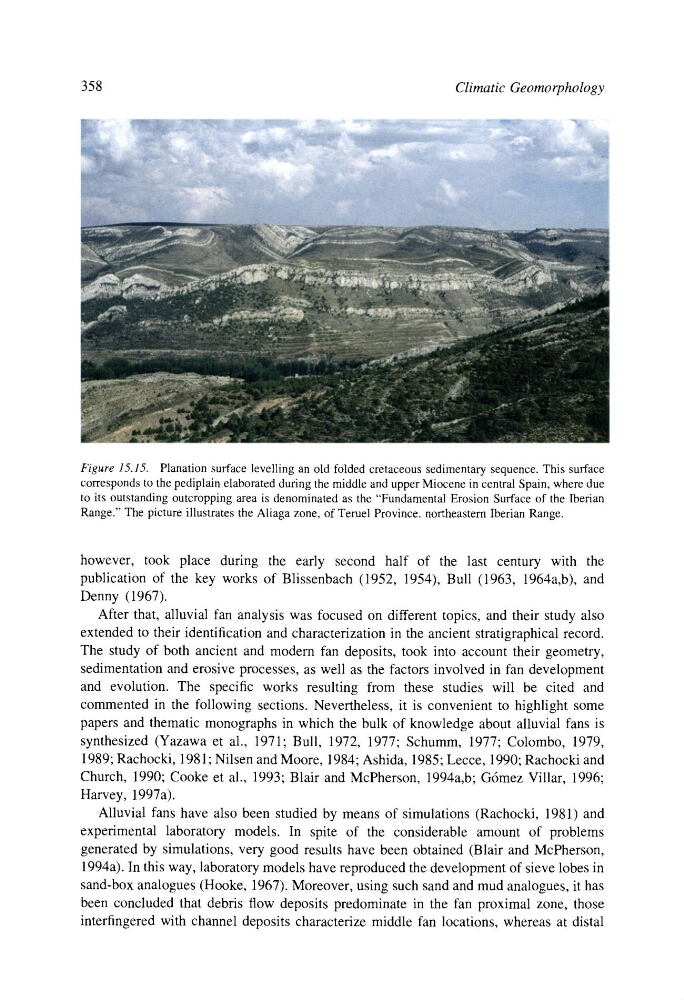
Figure 15.15. Planation surface levelling an old folded cretaceous sedimentary sequence. This surface
corresponds to the pediplain elaborated during the middle and upper Miocene in central Spain, where due
to its outstanding outcropping area is denominated as the "Fundamental Erosion Surface of the Iberian
Range." The picture illustrates the Aliaga zone, of Teruel Province. northeastern Iberian Range.
however, took place during the early second half of the last century with the
publication of the key works of Blissenbach (1952, 1954), Bull (1963, 1964a,b), and
Denny (1967).
After that, alluvial fan analysis was focused on different topics, and their study also
extended to their identification and characterization in the ancient stratigraphical record.
The study of both ancient and modern fan deposits, took into account their geometry,
sedimentation and erosive processes, as well as the factors involved in fan development
and evolution. The specific works resulting from these studies will be cited and
commented in the following sections. Nevertheless, it is convenient to highlight some
papers and thematic monographs in which the bulk of knowledge about alluvial fans is
synthesized (Yazawa et al., 1971; Bull, 1972, 1977; Schumm, 1977; Colombo, 1979,
1989; Rachocki, 1981; Nilsen and Moore, 1984; Ashida, 1985; Lecce, 1990; Rachocki and
Church, 1990; Cooke et al., 1993; Blair and McPherson, 1994a,b; G6mez Villar, 1996;
Harvey, 1997a).
Alluvial fans have also been studied by means of simulations (Rachocki, 1981) and
experimental laboratory models. In spite of the considerable amount of problems
generated by simulations, very good results have been obtained (Blair and McPherson,
1994a). In this way, laboratory models have reproduced the development of sieve lobes in
sand-box analogues (Hooke, 1967). Moreover, using such sand and mud analogues, it has
been concluded that debris flow deposits predominate in the fan proximal zone, those
interfingered with channel deposits characterize middle fan locations, whereas at distal
Climatic Geomorphology
Figure 15.15. Planation surface levelling an old folded cretaceous sedimentary sequence. This surface
corresponds to the pediplain elaborated during the middle and upper Miocene in central Spain, where due
to its outstanding outcropping area is denominated as the "Fundamental Erosion Surface of the Iberian
Range." The picture illustrates the Aliaga zone, of Teruel Province. northeastern Iberian Range.
however, took place during the early second half of the last century with the
publication of the key works of Blissenbach (1952, 1954), Bull (1963, 1964a,b), and
Denny (1967).
After that, alluvial fan analysis was focused on different topics, and their study also
extended to their identification and characterization in the ancient stratigraphical record.
The study of both ancient and modern fan deposits, took into account their geometry,
sedimentation and erosive processes, as well as the factors involved in fan development
and evolution. The specific works resulting from these studies will be cited and
commented in the following sections. Nevertheless, it is convenient to highlight some
papers and thematic monographs in which the bulk of knowledge about alluvial fans is
synthesized (Yazawa et al., 1971; Bull, 1972, 1977; Schumm, 1977; Colombo, 1979,
1989; Rachocki, 1981; Nilsen and Moore, 1984; Ashida, 1985; Lecce, 1990; Rachocki and
Church, 1990; Cooke et al., 1993; Blair and McPherson, 1994a,b; G6mez Villar, 1996;
Harvey, 1997a).
Alluvial fans have also been studied by means of simulations (Rachocki, 1981) and
experimental laboratory models. In spite of the considerable amount of problems
generated by simulations, very good results have been obtained (Blair and McPherson,
1994a). In this way, laboratory models have reproduced the development of sieve lobes in
sand-box analogues (Hooke, 1967). Moreover, using such sand and mud analogues, it has
been concluded that debris flow deposits predominate in the fan proximal zone, those
interfingered with channel deposits characterize middle fan locations, whereas at distal