

The arid region piedmonts: glacis and alluvial fans
(a)!
Uplifted Pediplain
V
Base-level of erosion
(b)l
I x\ .,.
ii
ii
ii
~
x x x
,,\
it
I
I
,
,
,
,
,
/
\
~
~
,
,
,"
,
I"
x
\
1
I
I
!
\
\
~
\
i
s
i
I'~
'.
'.
,
t
.,
i
\
~
,
,
/
/.,
I
,,
~
t
/
/
I
~
\
x
x
/
/
i
I
x_
x
x
~
~
/
/
\
x
x.
\
/
t
/
I%
x
x x
X\
I
/
/
/
\
\
~\
X
t
I
/
I\
\
.
.,
r
t
]
\
x
.
~
/
/
/
/
357
Figure 15.14.
1970).
(c)!
l/"\
-i
i I
\
[
I
~
i
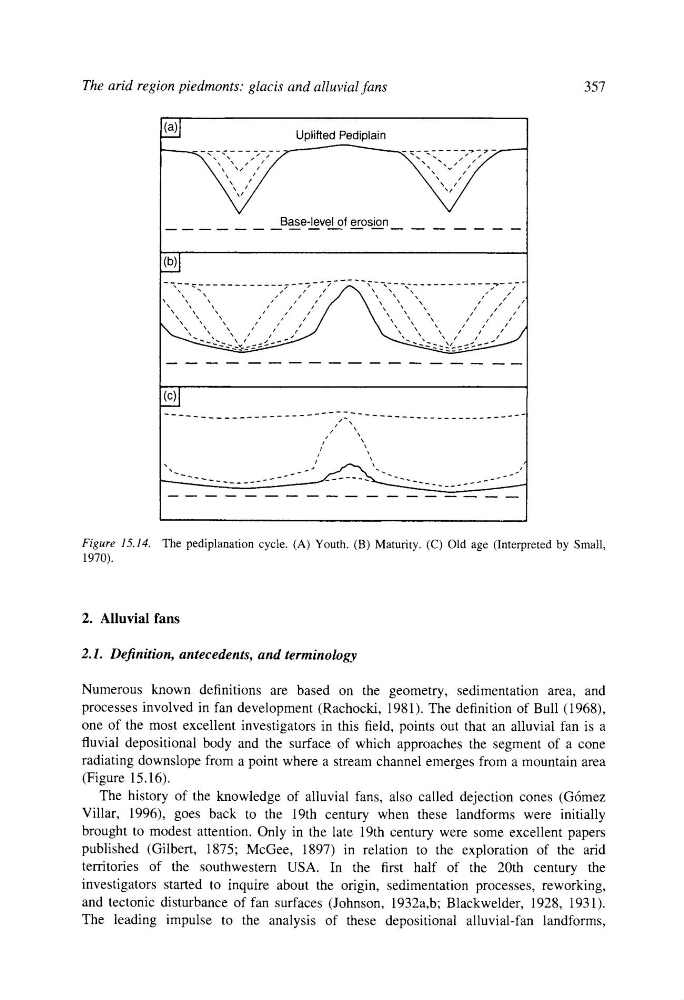
The pediplanation cycle. (A) Youth. (B) Maturity. (C) Old age (Interpreted by Small,
2. Alluvial fans
2.1. Definition, antecedents, and terminology
Numerous known definitions are based on the geometry, sedimentation area, and
processes involved in fan development (Rachocki, 1981). The definition of Bull (1968),
one of the most excellent investigators in this field, points out that an alluvial fan is a
fluvial depositional body and the surface of which approaches the segment of a cone
radiating downslope from a point where a stream channel emerges from a mountain area
(Figure 15.16).
The history of the knowledge of alluvial fans, also called dejection cones (G6mez
Villar, 1996), goes back to the 19th century when these landforms were initially
brought to modest attention. Only in the late 19th century were some excellent papers
published (Gilbert, 1875; McGee, 1897) in relation to the exploration of the arid
territories of the southwestern USA. In the first half of the 20th century the
investigators started to inquire about the origin, sedimentation processes, reworking,
and tectonic disturbance of fan surfaces (Johnson, 1932a,b; Blackwelder, 1928, 1931).
The leading impulse to the analysis of these depositional alluvial-fan landforms,
(a)!
Uplifted Pediplain
V
Base-level of erosion
(b)l
I x\ .,.
ii
ii
ii
~
x x x
,,\
it
I
I
,
,
,
,
,
/
\
~
~
,
,
,"
,
I"
x
\
1
I
I
!
\
\
~
\
i
s
i
I'~
'.
'.
,
t
.,
i
\
~
,
,
/
/.,
I
,,
~
t
/
/
I
~
\
x
x
/
/
i
I
x_
x
x
~
~
/
/
\
x
x.
\
/
t
/
I%
x
x x
X\
I
/
/
/
\
\
~\
X
t
I
/
I\
\
.
.,
r
t
]
\
x
.
~
/
/
/
/
357
Figure 15.14.
1970).
(c)!
l/"\
-i
i I
\
[
I
~
i
The pediplanation cycle. (A) Youth. (B) Maturity. (C) Old age (Interpreted by Small,
2. Alluvial fans
2.1. Definition, antecedents, and terminology
Numerous known definitions are based on the geometry, sedimentation area, and
processes involved in fan development (Rachocki, 1981). The definition of Bull (1968),
one of the most excellent investigators in this field, points out that an alluvial fan is a
fluvial depositional body and the surface of which approaches the segment of a cone
radiating downslope from a point where a stream channel emerges from a mountain area
(Figure 15.16).
The history of the knowledge of alluvial fans, also called dejection cones (G6mez
Villar, 1996), goes back to the 19th century when these landforms were initially
brought to modest attention. Only in the late 19th century were some excellent papers
published (Gilbert, 1875; McGee, 1897) in relation to the exploration of the arid
territories of the southwestern USA. In the first half of the 20th century the
investigators started to inquire about the origin, sedimentation processes, reworking,
and tectonic disturbance of fan surfaces (Johnson, 1932a,b; Blackwelder, 1928, 1931).
The leading impulse to the analysis of these depositional alluvial-fan landforms,