

356
Climatic Geomorphology
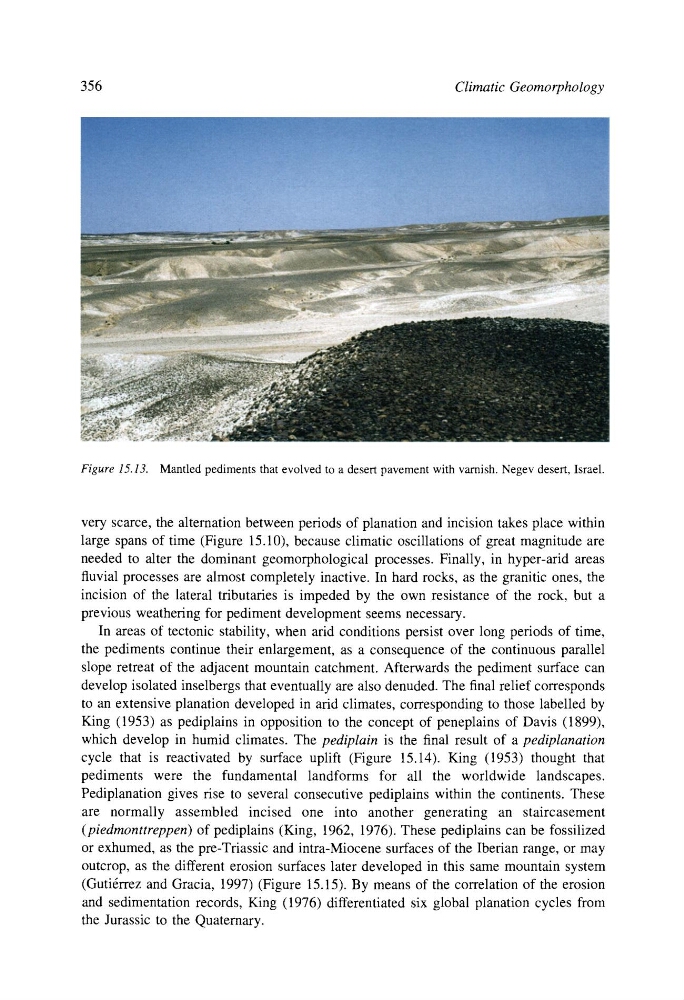
Figure 15.13. Mantled pediments that evolved to a desert pavement with varnish. Negev desert, Israel.
very scarce, the altemation between periods of planation and incision takes place within
large spans of time (Figure 15.10), because climatic oscillations of great magnitude are
needed to alter the dominant geomorphological processes. Finally, in hyper-arid areas
fluvial processes are almost completely inactive. In hard rocks, as the granitic ones, the
incision of the lateral tributaries is impeded by the own resistance of the rock, but a
previous weathering for pediment development seems necessary.
In areas of tectonic stability, when arid conditions persist over long periods of time,
the pediments continue their enlargement, as a consequence of the continuous parallel
slope retreat of the adjacent mountain catchment. Afterwards the pediment surface can
develop isolated inselbergs that eventually are also denuded. The final relief corresponds
to an extensive planation developed in arid climates, corresponding to those labelled by
King (1953) as pediplains in opposition to the concept of peneplains of Davis (1899),
which develop in humid climates. The pediplain is the final result of a pediplanation
cycle that is reactivated by surface uplift (Figure 15.14). King (1953) thought that
pediments were the fundamental landforms for all the worldwide landscapes.
Pediplanation gives rise to several consecutive pediplains within the continents. These
are normally assembled incised one into another generating an staircasement
(piedmonttreppen) of pediplains (King, 1962, 1976). These pediplains can be fossilized
or exhumed, as the pre-Triassic and intra-Miocene surfaces of the Iberian range, or may
outcrop, as the different erosion surfaces later developed in this same mountain system
(Guti~rrez and Gracia, 1997) (Figure 15.15). By means of the correlation of the erosion
and sedimentation records, King (1976) differentiated six global planation cycles from
the Jurassic to the Quaternary.
Climatic Geomorphology
Figure 15.13. Mantled pediments that evolved to a desert pavement with varnish. Negev desert, Israel.
very scarce, the altemation between periods of planation and incision takes place within
large spans of time (Figure 15.10), because climatic oscillations of great magnitude are
needed to alter the dominant geomorphological processes. Finally, in hyper-arid areas
fluvial processes are almost completely inactive. In hard rocks, as the granitic ones, the
incision of the lateral tributaries is impeded by the own resistance of the rock, but a
previous weathering for pediment development seems necessary.
In areas of tectonic stability, when arid conditions persist over long periods of time,
the pediments continue their enlargement, as a consequence of the continuous parallel
slope retreat of the adjacent mountain catchment. Afterwards the pediment surface can
develop isolated inselbergs that eventually are also denuded. The final relief corresponds
to an extensive planation developed in arid climates, corresponding to those labelled by
King (1953) as pediplains in opposition to the concept of peneplains of Davis (1899),
which develop in humid climates. The pediplain is the final result of a pediplanation
cycle that is reactivated by surface uplift (Figure 15.14). King (1953) thought that
pediments were the fundamental landforms for all the worldwide landscapes.
Pediplanation gives rise to several consecutive pediplains within the continents. These
are normally assembled incised one into another generating an staircasement
(piedmonttreppen) of pediplains (King, 1962, 1976). These pediplains can be fossilized
or exhumed, as the pre-Triassic and intra-Miocene surfaces of the Iberian range, or may
outcrop, as the different erosion surfaces later developed in this same mountain system
(Guti~rrez and Gracia, 1997) (Figure 15.15). By means of the correlation of the erosion
and sedimentation records, King (1976) differentiated six global planation cycles from
the Jurassic to the Quaternary.