

Slopes in arid zones
335
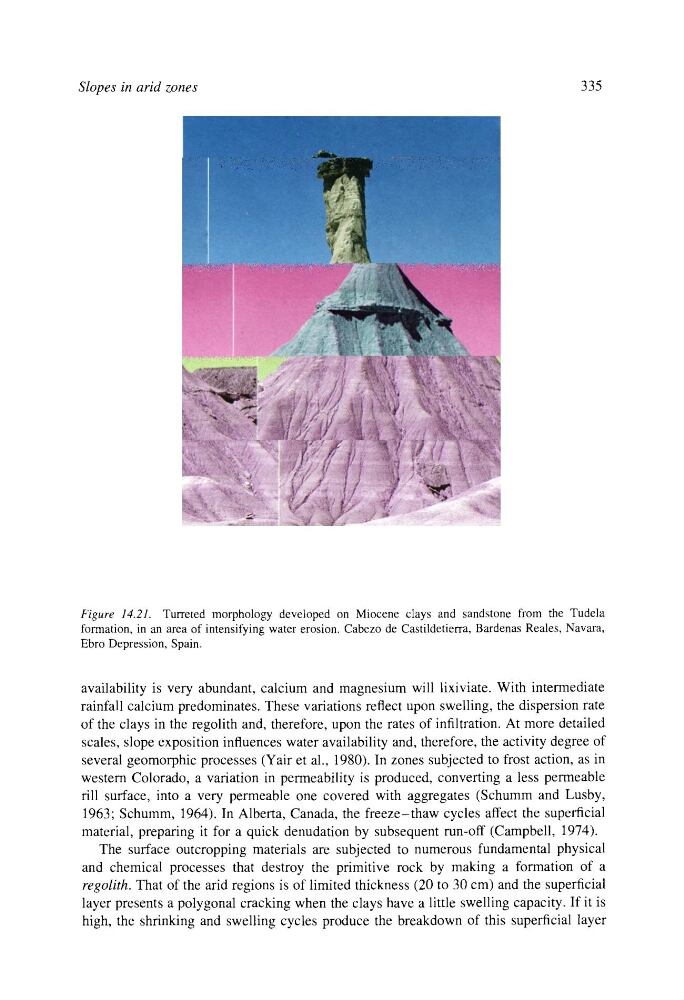
Figure 14.21. Turreted morphology developed on Miocene clays and sandstone from the Tudela
formation, in an area of intensifying water erosion. Cabezo de Castildetierra, Bardenas Reales, Navara,
Ebro Depression, Spain.
availability is very abundant, calcium and magnesium will lixiviate. With intermediate
rainfall calcium predominates. These variations reflect upon swelling, the dispersion rate
of the clays in the regolith and, therefore, upon the rates of infiltration. At more detailed
scales, slope exposition influences water availability and, therefore, the activity degree of
several geomorphic processes (Yair et al., 1980). In zones subjected to frost action, as in
western Colorado, a variation in permeability is produced, converting a less permeable
rill surface, into a very permeable one covered with aggregates (Schumm and Lusby,
1963; Schumm, 1964). In Alberta, Canada, the freeze-thaw cycles affect the superficial
material, preparing it for a quick denudation by subsequent run-off (Campbell, 1974).
The surface outcropping materials are subjected to numerous fundamental physical
and chemical processes that destroy the primitive rock by making a formation of a
regolith. That of the arid regions is of limited thickness (20 to 30 cm) and the superficial
layer presents a polygonal cracking when the clays have a little swelling capacity. If it is
high, the shrinking and swelling cycles produce the breakdown of this superficial layer
335
Figure 14.21. Turreted morphology developed on Miocene clays and sandstone from the Tudela
formation, in an area of intensifying water erosion. Cabezo de Castildetierra, Bardenas Reales, Navara,
Ebro Depression, Spain.
availability is very abundant, calcium and magnesium will lixiviate. With intermediate
rainfall calcium predominates. These variations reflect upon swelling, the dispersion rate
of the clays in the regolith and, therefore, upon the rates of infiltration. At more detailed
scales, slope exposition influences water availability and, therefore, the activity degree of
several geomorphic processes (Yair et al., 1980). In zones subjected to frost action, as in
western Colorado, a variation in permeability is produced, converting a less permeable
rill surface, into a very permeable one covered with aggregates (Schumm and Lusby,
1963; Schumm, 1964). In Alberta, Canada, the freeze-thaw cycles affect the superficial
material, preparing it for a quick denudation by subsequent run-off (Campbell, 1974).
The surface outcropping materials are subjected to numerous fundamental physical
and chemical processes that destroy the primitive rock by making a formation of a
regolith. That of the arid regions is of limited thickness (20 to 30 cm) and the superficial
layer presents a polygonal cracking when the clays have a little swelling capacity. If it is
high, the shrinking and swelling cycles produce the breakdown of this superficial layer