

334
Climatic Geomorphology
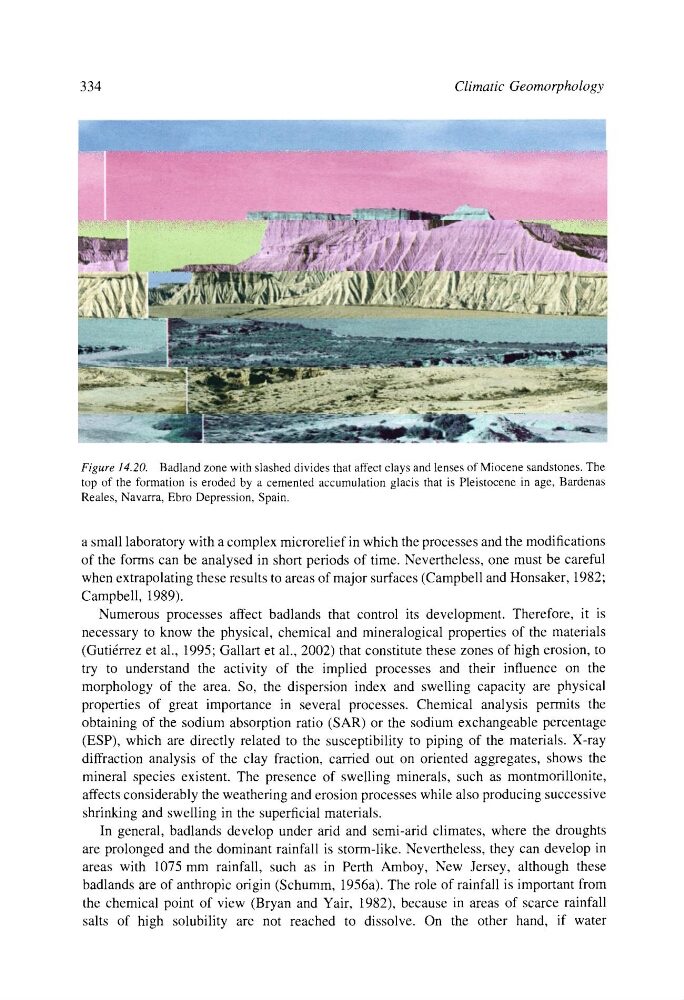
Figure 14.20. Badland zone with slashed divides that affect clays and lenses of Miocene sandstones. The
top of the formation is eroded by a cemented accumulation glacis that is Pleistocene in age, Bardenas
Reales, Navarra, Ebro Depression, Spain.
a small laboratory with a complex microrelief in which the processes and the modifications
of the forms can be analysed in short periods of time. Nevertheless, one must be careful
when extrapolating these results to areas of major surfaces (Campbell and Honsaker, 1982;
Campbell, 1989).
Numerous processes affect badlands that control its development. Therefore, it is
necessary to know the physical, chemical and mineralogical properties of the materials
(Guti6rrez et al., 1995; Gallart et al., 2002) that constitute these zones of high erosion, to
try to understand the activity of the implied processes and their influence on the
morphology of the area. So, the dispersion index and swelling capacity are physical
properties of great importance in several processes. Chemical analysis permits the
obtaining of the sodium absorption ratio (SAR) or the sodium exchangeable percentage
(ESP), which are directly related to the susceptibility to piping of the materials. X-ray
diffraction analysis of the clay fraction, carried out on oriented aggregates, shows the
mineral species existent. The presence of swelling minerals, such as montmorillonite,
affects considerably the weathering and erosion processes while also producing successive
shrinking and swelling in the superficial materials.
In general, badlands develop under arid and semi-arid climates, where the droughts
are prolonged and the dominant rainfall is storm-like. Nevertheless, they can develop in
areas with 1075 mm rainfall, such as in Perth Amboy, New Jersey, although these
badlands are of anthropic origin (Schumm, 1956a). The role of rainfall is important from
the chemical point of view (Bryan and Yair, 1982), because in areas of scarce rainfall
salts of high solubility are not reached to dissolve. On the other hand, if water
Climatic Geomorphology
Figure 14.20. Badland zone with slashed divides that affect clays and lenses of Miocene sandstones. The
top of the formation is eroded by a cemented accumulation glacis that is Pleistocene in age, Bardenas
Reales, Navarra, Ebro Depression, Spain.
a small laboratory with a complex microrelief in which the processes and the modifications
of the forms can be analysed in short periods of time. Nevertheless, one must be careful
when extrapolating these results to areas of major surfaces (Campbell and Honsaker, 1982;
Campbell, 1989).
Numerous processes affect badlands that control its development. Therefore, it is
necessary to know the physical, chemical and mineralogical properties of the materials
(Guti6rrez et al., 1995; Gallart et al., 2002) that constitute these zones of high erosion, to
try to understand the activity of the implied processes and their influence on the
morphology of the area. So, the dispersion index and swelling capacity are physical
properties of great importance in several processes. Chemical analysis permits the
obtaining of the sodium absorption ratio (SAR) or the sodium exchangeable percentage
(ESP), which are directly related to the susceptibility to piping of the materials. X-ray
diffraction analysis of the clay fraction, carried out on oriented aggregates, shows the
mineral species existent. The presence of swelling minerals, such as montmorillonite,
affects considerably the weathering and erosion processes while also producing successive
shrinking and swelling in the superficial materials.
In general, badlands develop under arid and semi-arid climates, where the droughts
are prolonged and the dominant rainfall is storm-like. Nevertheless, they can develop in
areas with 1075 mm rainfall, such as in Perth Amboy, New Jersey, although these
badlands are of anthropic origin (Schumm, 1956a). The role of rainfall is important from
the chemical point of view (Bryan and Yair, 1982), because in areas of scarce rainfall
salts of high solubility are not reached to dissolve. On the other hand, if water