

Slopes in arid zones
333
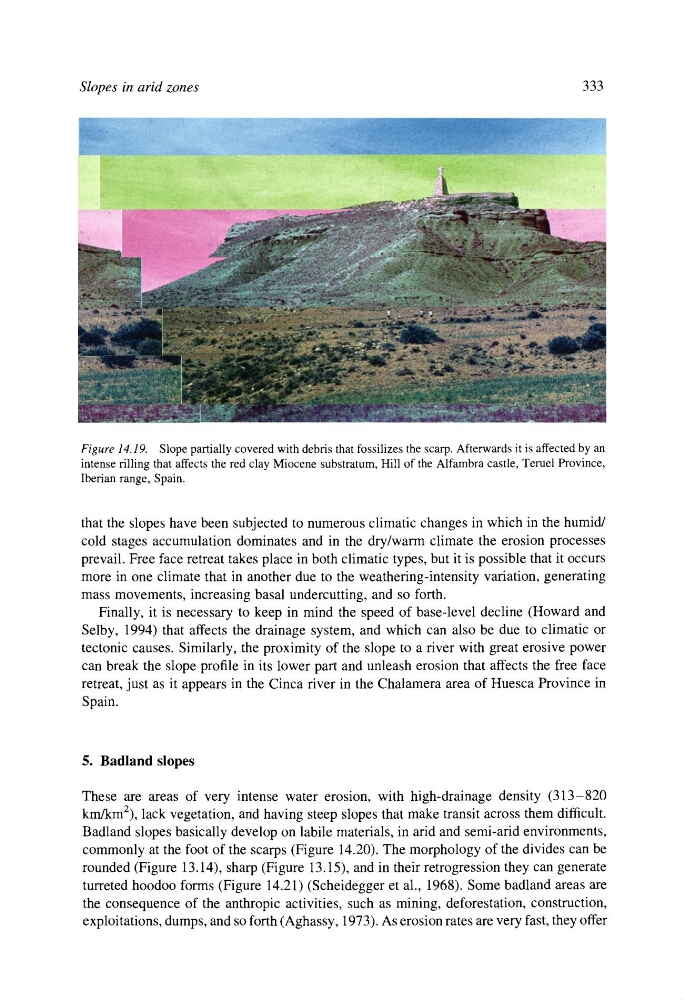
Figure 14.19. Slope partially covered with debris that fossilizes the scarp. Afterwards it is affected by an
intense filling that affects the red clay Miocene substratum, Hill of the Alfambra castle, Teruel Province,
Iberian range, Spain.
that the slopes have been subjected to numerous climatic changes in which in the humid/
cold stages accumulation dominates and in the dry/warm climate the erosion processes
prevail. Free face retreat takes place in both climatic types, but it is possible that it occurs
more in one climate that in another due to the weathering-intensity variation, generating
mass movements, increasing basal undercutting, and so forth.
Finally, it is necessary to keep in mind the speed of base-level decline (Howard and
Selby, 1994) that affects the drainage system, and which can also be due to climatic or
tectonic causes. Similarly, the proximity of the slope to a fiver with great erosive power
can break the slope profile in its lower part and unleash erosion that affects the free face
retreat, just as it appears in the Cinca fiver in the Chalamera area of Huesca Province in
Spain.
5. Badland slopes
These are areas of very intense water erosion, with high-drainage density (313-820
km/km2), lack vegetation, and having steep slopes that make transit across them difficult.
Badland slopes basically develop on labile materials, in arid and semi-arid environments,
commonly at the foot of the scarps (Figure 14.20). The morphology of the divides can be
rounded (Figure 13.14), sharp (Figure 13.15), and in their retrogression they can generate
turreted hoodoo forms (Figure 14.21) (Scheidegger et al., 1968). Some badland areas are
the consequence of the anthropic activities, such as mining, deforestation, construction,
exploitations, dumps, and so forth (Aghassy, 1973). As erosion rates are very fast, they offer
333
Figure 14.19. Slope partially covered with debris that fossilizes the scarp. Afterwards it is affected by an
intense filling that affects the red clay Miocene substratum, Hill of the Alfambra castle, Teruel Province,
Iberian range, Spain.
that the slopes have been subjected to numerous climatic changes in which in the humid/
cold stages accumulation dominates and in the dry/warm climate the erosion processes
prevail. Free face retreat takes place in both climatic types, but it is possible that it occurs
more in one climate that in another due to the weathering-intensity variation, generating
mass movements, increasing basal undercutting, and so forth.
Finally, it is necessary to keep in mind the speed of base-level decline (Howard and
Selby, 1994) that affects the drainage system, and which can also be due to climatic or
tectonic causes. Similarly, the proximity of the slope to a fiver with great erosive power
can break the slope profile in its lower part and unleash erosion that affects the free face
retreat, just as it appears in the Cinca fiver in the Chalamera area of Huesca Province in
Spain.
5. Badland slopes
These are areas of very intense water erosion, with high-drainage density (313-820
km/km2), lack vegetation, and having steep slopes that make transit across them difficult.
Badland slopes basically develop on labile materials, in arid and semi-arid environments,
commonly at the foot of the scarps (Figure 14.20). The morphology of the divides can be
rounded (Figure 13.14), sharp (Figure 13.15), and in their retrogression they can generate
turreted hoodoo forms (Figure 14.21) (Scheidegger et al., 1968). Some badland areas are
the consequence of the anthropic activities, such as mining, deforestation, construction,
exploitations, dumps, and so forth (Aghassy, 1973). As erosion rates are very fast, they offer