

332
Climatic Geomorphology
....... 9 ........:~"~ii,!i~:....,,ii'..-:::: :~111 .....
S 4
....
,..~.: .,,~,:~,,.. ...~....,: .....
d
d
d
~
"
d
25 m.
25 ~n.
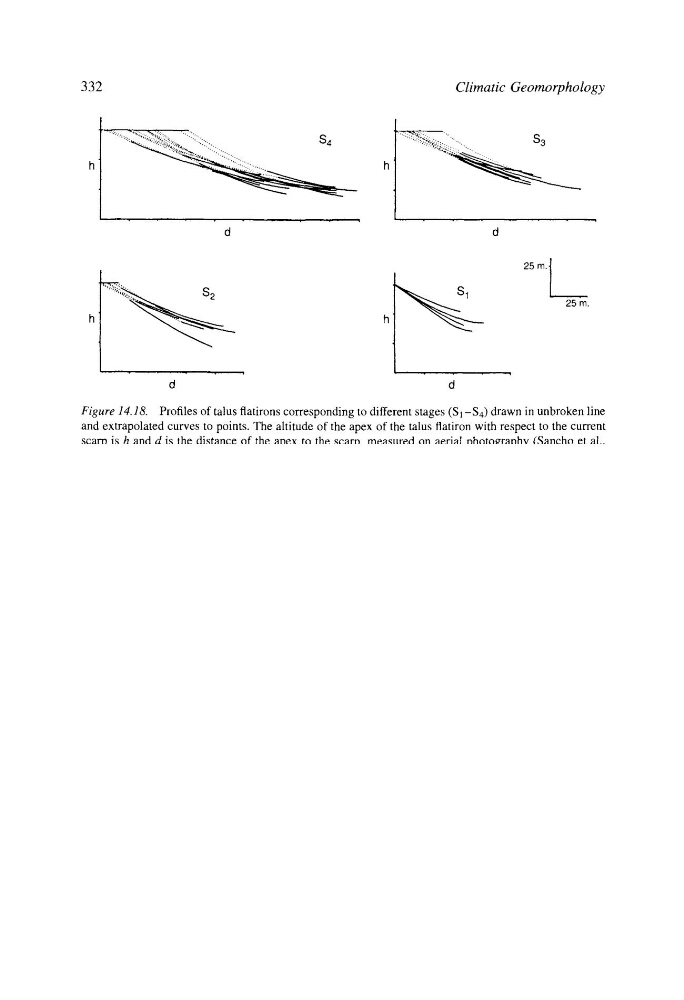
Figure 14.18. Profiles of talus flatirons corresponding to different stages (51-54) drawn in unbroken line
and extrapolated curves to points. The altitude of the apex of the talus flatiron with respect to the current
scarp is h and d is the distance of the apex to the scarp, measured on aerial photography (Sancho et al.,
1988).
production of particles by the weathering processes present in the area. On the contrary, if
the free face materials are a little thick, free face retreat is much faster. The degree of
fracturing of the materials of the free face constitutes one of the most significant factors
with respect to the retreat rate and mainly controls the degree of resistance to erosion. In
this way, the rocks affected by a highly significant fracture density show higher values of
retreat rate. Evidently, the erosion intensity of the substrate also affects free face retreat,
because where it is composed of highly erodable rocks such as clays and marls, rills
progress toward the base of the scarp producing basal undercutting and rock falls
(Schipull, 1980; Gerson and Grossman, 1987).
Another extraordinarily important factor related to scarp retreat, is the intensity of the
physical, chemical, and biological weathering processes that produce rock disintegration
and accumulation on the debris slope. These processes vary as a function of the
lithological and structural characteristics of the rocks, as well as with the climate and its
changes, and also with the acting period of these processes.
It has been already indicated that there exists a balance between the supply rate of
fragments from the free face to the slope (p) and the erosion rate (d) of these
accumulations, which constitutes the weathering relation (W) of Schumm and Chorley
(1966). In some cases, p clearly surpasses d and the slope accumulation surpasses the free
face, fossilizing it. In these conditions free face retreat is paralysed, although chemical
weathering can continue to act (Figure 14.19). This balance of production-destruction can
occur without big oscillations because the changes do not significantly affect the system. It
can lead to major erosion, however, so that the debris slopes gradually remain suspended
or isolated. This breakdown of the balance is due to an environmental change and implies
the overcoming of a geomorphic threshold (Schumm, 1979). Most researchers estimate
Climatic Geomorphology
....... 9 ........:~"~ii,!i~:....,,ii'..-:::: :~111 .....
S 4
....
,..~.: .,,~,:~,,.. ...~....,: .....
d
d
d
~
"
d
25 m.
25 ~n.
Figure 14.18. Profiles of talus flatirons corresponding to different stages (51-54) drawn in unbroken line
and extrapolated curves to points. The altitude of the apex of the talus flatiron with respect to the current
scarp is h and d is the distance of the apex to the scarp, measured on aerial photography (Sancho et al.,
1988).
production of particles by the weathering processes present in the area. On the contrary, if
the free face materials are a little thick, free face retreat is much faster. The degree of
fracturing of the materials of the free face constitutes one of the most significant factors
with respect to the retreat rate and mainly controls the degree of resistance to erosion. In
this way, the rocks affected by a highly significant fracture density show higher values of
retreat rate. Evidently, the erosion intensity of the substrate also affects free face retreat,
because where it is composed of highly erodable rocks such as clays and marls, rills
progress toward the base of the scarp producing basal undercutting and rock falls
(Schipull, 1980; Gerson and Grossman, 1987).
Another extraordinarily important factor related to scarp retreat, is the intensity of the
physical, chemical, and biological weathering processes that produce rock disintegration
and accumulation on the debris slope. These processes vary as a function of the
lithological and structural characteristics of the rocks, as well as with the climate and its
changes, and also with the acting period of these processes.
It has been already indicated that there exists a balance between the supply rate of
fragments from the free face to the slope (p) and the erosion rate (d) of these
accumulations, which constitutes the weathering relation (W) of Schumm and Chorley
(1966). In some cases, p clearly surpasses d and the slope accumulation surpasses the free
face, fossilizing it. In these conditions free face retreat is paralysed, although chemical
weathering can continue to act (Figure 14.19). This balance of production-destruction can
occur without big oscillations because the changes do not significantly affect the system. It
can lead to major erosion, however, so that the debris slopes gradually remain suspended
or isolated. This breakdown of the balance is due to an environmental change and implies
the overcoming of a geomorphic threshold (Schumm, 1979). Most researchers estimate