

324
Climatic Geomorphology
a
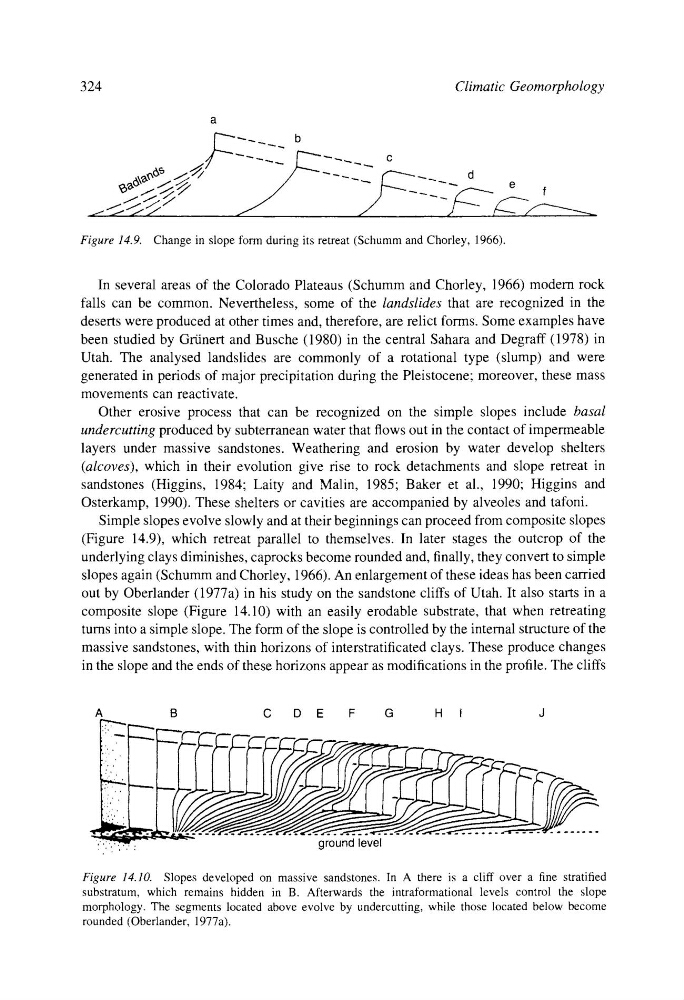
Figure 14.9. Change in slope form during its retreat (Schumm and Chorley, 1966).
In several areas of the Colorado Plateaus (Schumm and Chorley, 1966) modern rock
falls can be common. Nevertheless, some of the landslides that are recognized in the
deserts were produced at other times and, therefore, are relict forms. Some examples have
been studied by Grtinert and Busche (1980) in the central Sahara and Degraff (1978) in
Utah. The analysed landslides are commonly of a rotational type (slump) and were
generated in periods of major precipitation during the Pleistocene; moreover, these mass
movements can reactivate.
Other erosive process that can be recognized on the simple slopes include basal
undercutting produced by subterranean water that flows out in the contact of impermeable
layers under massive sandstones. Weathering and erosion by water develop shelters
(alcoves), which in their evolution give rise to rock detachments and slope retreat in
sandstones (Higgins, 1984; Laity and Malin, 1985; Baker et al., 1990; Higgins and
Osterkamp, 1990). These shelters or cavities are accompanied by alveoles and tafoni.
Simple slopes evolve slowly and at their beginnings can proceed from composite slopes
(Figure 14.9), which retreat parallel to themselves. In later stages the outcrop of the
underlying clays diminishes, caprocks become rounded and, finally, they convert to simple
slopes again (Schumm and Chorley, 1966). An enlargement of these ideas has been carried
out by Oberlander (1977a) in his study on the sandstone cliffs of Utah. It also starts in a
composite slope (Figure 14.10) with an easily erodable substrate, that when retreating
turns into a simple slope. The form of the slope is controlled by the internal structure of the
massive sandstones, with thin horizons of interstratificated clays. These produce changes
in the slope and the ends of these horizons appear as modifications in the profile. The cliffs
A
B
C
D E
F
G
H I
J
ground level
Figure 14.10. Slopes developed on massive sandstones. In A there is a cliff over a fine stratified
substratum, which remains hidden in B. Afterwards the intraformational levels control the slope
morphology. The segments located above evolve by undercutting, while those located below become
rounded (Oberlander, 1977a).
Climatic Geomorphology
a
Figure 14.9. Change in slope form during its retreat (Schumm and Chorley, 1966).
In several areas of the Colorado Plateaus (Schumm and Chorley, 1966) modern rock
falls can be common. Nevertheless, some of the landslides that are recognized in the
deserts were produced at other times and, therefore, are relict forms. Some examples have
been studied by Grtinert and Busche (1980) in the central Sahara and Degraff (1978) in
Utah. The analysed landslides are commonly of a rotational type (slump) and were
generated in periods of major precipitation during the Pleistocene; moreover, these mass
movements can reactivate.
Other erosive process that can be recognized on the simple slopes include basal
undercutting produced by subterranean water that flows out in the contact of impermeable
layers under massive sandstones. Weathering and erosion by water develop shelters
(alcoves), which in their evolution give rise to rock detachments and slope retreat in
sandstones (Higgins, 1984; Laity and Malin, 1985; Baker et al., 1990; Higgins and
Osterkamp, 1990). These shelters or cavities are accompanied by alveoles and tafoni.
Simple slopes evolve slowly and at their beginnings can proceed from composite slopes
(Figure 14.9), which retreat parallel to themselves. In later stages the outcrop of the
underlying clays diminishes, caprocks become rounded and, finally, they convert to simple
slopes again (Schumm and Chorley, 1966). An enlargement of these ideas has been carried
out by Oberlander (1977a) in his study on the sandstone cliffs of Utah. It also starts in a
composite slope (Figure 14.10) with an easily erodable substrate, that when retreating
turns into a simple slope. The form of the slope is controlled by the internal structure of the
massive sandstones, with thin horizons of interstratificated clays. These produce changes
in the slope and the ends of these horizons appear as modifications in the profile. The cliffs
A
B
C
D E
F
G
H I
J
ground level
Figure 14.10. Slopes developed on massive sandstones. In A there is a cliff over a fine stratified
substratum, which remains hidden in B. Afterwards the intraformational levels control the slope
morphology. The segments located above evolve by undercutting, while those located below become
rounded (Oberlander, 1977a).