

Slopes in arid zones
325
produced evolve by basal undercutting, while the segments situated below the clay strata
become rounded.
2.2. Composite slopes
These types of slopes are constituted by a rocky cliff in the upper part and a group of easily
erodable layers below (Figure 14.6). The components of those slopes adjust to the ones
defined by Wood (1942) and Fair (1947, 1948) in their studies in South Africa, that where
extensively analysed and renamed by King (1957a,b). This author considered these slopes
as "normal" ones, instead of those indicated otherwise by numerous researchers in climatic
geomorphology. For King they are part of a universal model; these slopes from desert
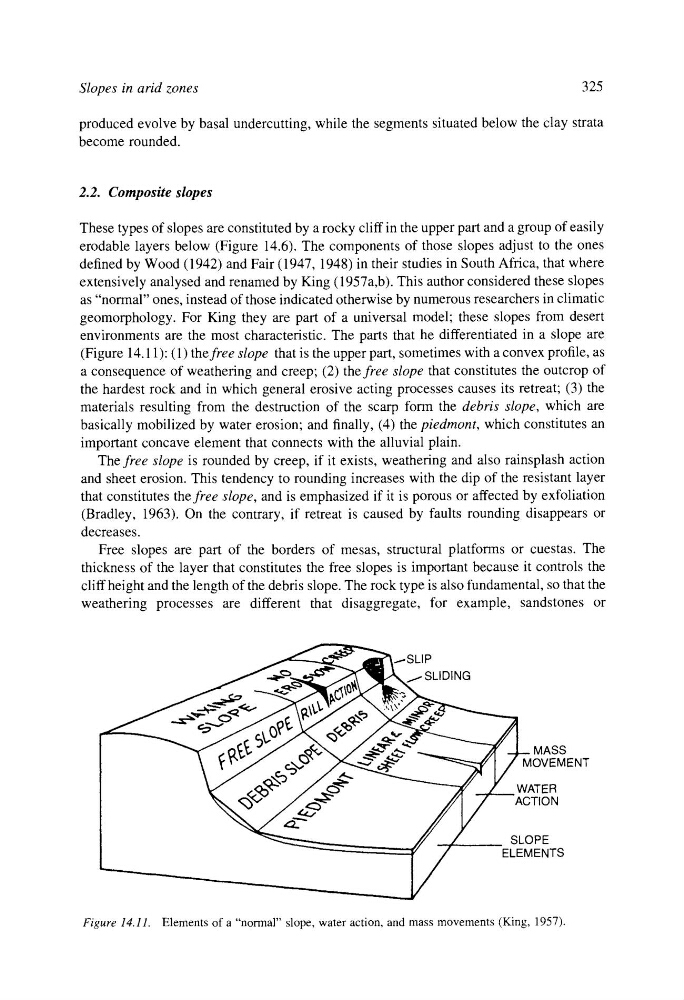
environments are the most characteristic. The parts that he differentiated in a slope are
(Figure 14.11): (1) the free slope that is the upper part, sometimes with a convex profile, as
a consequence of weathering and creep; (2) the free slope that constitutes the outcrop of
the hardest rock and in which general erosive acting processes causes its retreat; (3) the
materials resulting from the destruction of the scarp form the debris slope, which are
basically mobilized by water erosion; and finally, (4) the piedmont, which constitutes an
important concave element that connects with the alluvial plain.
The free slope is rounded by creep, if it exists, weathering and also rainsplash action
and sheet erosion. This tendency to rounding increases with the dip of the resistant layer
that constitutes the free slope, and is emphasized if it is porous or affected by exfoliation
(Bradley, 1963). On the contrary, if retreat is caused by faults rounding disappears or
decreases.
Free slopes are part of the borders of mesas, structural platforms or cuestas. The
thickness of the layer that constitutes the free slopes is important because it controls the
cliff height and the length of the debris slope. The rock type is also fundamental, so that the
weathering processes are different that disaggregate, for example, sandstones or
ISLIP
k~ j SLIDING
_
MASS
MOVEMENT
WATER
ACTION
SLOPE
ELEMENTS
Figure 14.11. Elements of a "normal" slope, water action, and mass movements (King, 1957).
325
produced evolve by basal undercutting, while the segments situated below the clay strata
become rounded.
2.2. Composite slopes
These types of slopes are constituted by a rocky cliff in the upper part and a group of easily
erodable layers below (Figure 14.6). The components of those slopes adjust to the ones
defined by Wood (1942) and Fair (1947, 1948) in their studies in South Africa, that where
extensively analysed and renamed by King (1957a,b). This author considered these slopes
as "normal" ones, instead of those indicated otherwise by numerous researchers in climatic
geomorphology. For King they are part of a universal model; these slopes from desert
environments are the most characteristic. The parts that he differentiated in a slope are
(Figure 14.11): (1) the free slope that is the upper part, sometimes with a convex profile, as
a consequence of weathering and creep; (2) the free slope that constitutes the outcrop of
the hardest rock and in which general erosive acting processes causes its retreat; (3) the
materials resulting from the destruction of the scarp form the debris slope, which are
basically mobilized by water erosion; and finally, (4) the piedmont, which constitutes an
important concave element that connects with the alluvial plain.
The free slope is rounded by creep, if it exists, weathering and also rainsplash action
and sheet erosion. This tendency to rounding increases with the dip of the resistant layer
that constitutes the free slope, and is emphasized if it is porous or affected by exfoliation
(Bradley, 1963). On the contrary, if retreat is caused by faults rounding disappears or
decreases.
Free slopes are part of the borders of mesas, structural platforms or cuestas. The
thickness of the layer that constitutes the free slopes is important because it controls the
cliff height and the length of the debris slope. The rock type is also fundamental, so that the
weathering processes are different that disaggregate, for example, sandstones or
ISLIP
k~ j SLIDING
_
MASS
MOVEMENT
WATER
ACTION
SLOPE
ELEMENTS
Figure 14.11. Elements of a "normal" slope, water action, and mass movements (King, 1957).