

Slopes in arid zones
323
the rocks and the activity of numerous geomorphological processes, which act or have
acted jointly or separately, spatially as well as temporally.
Discontinuities in the sandstone, as with thin clay intercalations or beds with cross
stratification, constitute zones more favourable for erosion and generate manifest changes
in the profiles of the slopes. Joint systems and vertical fractures constitute weakness zones
and along them can form routes of major moisture. As a consequence, the production of
weathering particles is increased there and remains trapped in the bottom of the fracture
system (Doelling, 1985). Also, in zones of major fault density, slope retreat gives rise more
rapidly to successive indentations and salients (Nicholas and Dixon, 1986). It has been
already indicated that in massive rocks, such as those that produce these simple slopes, the
development of sheeting is common, which has been noted in the arkoses of the famous
monolith of Ayers Rock (Uluru), in the central Australian Desert (Twidale, 1978) and also
in the sandstones of the Colorado Plateau (Bradley, 1963). This produces a convexity in
the slopes and sheets of a few centimetres to a metre in thickness. The dominant
weathering processes in sandstones are salt weathering and wetting and drying, although
in areas with freezing periods, gelifraction can be significant. The composition of the
cement also is important. In sandstones with a carbonate cement, this dissolves more easily
in cold water and siliceous cements need a pH > 8 to accelerate the dissolution. The loss
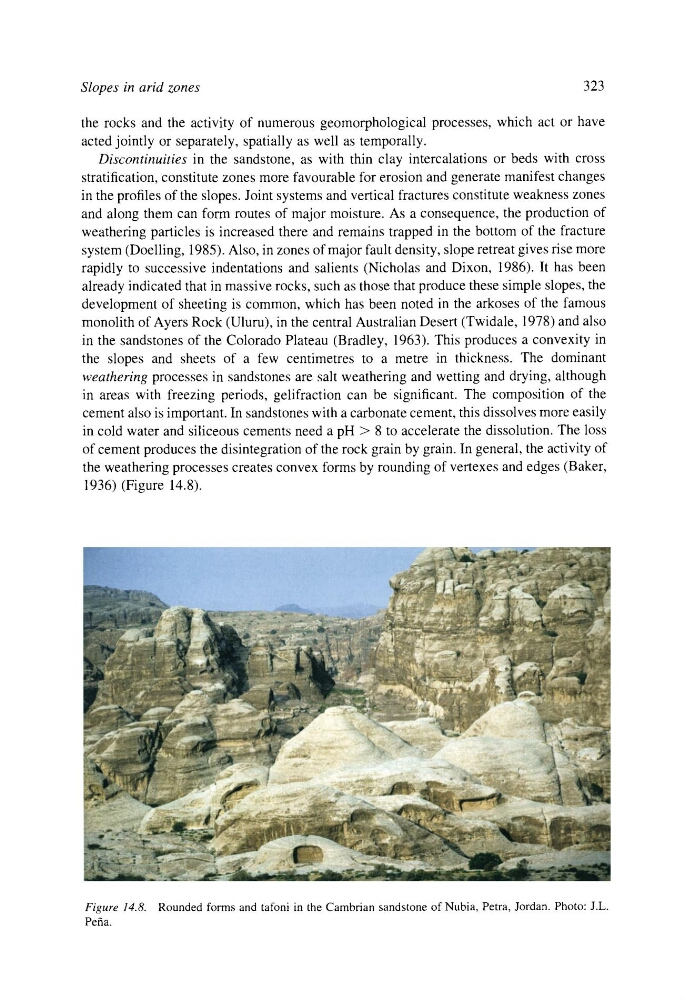
of cement produces the disintegration of the rock grain by grain. In general, the activity of
the weathering processes creates convex forms by rounding of vertexes and edges (Baker,
1936) (Figure 14.8).
Figure 14.8. Rounded forms and tafoni in the Cambrian sandstone of Nubia, Petra, Jordan. Photo: J.L.
Pefia.
323
the rocks and the activity of numerous geomorphological processes, which act or have
acted jointly or separately, spatially as well as temporally.
Discontinuities in the sandstone, as with thin clay intercalations or beds with cross
stratification, constitute zones more favourable for erosion and generate manifest changes
in the profiles of the slopes. Joint systems and vertical fractures constitute weakness zones
and along them can form routes of major moisture. As a consequence, the production of
weathering particles is increased there and remains trapped in the bottom of the fracture
system (Doelling, 1985). Also, in zones of major fault density, slope retreat gives rise more
rapidly to successive indentations and salients (Nicholas and Dixon, 1986). It has been
already indicated that in massive rocks, such as those that produce these simple slopes, the
development of sheeting is common, which has been noted in the arkoses of the famous
monolith of Ayers Rock (Uluru), in the central Australian Desert (Twidale, 1978) and also
in the sandstones of the Colorado Plateau (Bradley, 1963). This produces a convexity in
the slopes and sheets of a few centimetres to a metre in thickness. The dominant
weathering processes in sandstones are salt weathering and wetting and drying, although
in areas with freezing periods, gelifraction can be significant. The composition of the
cement also is important. In sandstones with a carbonate cement, this dissolves more easily
in cold water and siliceous cements need a pH > 8 to accelerate the dissolution. The loss
of cement produces the disintegration of the rock grain by grain. In general, the activity of
the weathering processes creates convex forms by rounding of vertexes and edges (Baker,
1936) (Figure 14.8).
Figure 14.8. Rounded forms and tafoni in the Cambrian sandstone of Nubia, Petra, Jordan. Photo: J.L.
Pefia.