

The action of water in arid regions
307
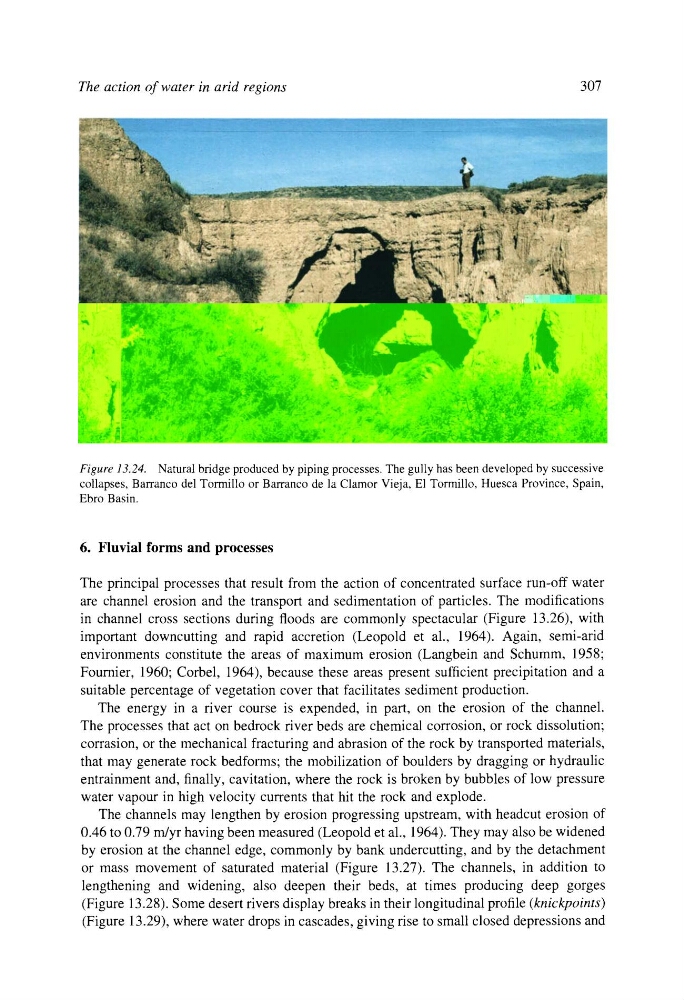
Figure 13.24. Natural bridge produced by piping processes. The gully has been developed by successive
collapses, Barranco del Tormillo or Barranco de la Clamor Vieja, E1 Tormillo, Huesca Province, Spain,
Ebro Basin.
6. Fluvial forms and processes
The principal processes that result from the action of concentrated surface run-off water
are channel erosion and the transport and sedimentation of particles. The modifications
in channel cross sections during floods are commonly spectacular (Figure 13.26), with
important downcutting and rapid accretion (Leopold et al., 1964). Again, semi-arid
environments constitute the areas of maximum erosion (Langbein and Schumm, 1958;
Fournier, 1960; Corbel, 1964), because these areas present sufficient precipitation and a
suitable percentage of vegetation cover that facilitates sediment production.
The energy in a fiver course is expended, in part, on the erosion of the channel.
The processes that act on bedrock river beds are chemical corrosion, or rock dissolution;
corrasion, or the mechanical fracturing and abrasion of the rock by transported materials,
that may generate rock bedforms; the mobilization of boulders by dragging or hydraulic
entrainment and, finally, cavitation, where the rock is broken by bubbles of low pressure
water vapour in high velocity currents that hit the rock and explode.
The channels may lengthen by erosion progressing upstream, with headcut erosion of
0.46 to 0.79 rn/yr having been measured (Leopold et al., 1964). They may also be widened
by erosion at the channel edge, commonly by bank undercutting, and by the detachment
or mass movement of saturated material (Figure 13.27). The channels, in addition to
lengthening and widening, also deepen their beds, at times producing deep gorges
(Figure 13.28). Some desert rivers display breaks in their longitudinal profile (knickpoints)
(Figure 13.29), where water drops in cascades, giving rise to small closed depressions and
307
Figure 13.24. Natural bridge produced by piping processes. The gully has been developed by successive
collapses, Barranco del Tormillo or Barranco de la Clamor Vieja, E1 Tormillo, Huesca Province, Spain,
Ebro Basin.
6. Fluvial forms and processes
The principal processes that result from the action of concentrated surface run-off water
are channel erosion and the transport and sedimentation of particles. The modifications
in channel cross sections during floods are commonly spectacular (Figure 13.26), with
important downcutting and rapid accretion (Leopold et al., 1964). Again, semi-arid
environments constitute the areas of maximum erosion (Langbein and Schumm, 1958;
Fournier, 1960; Corbel, 1964), because these areas present sufficient precipitation and a
suitable percentage of vegetation cover that facilitates sediment production.
The energy in a fiver course is expended, in part, on the erosion of the channel.
The processes that act on bedrock river beds are chemical corrosion, or rock dissolution;
corrasion, or the mechanical fracturing and abrasion of the rock by transported materials,
that may generate rock bedforms; the mobilization of boulders by dragging or hydraulic
entrainment and, finally, cavitation, where the rock is broken by bubbles of low pressure
water vapour in high velocity currents that hit the rock and explode.
The channels may lengthen by erosion progressing upstream, with headcut erosion of
0.46 to 0.79 rn/yr having been measured (Leopold et al., 1964). They may also be widened
by erosion at the channel edge, commonly by bank undercutting, and by the detachment
or mass movement of saturated material (Figure 13.27). The channels, in addition to
lengthening and widening, also deepen their beds, at times producing deep gorges
(Figure 13.28). Some desert rivers display breaks in their longitudinal profile (knickpoints)
(Figure 13.29), where water drops in cascades, giving rise to small closed depressions and