

308
Climatic Geomorphology
t-(.9
<
rr"
F-X
I.U
Z
o
~,,
-
~Z
+
a
o
I--Z
u.I
0
rr
i.u
I1.
100
80
60
40
................
R9
R3 _~ R6
R5
DISPERSIVE
R8
$
R7
C5 9 9 C4
BR2
BR1 '~
C3
9
9 o BC3
BR4
C2 9
9 BR3
...........
BR5 9
,,, BC2
BC1
, TRANSITION ~
o BA1
L . . . . . . . . . . . . . . . . . . . . . . .
NONDISPERSIVE
AC1
R2~i A
20 ~
.........
1
1
10
100
1000
TOTAL DISSOLVED SALTS IN SATURATION EXTRACT
meq/I (Ca+Mg+Na+K)
9 La Charca plot
o Bardenas-1 plot
9 El Barranco plot
9 Bardenas-2 plot
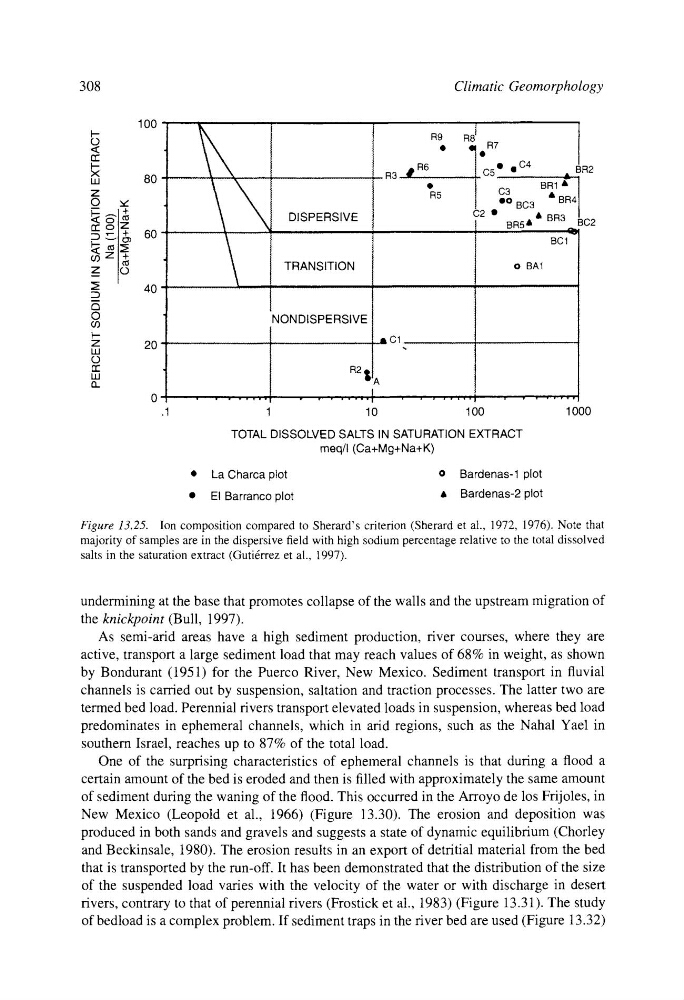
Figure 13.25. Ion composition compared to Sherard's criterion (Sherard et al., 1972, 1976). Note that
majority of samples are in the dispersive field with high sodium percentage relative to the total dissolved
salts in the saturation extract (Guti~rrez et al., 1997).
undermining at the base that promotes collapse of the walls and the upstream migration of
the knickpoint (Bull, 1997).
As semi-arid areas have a high sediment production, fiver courses, where they are
active, transport a large sediment load that may reach values of 68% in weight, as shown
by Bondurant (1951) for the Puerco River, New Mexico. Sediment transport in fluvial
channels is carried out by suspension, saltation and traction processes. The latter two are
termed bed load. Perennial rivers transport elevated loads in suspension, whereas bed load
predominates in ephemeral channels, which in arid regions, such as the Nahal Yael in
southern Israel, reaches up to 87% of the total load.
One of the surprising characteristics of ephemeral channels is that during a flood a
certain amount of the bed is eroded and then is filled with approximately the same amount
of sediment during the waning of the flood. This occurred in the Arroyo de los Frijoles, in
New Mexico (Leopold et al., 1966) (Figure 13.30). The erosion and deposition was
produced in both sands and gravels and suggests a state of dynamic equilibrium (Chorley
and Beckinsale, 1980). The erosion results in an export of detritial material from the bed
that is transported by the run-off. It has been demonstrated that the distribution of the size
of the suspended load varies with the velocity of the water or with discharge in desert
rivers, contrary to that of perennial rivers (Frostick et al., 1983) (Figure 13.31). The study
of bedload is a complex problem. If sediment traps in the fiver bed are used (Figure 13.32)
Climatic Geomorphology
t-(.9
<
rr"
F-X
I.U
Z
o
~,,
-
~Z
+
a
o
I--Z
u.I
0
rr
i.u
I1.
100
80
60
40
................
R9
R3 _~ R6
R5
DISPERSIVE
R8
$
R7
C5 9 9 C4
BR2
BR1 '~
C3
9
9 o BC3
BR4
C2 9
9 BR3
...........
BR5 9
,,, BC2
BC1
, TRANSITION ~
o BA1
L . . . . . . . . . . . . . . . . . . . . . . .
NONDISPERSIVE
AC1
R2~i A
20 ~
.........
1
1
10
100
1000
TOTAL DISSOLVED SALTS IN SATURATION EXTRACT
meq/I (Ca+Mg+Na+K)
9 La Charca plot
o Bardenas-1 plot
9 El Barranco plot
9 Bardenas-2 plot
Figure 13.25. Ion composition compared to Sherard's criterion (Sherard et al., 1972, 1976). Note that
majority of samples are in the dispersive field with high sodium percentage relative to the total dissolved
salts in the saturation extract (Guti~rrez et al., 1997).
undermining at the base that promotes collapse of the walls and the upstream migration of
the knickpoint (Bull, 1997).
As semi-arid areas have a high sediment production, fiver courses, where they are
active, transport a large sediment load that may reach values of 68% in weight, as shown
by Bondurant (1951) for the Puerco River, New Mexico. Sediment transport in fluvial
channels is carried out by suspension, saltation and traction processes. The latter two are
termed bed load. Perennial rivers transport elevated loads in suspension, whereas bed load
predominates in ephemeral channels, which in arid regions, such as the Nahal Yael in
southern Israel, reaches up to 87% of the total load.
One of the surprising characteristics of ephemeral channels is that during a flood a
certain amount of the bed is eroded and then is filled with approximately the same amount
of sediment during the waning of the flood. This occurred in the Arroyo de los Frijoles, in
New Mexico (Leopold et al., 1966) (Figure 13.30). The erosion and deposition was
produced in both sands and gravels and suggests a state of dynamic equilibrium (Chorley
and Beckinsale, 1980). The erosion results in an export of detritial material from the bed
that is transported by the run-off. It has been demonstrated that the distribution of the size
of the suspended load varies with the velocity of the water or with discharge in desert
rivers, contrary to that of perennial rivers (Frostick et al., 1983) (Figure 13.31). The study
of bedload is a complex problem. If sediment traps in the fiver bed are used (Figure 13.32)