

The action of water in arid regions
289
r
.o_
0
III
(a)
Vegetation ~
(b)
Vegetation
t.o_
o~
C)
UJ
(c)
Vegetation ~
(d)
Vegetation
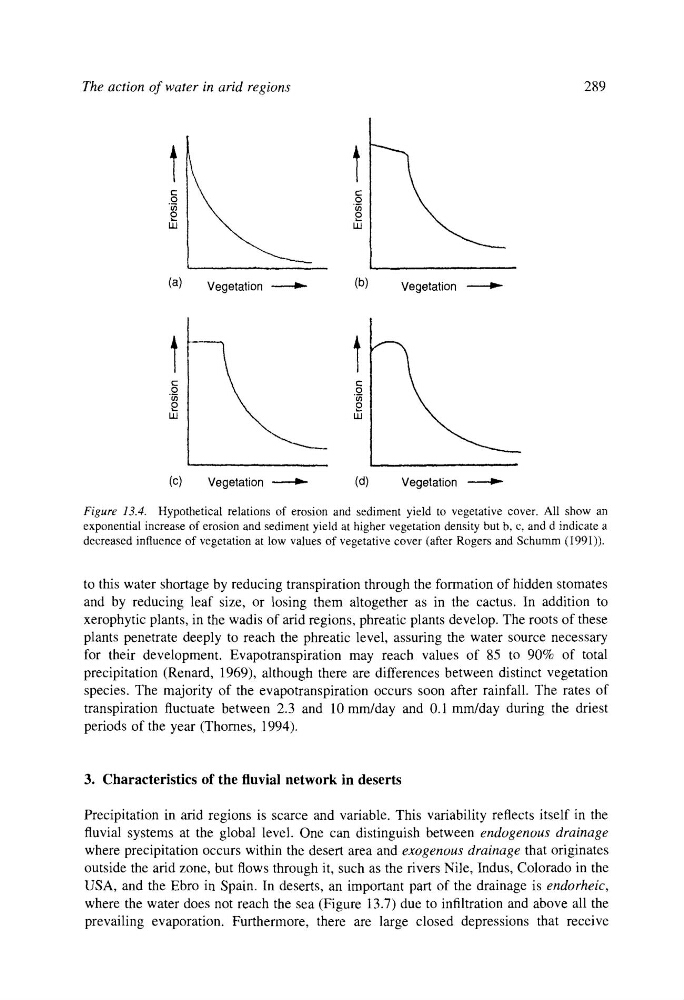
Figure 13.4. Hypothetical relations of erosion and sediment yield to vegetative cover. All show an
exponential increase of erosion and sediment yield at higher vegetation density but b, c, and d indicate a
decreased influence of vegetation at low values of vegetative cover (after Rogers and Schumm (1991)).
to this water shortage by reducing transpiration through the formation of hidden stomates
and by reducing leaf size, or losing them altogether as in the cactus. In addition to
xerophytic plants, in the wadis of arid regions, phreatic plants develop. The roots of these
plants penetrate deeply to reach the phreatic level, assuring the water source necessary
for their development. Evapotranspiration may reach values of 85 to 90% of total
precipitation (Renard, 1969), although there are differences between distinct vegetation
species. The majority of the evapotranspiration occurs soon after rainfall. The rates of
transpiration fluctuate between 2.3 and 10 mm/day and 0.1 ram/day during the driest
periods of the year (Thornes, 1994).
3. Characteristics of the fluvial network in deserts
Precipitation in arid regions is scarce and variable. This variability reflects itself in the
fluvial systems at the global level. One can distinguish between endogenous drainage
where precipitation occurs within the desert area and exogenous drainage that originates
outside the arid zone, but flows through it, such as the rivers Nile, Indus, Colorado in the
USA, and the Ebro in Spain. In deserts, an important part of the drainage is endorheic,
where the water does not reach the sea (Figure 13.7) due to infiltration and above all the
prevailing evaporation. Furthermore, there are large closed depressions that receive
289
r
.o_
0
III
(a)
Vegetation ~
(b)
Vegetation
t.o_
o~
C)
UJ
(c)
Vegetation ~
(d)
Vegetation
Figure 13.4. Hypothetical relations of erosion and sediment yield to vegetative cover. All show an
exponential increase of erosion and sediment yield at higher vegetation density but b, c, and d indicate a
decreased influence of vegetation at low values of vegetative cover (after Rogers and Schumm (1991)).
to this water shortage by reducing transpiration through the formation of hidden stomates
and by reducing leaf size, or losing them altogether as in the cactus. In addition to
xerophytic plants, in the wadis of arid regions, phreatic plants develop. The roots of these
plants penetrate deeply to reach the phreatic level, assuring the water source necessary
for their development. Evapotranspiration may reach values of 85 to 90% of total
precipitation (Renard, 1969), although there are differences between distinct vegetation
species. The majority of the evapotranspiration occurs soon after rainfall. The rates of
transpiration fluctuate between 2.3 and 10 mm/day and 0.1 ram/day during the driest
periods of the year (Thornes, 1994).
3. Characteristics of the fluvial network in deserts
Precipitation in arid regions is scarce and variable. This variability reflects itself in the
fluvial systems at the global level. One can distinguish between endogenous drainage
where precipitation occurs within the desert area and exogenous drainage that originates
outside the arid zone, but flows through it, such as the rivers Nile, Indus, Colorado in the
USA, and the Ebro in Spain. In deserts, an important part of the drainage is endorheic,
where the water does not reach the sea (Figure 13.7) due to infiltration and above all the
prevailing evaporation. Furthermore, there are large closed depressions that receive