

264
Climatic Geomorphology
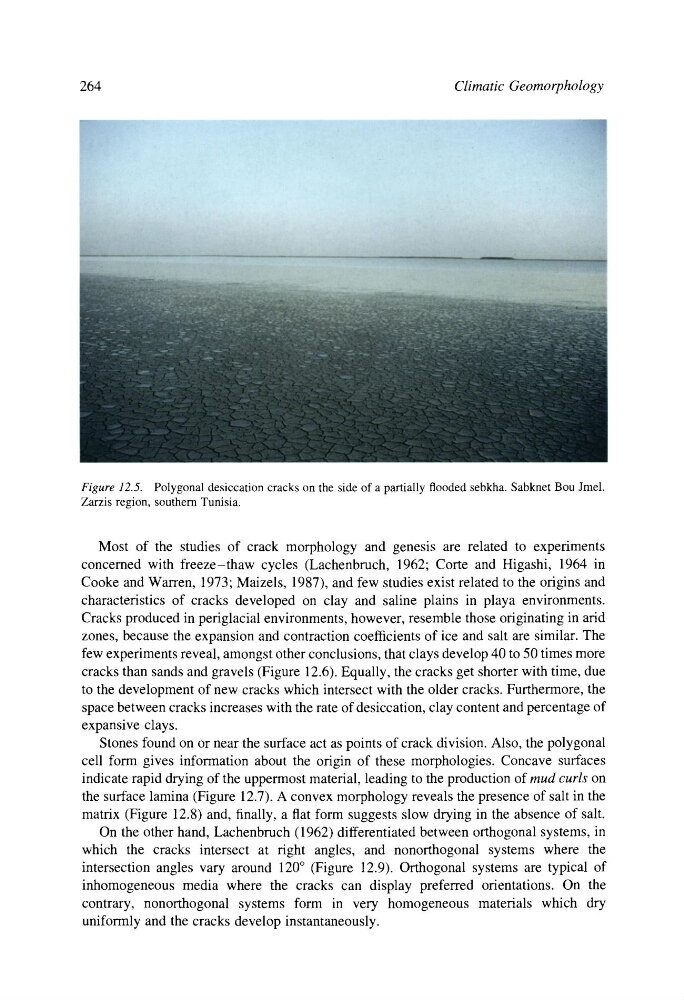
Figure 12.5. Polygonal desiccation cracks on the side of a partially flooded sebkha. Sabknet Bou Jmel.
Zarzis region, southern Tunisia.
Most of the studies of crack morphology and genesis are related to experiments
concerned with freeze-thaw cycles (Lachenbruch, 1962; Corte and Higashi, 1964 in
Cooke and Warren, 1973; Maizels, 1987), and few studies exist related to the origins and
characteristics of cracks developed on clay and saline plains in playa environments.
Cracks produced in periglacial environments, however, resemble those originating in arid
zones, because the expansion and contraction coefficients of ice and salt are similar. The
few experiments reveal, amongst other conclusions, that clays develop 40 to 50 times more
cracks than sands and gravels (Figure 12.6). Equally, the cracks get shorter with time, due
to the development of new cracks which intersect with the older cracks. Furthermore, the
space between cracks increases with the rate of desiccation, clay content and percentage of
expansive clays.
Stones found on or near the surface act as points of crack division. Also, the polygonal
cell form gives information about the origin of these morphologies. Concave surfaces
indicate rapid drying of the uppermost material, leading to the production of mud curls on
the surface lamina (Figure 12.7). A convex morphology reveals the presence of salt in the
matrix (Figure 12.8) and, finally, a flat form suggests slow drying in the absence of salt.
On the other hand, Lachenbruch (1962) differentiated between orthogonal systems, in
which the cracks intersect at fight angles, and nonorthogonal systems where the
intersection angles vary around 120 ~ (Figure 12.9). Orthogonal systems are typical of
inhomogeneous media where the cracks can display preferred orientations. On the
contrary, nonorthogonal systems form in very homogeneous materials which dry
uniformly and the cracks develop instantaneously.
Climatic Geomorphology
Figure 12.5. Polygonal desiccation cracks on the side of a partially flooded sebkha. Sabknet Bou Jmel.
Zarzis region, southern Tunisia.
Most of the studies of crack morphology and genesis are related to experiments
concerned with freeze-thaw cycles (Lachenbruch, 1962; Corte and Higashi, 1964 in
Cooke and Warren, 1973; Maizels, 1987), and few studies exist related to the origins and
characteristics of cracks developed on clay and saline plains in playa environments.
Cracks produced in periglacial environments, however, resemble those originating in arid
zones, because the expansion and contraction coefficients of ice and salt are similar. The
few experiments reveal, amongst other conclusions, that clays develop 40 to 50 times more
cracks than sands and gravels (Figure 12.6). Equally, the cracks get shorter with time, due
to the development of new cracks which intersect with the older cracks. Furthermore, the
space between cracks increases with the rate of desiccation, clay content and percentage of
expansive clays.
Stones found on or near the surface act as points of crack division. Also, the polygonal
cell form gives information about the origin of these morphologies. Concave surfaces
indicate rapid drying of the uppermost material, leading to the production of mud curls on
the surface lamina (Figure 12.7). A convex morphology reveals the presence of salt in the
matrix (Figure 12.8) and, finally, a flat form suggests slow drying in the absence of salt.
On the other hand, Lachenbruch (1962) differentiated between orthogonal systems, in
which the cracks intersect at fight angles, and nonorthogonal systems where the
intersection angles vary around 120 ~ (Figure 12.9). Orthogonal systems are typical of
inhomogeneous media where the cracks can display preferred orientations. On the
contrary, nonorthogonal systems form in very homogeneous materials which dry
uniformly and the cracks develop instantaneously.