

252
Climatic Geomorphology
indicated by the development of exokarstic and endokarstic forms. Despite the scarcity
of water, the high solubility of these salts permits a complete development of karst. An
excellent example of karstification in evaporites is Mount Sedom in Israel, in the
proximity of the Dead Sea, in which the recorded precipitation is only 50 mrn/yr (Frumkin,
1995; Frumkin and Ford, 1995). The evaporites are part of a diapir, constituted of salts of
marine origin and Late Cenozoic in age. Where they crop out, dissolution of chlorides
starts giving rise to a caprock 50 m thick that is constituted of anhydrite, dolomite, and
clastic sediments with a dominant nucleus of chloride salts. In the caprock sinkholes
have developed, some of which are connected to an important network of subterranean
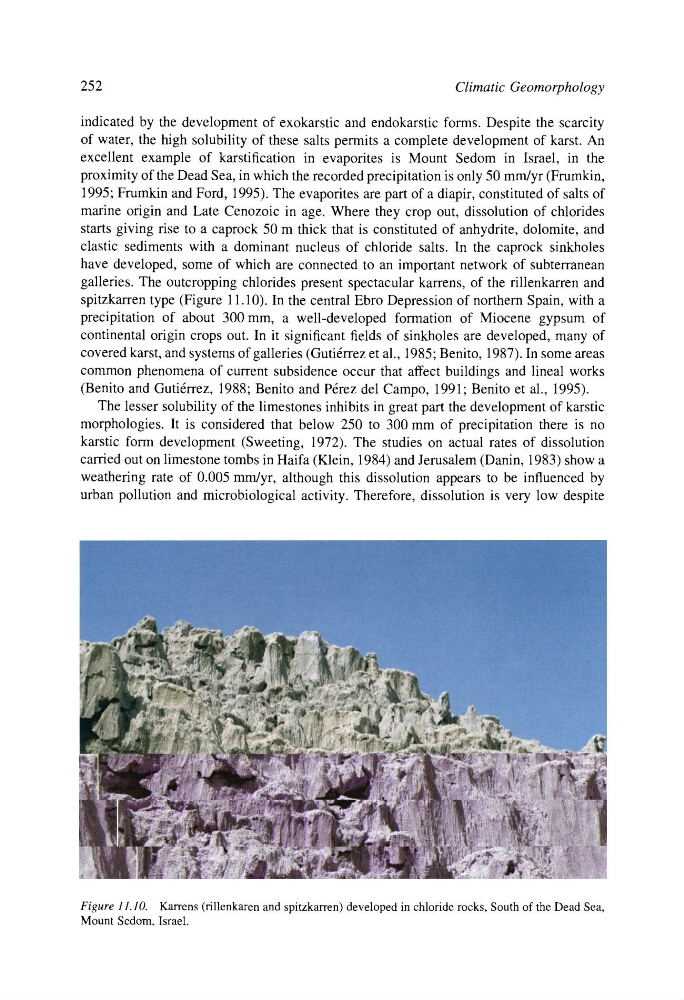
galleries. The outcropping chlorides present spectacular karrens, of the rillenkarren and
spitzkarren type (Figure 11.10). In the central Ebro Depression of northern Spain, with a
precipitation of about 300 mm, a well-developed formation of Miocene gypsum of
continental origin crops out. In it significant fields of sinkholes are developed, many of
covered karst, and systems of galleries (Guti6rrez et al., 1985; Benito, 1987). In some areas
common phenomena of current subsidence occur that affect buildings and lineal works
(Benito and Guti6rrez, 1988; Benito and P6rez del Campo, 1991; Benito et al., 1995).
The lesser solubility of the limestones inhibits in great part the development of karstic
morphologies. It is considered that below 250 to 300 mm of precipitation there is no
karstic form development (Sweeting, 1972). The studies on actual rates of dissolution
carried out on limestone tombs in Haifa (Klein, 1984) and Jerusalem (Danin, 1983) show a
weathering rate of 0.005 mm/yr, although this dissolution appears to be influenced by
urban pollution and microbiological activity. Therefore, dissolution is very low despite
Figure 11.10. Karrens (rillenkaren and spitzkarren) developed in chloride rocks, South of the Dead Sea,
Mount Sedorn. Israel.
Climatic Geomorphology
indicated by the development of exokarstic and endokarstic forms. Despite the scarcity
of water, the high solubility of these salts permits a complete development of karst. An
excellent example of karstification in evaporites is Mount Sedom in Israel, in the
proximity of the Dead Sea, in which the recorded precipitation is only 50 mrn/yr (Frumkin,
1995; Frumkin and Ford, 1995). The evaporites are part of a diapir, constituted of salts of
marine origin and Late Cenozoic in age. Where they crop out, dissolution of chlorides
starts giving rise to a caprock 50 m thick that is constituted of anhydrite, dolomite, and
clastic sediments with a dominant nucleus of chloride salts. In the caprock sinkholes
have developed, some of which are connected to an important network of subterranean
galleries. The outcropping chlorides present spectacular karrens, of the rillenkarren and
spitzkarren type (Figure 11.10). In the central Ebro Depression of northern Spain, with a
precipitation of about 300 mm, a well-developed formation of Miocene gypsum of
continental origin crops out. In it significant fields of sinkholes are developed, many of
covered karst, and systems of galleries (Guti6rrez et al., 1985; Benito, 1987). In some areas
common phenomena of current subsidence occur that affect buildings and lineal works
(Benito and Guti6rrez, 1988; Benito and P6rez del Campo, 1991; Benito et al., 1995).
The lesser solubility of the limestones inhibits in great part the development of karstic
morphologies. It is considered that below 250 to 300 mm of precipitation there is no
karstic form development (Sweeting, 1972). The studies on actual rates of dissolution
carried out on limestone tombs in Haifa (Klein, 1984) and Jerusalem (Danin, 1983) show a
weathering rate of 0.005 mm/yr, although this dissolution appears to be influenced by
urban pollution and microbiological activity. Therefore, dissolution is very low despite
Figure 11.10. Karrens (rillenkaren and spitzkarren) developed in chloride rocks, South of the Dead Sea,
Mount Sedorn. Israel.