

Weathering processes and resulting forms
253
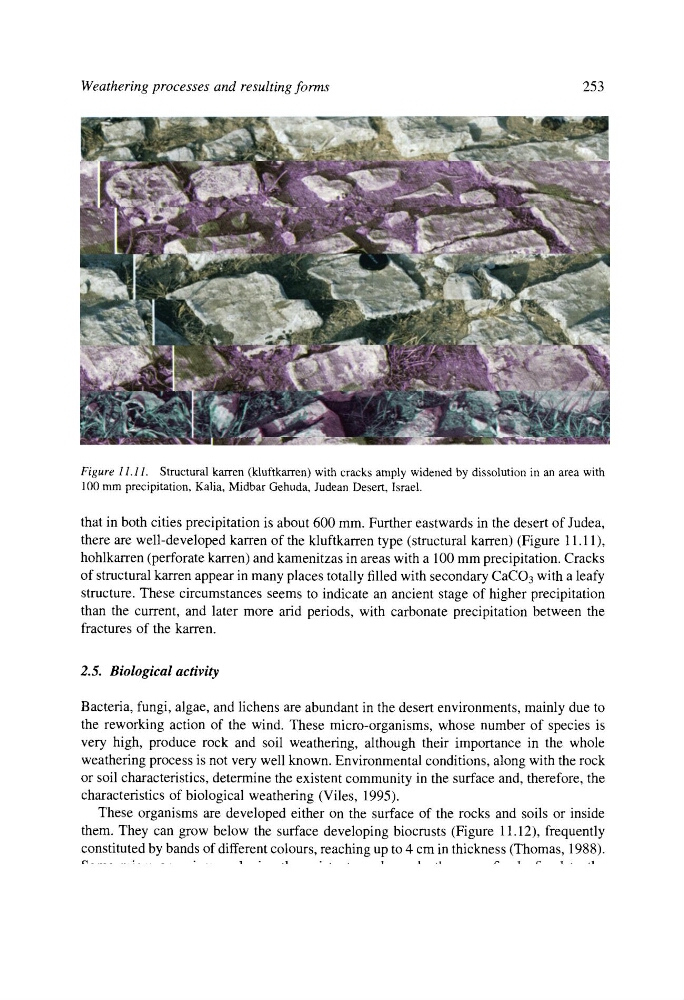
Figure 11.I 1. Structural karren (kluftkarren) with cracks amply widened by dissolution in an area with
100 mm precipitation, Kalia, Midbar Gehuda, Judean Desert, Israel.
that in both cities precipitation is about 600 mm. Further eastwards in the desert of Judea,
there are well-developed karren of the kluftkarren type (structural karren) (Figure 11.11),
hohlkarren (perforate karren) and kamenitzas in areas with a 100 mm precipitation. Cracks
of structural karren appear in many places totally filled with secondary CaCO3 with a leafy
structure. These circumstances seems to indicate an ancient stage of higher precipitation
than the current, and later more arid periods, with carbonate precipitation between the
fractures of the karren.
2.5. Biological activity
Bacteria, fungi, algae, and lichens are abundant in the desert environments, mainly due to
the reworking action of the wind. These micro-organisms, whose number of species is
very high, produce rock and soil weathering, although their importance in the whole
weathering process is not very well known. Environmental conditions, along with the rock
or soil characteristics, determine the existent community in the surface and, therefore, the
characteristics of biological weathering (Viles, 1995).
These organisms are developed either on the surface of the rocks and soils or inside
them. They can grow below the surface developing biocrusts (Figure 11.12), frequently
constituted by bands of different colours, reaching up to 4 cm in thickness (Thomas, 1988).
Some micro-organisms colonize the existent cracks and others are firmly fixed to the
surface (Figure 11.12).
This biological activity, resulting from vital processes or from secreted products,
generates substantial changes in the superficial micromorphology. These modifications are
253
Figure 11.I 1. Structural karren (kluftkarren) with cracks amply widened by dissolution in an area with
100 mm precipitation, Kalia, Midbar Gehuda, Judean Desert, Israel.
that in both cities precipitation is about 600 mm. Further eastwards in the desert of Judea,
there are well-developed karren of the kluftkarren type (structural karren) (Figure 11.11),
hohlkarren (perforate karren) and kamenitzas in areas with a 100 mm precipitation. Cracks
of structural karren appear in many places totally filled with secondary CaCO3 with a leafy
structure. These circumstances seems to indicate an ancient stage of higher precipitation
than the current, and later more arid periods, with carbonate precipitation between the
fractures of the karren.
2.5. Biological activity
Bacteria, fungi, algae, and lichens are abundant in the desert environments, mainly due to
the reworking action of the wind. These micro-organisms, whose number of species is
very high, produce rock and soil weathering, although their importance in the whole
weathering process is not very well known. Environmental conditions, along with the rock
or soil characteristics, determine the existent community in the surface and, therefore, the
characteristics of biological weathering (Viles, 1995).
These organisms are developed either on the surface of the rocks and soils or inside
them. They can grow below the surface developing biocrusts (Figure 11.12), frequently
constituted by bands of different colours, reaching up to 4 cm in thickness (Thomas, 1988).
Some micro-organisms colonize the existent cracks and others are firmly fixed to the
surface (Figure 11.12).
This biological activity, resulting from vital processes or from secreted products,
generates substantial changes in the superficial micromorphology. These modifications are