

Weathering processes and resulting forms
251
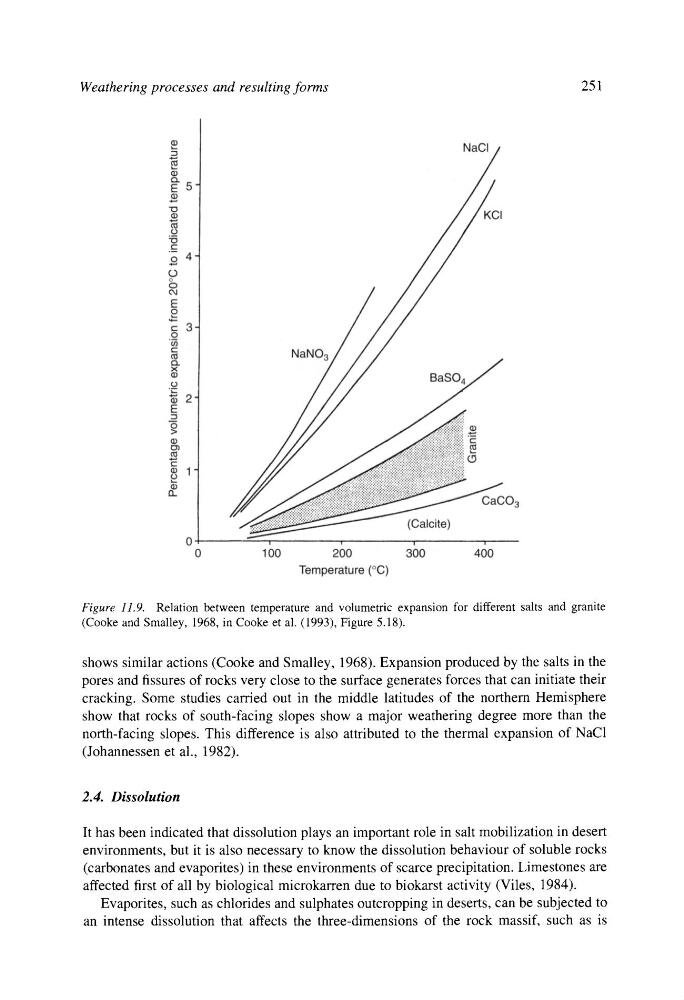
Figure 11.9. Relation between temperature and volumetric expansion for different salts and granite
(Cooke and Smalley, 1968, in Cooke et al. (1993), Figure 5.18).
shows similar actions (Cooke and Smalley, 1968). Expansion produced by the salts in the
pores and fissures of rocks very close to the surface generates forces that can initiate their
cracking. Some studies carried out in the middle latitudes of the northern Hemisphere
show that rocks of south-facing slopes show a major weathering degree more than the
north-facing slopes. This difference is also attributed to the thermal expansion of NaC1
(Johannessen et al., 1982).
2.4. Dissolution
It has been indicated that dissolution plays an important role in salt mobilization in desert
environments, but it is also necessary to know the dissolution behaviour of soluble rocks
(carbonates and evaporites) in these environments of scarce precipitation. Limestones are
affected first of all by biological microkarren due to biokarst activity (Viles, 1984).
Evaporites, such as chlorides and sulphates outcropping in deserts, can be subjected to
an intense dissolution that affects the three-dimensions of the rock massif, such as is
251
Figure 11.9. Relation between temperature and volumetric expansion for different salts and granite
(Cooke and Smalley, 1968, in Cooke et al. (1993), Figure 5.18).
shows similar actions (Cooke and Smalley, 1968). Expansion produced by the salts in the
pores and fissures of rocks very close to the surface generates forces that can initiate their
cracking. Some studies carried out in the middle latitudes of the northern Hemisphere
show that rocks of south-facing slopes show a major weathering degree more than the
north-facing slopes. This difference is also attributed to the thermal expansion of NaC1
(Johannessen et al., 1982).
2.4. Dissolution
It has been indicated that dissolution plays an important role in salt mobilization in desert
environments, but it is also necessary to know the dissolution behaviour of soluble rocks
(carbonates and evaporites) in these environments of scarce precipitation. Limestones are
affected first of all by biological microkarren due to biokarst activity (Viles, 1984).
Evaporites, such as chlorides and sulphates outcropping in deserts, can be subjected to
an intense dissolution that affects the three-dimensions of the rock massif, such as is