

Weathering processes and resulting forms
247
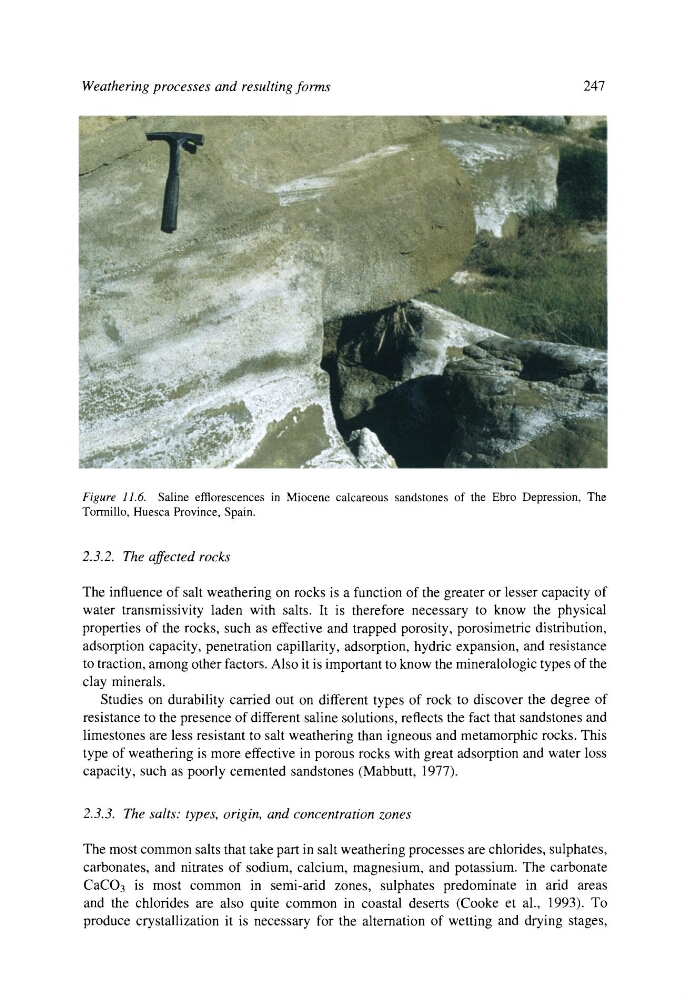
Figure 11.6. Saline efflorescences in Miocene calcareous sandstones of the Ebro Depression, The
Tormillo, Huesca Province, Spain.
2.3.2. The affected rocks
The influence of salt weathering on rocks is a function of the greater or lesser capacity of
water transmissivity laden with salts. It is therefore necessary to know the physical
properties of the rocks, such as effective and trapped porosity, porosimetric distribution,
adsorption capacity, penetration capillarity, adsorption, hydric expansion, and resistance
to traction, among other factors. Also it is important to know the mineralologic types of the
clay minerals.
Studies on durability carried out on different types of rock to discover the degree of
resistance to the presence of different saline solutions, reflects the fact that sandstones and
limestones are less resistant to salt weathering than igneous and metamorphic rocks. This
type of weathering is more effective in porous rocks with great adsorption and water loss
capacity, such as poorly cemented sandstones (Mabbutt, 1977).
2.3.3. The salts: types, origin, and concentration zones
The most common salts that take part in salt weathering processes are chlorides, sulphates,
carbonates, and nitrates of sodium, calcium, magnesium, and potassium. The carbonate
CaCO3 is most common in semi-arid zones, sulphates predominate in arid areas
and the chlorides are also quite common in coastal deserts (Cooke et al., 1993). To
produce crystallization it is necessary for the alternation of wetting and drying stages,
247
Figure 11.6. Saline efflorescences in Miocene calcareous sandstones of the Ebro Depression, The
Tormillo, Huesca Province, Spain.
2.3.2. The affected rocks
The influence of salt weathering on rocks is a function of the greater or lesser capacity of
water transmissivity laden with salts. It is therefore necessary to know the physical
properties of the rocks, such as effective and trapped porosity, porosimetric distribution,
adsorption capacity, penetration capillarity, adsorption, hydric expansion, and resistance
to traction, among other factors. Also it is important to know the mineralologic types of the
clay minerals.
Studies on durability carried out on different types of rock to discover the degree of
resistance to the presence of different saline solutions, reflects the fact that sandstones and
limestones are less resistant to salt weathering than igneous and metamorphic rocks. This
type of weathering is more effective in porous rocks with great adsorption and water loss
capacity, such as poorly cemented sandstones (Mabbutt, 1977).
2.3.3. The salts: types, origin, and concentration zones
The most common salts that take part in salt weathering processes are chlorides, sulphates,
carbonates, and nitrates of sodium, calcium, magnesium, and potassium. The carbonate
CaCO3 is most common in semi-arid zones, sulphates predominate in arid areas
and the chlorides are also quite common in coastal deserts (Cooke et al., 1993). To
produce crystallization it is necessary for the alternation of wetting and drying stages,