

248
Climatic Geomorphology
and the higher the number of cycles, the greater the salt weathering intensity. The
effectiveness of weathering varies with salt solubility, hydration capacity, and crystallization strength. Some salts, such as mirabilite (NazSO4-10H20) have a disruptive
strength much greater than that of freezing water. Laboratory experiments carried out with
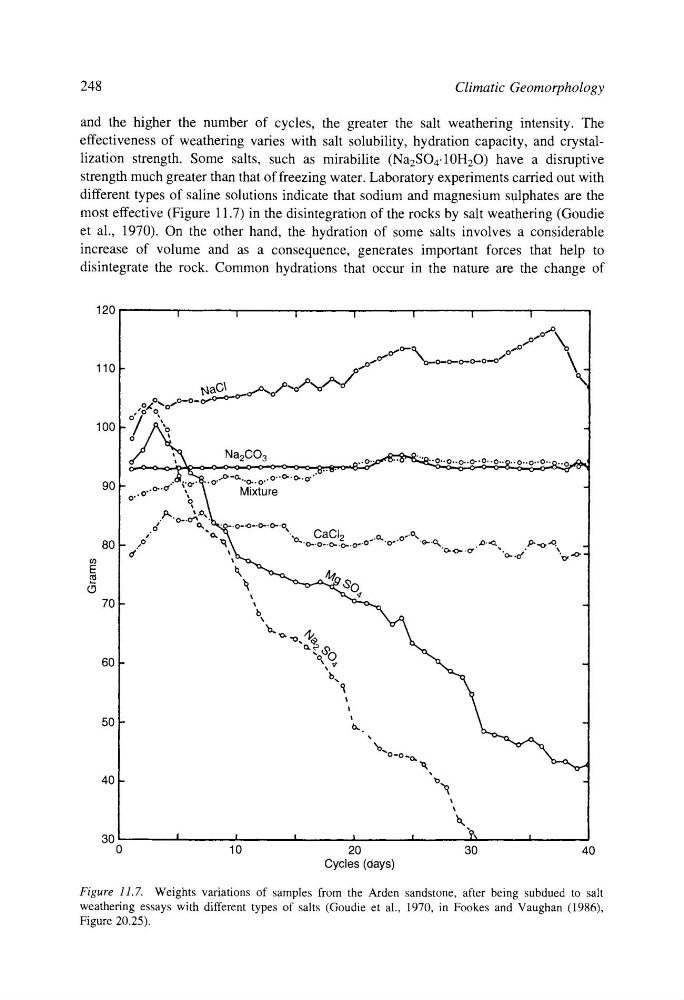
different types of saline solutions indicate that sodium and magnesium sulphates are the
most effective (Figure 11.7) in the disintegration of the rocks by salt weathering (Goudie
et al., 1970). On the other hand, the hydration of some salts involves a considerable
increase of volume and as a consequence, generates important forces that help to
disintegrate the rock. Common hydrations that occur in the nature are the change of
120
110
100 - "~
ff
0
//
90- 0.-0
80 - .,o
o"
4030
0
I
I'
I
I
I
I"
I
'
r
Na2CO 3
.. 9
. .
.0"0"0'.0"
' 0"0"(3"'0
- O"
Mixture
"'o. CaCI2
.o. o ..~
9 o*.o--o-.o-.o
-'o"
"o'"
-e--o,,
"o- .o- ,o'
,o,._ ~,
g.
o--u -_
.0
O~
O,
b,, cl
I
I
'~0~'0-0 "C~,
"o,
3O
..o.-o. .~..o..,o.
"o-.o'
"~ .o.
=,
|
, , I
i
I
,
J
I
10
20
40
Cycles (days)
Figure 11.7. Weights variations of samples from the Arden sandstone, after being subdued to salt
weathering essays with different types of salts (Goudie et al., 1970, in Fookes and Vaughan (1986),
Figure 20.25).
Climatic Geomorphology
and the higher the number of cycles, the greater the salt weathering intensity. The
effectiveness of weathering varies with salt solubility, hydration capacity, and crystallization strength. Some salts, such as mirabilite (NazSO4-10H20) have a disruptive
strength much greater than that of freezing water. Laboratory experiments carried out with
different types of saline solutions indicate that sodium and magnesium sulphates are the
most effective (Figure 11.7) in the disintegration of the rocks by salt weathering (Goudie
et al., 1970). On the other hand, the hydration of some salts involves a considerable
increase of volume and as a consequence, generates important forces that help to
disintegrate the rock. Common hydrations that occur in the nature are the change of
120
110
100 - "~
ff
0
//
90- 0.-0
80 - .,o
o"
4030
0
I
I'
I
I
I
I"
I
'
r
Na2CO 3
.. 9
. .
.0"0"0'.0"
' 0"0"(3"'0
- O"
Mixture
"'o. CaCI2
.o. o ..~
9 o*.o--o-.o-.o
-'o"
"o'"
-e--o,,
"o- .o- ,o'
,o,._ ~,
g.
o--u -_
.0
O~
O,
b,, cl
I
I
'~0~'0-0 "C~,
"o,
3O
..o.-o. .~..o..,o.
"o-.o'
"~ .o.
=,
|
, , I
i
I
,
J
I
10
20
40
Cycles (days)
Figure 11.7. Weights variations of samples from the Arden sandstone, after being subdued to salt
weathering essays with different types of salts (Goudie et al., 1970, in Fookes and Vaughan (1986),
Figure 20.25).