

246
Climatic Geomorphology
and consequences of salt weathering (Evans, 1969 to 1970; Goudie et al., 1970; Goudie,
1974; Cooke, 1979, 1981; Williams and Robinson, 1981; McGreevy, 1982; Sperling and
Cooke, 1985; Fahey, 1986; Goudie and Viles, 1995). These works take into account the
environmental conditions and the materials affected by salt weathering. Similarly, they
have experimented with the activity of different saline solutions in order to know the
different salt weathering intensities. They also investigate the effects and the freed
particles. Finally, another aspect is involved in the correct knowledge of the processes
implied in salt weathering. In Cooke et al. (1993) can be found an excellent synthesis of
salt weathering. Also salt weathering has been studied in a qualitative way in order to
analyse the origin of diverse micromorphologies. These works will be referred to later, in
the section on resultant forms. Similarly, considerable advances have been produced
in the field of applications, as long as the activity of the salts causes disturbances and
damages to highways, buildings and engineering structures, mainly due to reactions
between the cement and gypsum that generate expansions and subsequent cracking
(Goudie and Viles, 1997).
2.3.1. Influence of climate
The wide diurnal and seasonal variations of temperature and relative humidity in all
deserts, together with the presence of dry and sporadic winds, favour salt weathering.
Moreover, these temperature and humidity variations are not ephemeral, because they
can also occur over the surface and close to it, so that is why they influence the spatial
variability of salt weathering. The high temperatures favour the evaporation of the saline
solutions and finally result in their precipitation. Similarly, cooling of saturated solutions
can also produce salt precipitation. On the other hand, the humidity increase generates
hydrous salts and the temperature increase results in thermal expansion of saline crystals.
These crystal growths, hydration, and expansion processes produce important volumetric
modifications, which give rise to disruptive forces in the rocks (Cooke et al., 1993).
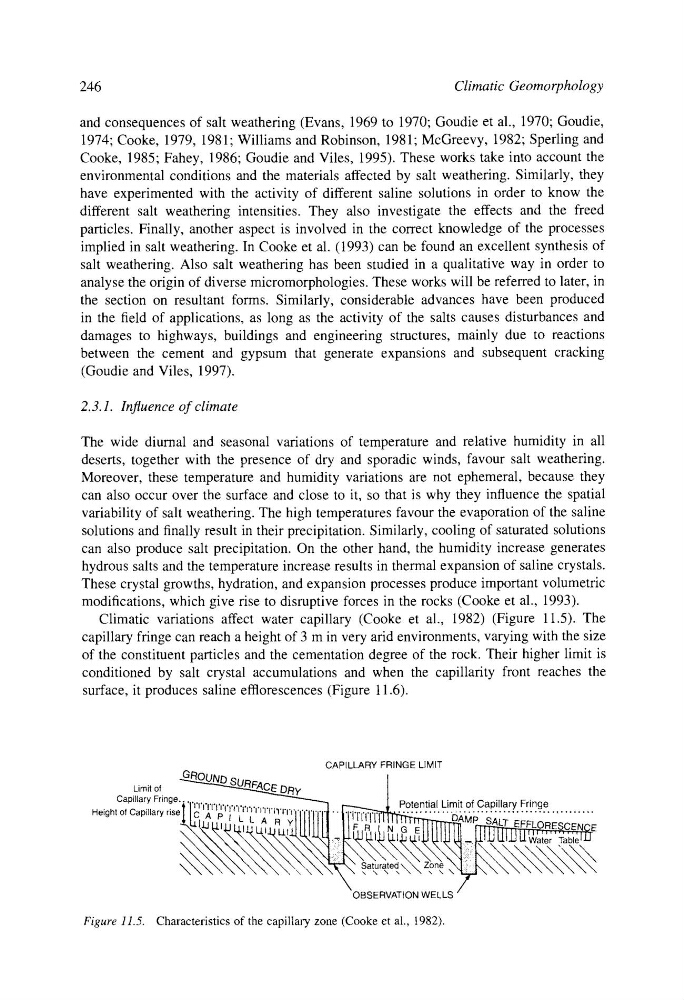
Climatic variations affect water capillary (Cooke et al., 1982) (Figure 11.5). The
capillary fringe can reach a height of 3 m in very arid environments, varying with the size
of the constituent particles and the cementation degree of the rock. Their higher limit is
conditioned by salt crystal accumulations and when the capillarity front reaches the
surface, it produces saline efflorescences (Figure 11.6).
CAPILLARY FRINGE LIMIT
Limit of ~FrFACE DFIy
Capillary Fringe ....
~
i:~,
Potential Limit of Capillary Fringe
J I'l'l'l'l'l'l'l'l'l'l'l'l'l'l'l'l I rl I iJ
Height of Capillary rise' 'C -
-~.~- ,' ~ HI LL A" ..... R Y
~~i~,~Mp'"
SALT" "EFFLORE'SC'EN" ""
~LL L'IJ LLI,IJ LLI.IJ LLI
LJ LLI.LI ~l.IJJ ~il_l ~
.. U.J~'er
Tabe ~j ~j ~
R
N G E
i~ .... ' ..... E
9
"
NS~al ~ura~te~d~' ~ZZone,,
\
;..i !;i i i i ;
~
"\ ~
OBSERVATION WELLS "
Figure 11.5. Characteristics of the capillary zone (Cooke et al., 1982).
Climatic Geomorphology
and consequences of salt weathering (Evans, 1969 to 1970; Goudie et al., 1970; Goudie,
1974; Cooke, 1979, 1981; Williams and Robinson, 1981; McGreevy, 1982; Sperling and
Cooke, 1985; Fahey, 1986; Goudie and Viles, 1995). These works take into account the
environmental conditions and the materials affected by salt weathering. Similarly, they
have experimented with the activity of different saline solutions in order to know the
different salt weathering intensities. They also investigate the effects and the freed
particles. Finally, another aspect is involved in the correct knowledge of the processes
implied in salt weathering. In Cooke et al. (1993) can be found an excellent synthesis of
salt weathering. Also salt weathering has been studied in a qualitative way in order to
analyse the origin of diverse micromorphologies. These works will be referred to later, in
the section on resultant forms. Similarly, considerable advances have been produced
in the field of applications, as long as the activity of the salts causes disturbances and
damages to highways, buildings and engineering structures, mainly due to reactions
between the cement and gypsum that generate expansions and subsequent cracking
(Goudie and Viles, 1997).
2.3.1. Influence of climate
The wide diurnal and seasonal variations of temperature and relative humidity in all
deserts, together with the presence of dry and sporadic winds, favour salt weathering.
Moreover, these temperature and humidity variations are not ephemeral, because they
can also occur over the surface and close to it, so that is why they influence the spatial
variability of salt weathering. The high temperatures favour the evaporation of the saline
solutions and finally result in their precipitation. Similarly, cooling of saturated solutions
can also produce salt precipitation. On the other hand, the humidity increase generates
hydrous salts and the temperature increase results in thermal expansion of saline crystals.
These crystal growths, hydration, and expansion processes produce important volumetric
modifications, which give rise to disruptive forces in the rocks (Cooke et al., 1993).
Climatic variations affect water capillary (Cooke et al., 1982) (Figure 11.5). The
capillary fringe can reach a height of 3 m in very arid environments, varying with the size
of the constituent particles and the cementation degree of the rock. Their higher limit is
conditioned by salt crystal accumulations and when the capillarity front reaches the
surface, it produces saline efflorescences (Figure 11.6).
CAPILLARY FRINGE LIMIT
Limit of ~FrFACE DFIy
Capillary Fringe ....
~
i:~,
Potential Limit of Capillary Fringe
J I'l'l'l'l'l'l'l'l'l'l'l'l'l'l'l'l I rl I iJ
Height of Capillary rise' 'C -
-~.~- ,' ~ HI LL A" ..... R Y
~~i~,~Mp'"
SALT" "EFFLORE'SC'EN" ""
~LL L'IJ LLI,IJ LLI.IJ LLI
LJ LLI.LI ~l.IJJ ~il_l ~
.. U.J~'er
Tabe ~j ~j ~
R
N G E
i~ .... ' ..... E
9
"
NS~al ~ura~te~d~' ~ZZone,,
\
;..i !;i i i i ;
~
"\ ~
OBSERVATION WELLS "
Figure 11.5. Characteristics of the capillary zone (Cooke et al., 1982).