

Weathering processes and resulting forms
245
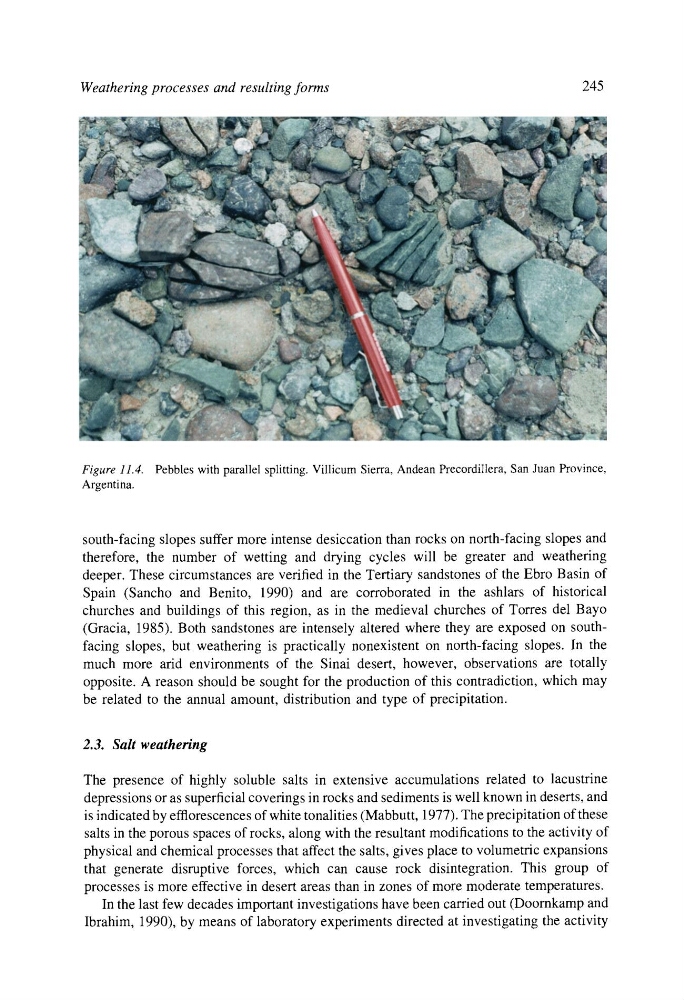
Figure 11.4. Pebbles with parallel splitting. Villicum Sierra, Andean Precordillera, San Juan Province,
Argentina.
south-facing slopes suffer more intense desiccation than rocks on north-facing slopes and
therefore, the number of wetting and drying cycles will be greater and weathering
deeper. These circumstances are verified in the Tertiary sandstones of the Ebro Basin of
Spain (Sancho and Benito, 1990) and are corroborated in the ashlars of historical
churches and buildings of this region, as in the medieval churches of Torres del Bayo
(Gracia, 1985). Both sandstones are intensely altered where they are exposed on southfacing slopes, but weathering is practically nonexistent on north-facing slopes. In the
much more arid environments of the Sinai desert, however, observations are totally
opposite. A reason should be sought for the production of this contradiction, which may
be related to the annual amount, distribution and type of precipitation.
2.3. Salt weathering
The presence of highly soluble salts in extensive accumulations related to lacustrine
depressions or as superficial coverings in rocks and sediments is well known in deserts, and
is indicated by efflorescences of white tonalities (Mabbutt, 1977). The precipitation of these
salts in the porous spaces of rocks, along with the resultant modifications to the activity of
physical and chemical processes that affect the salts, gives place to volumetric expansions
that generate disruptive forces, which can cause rock disintegration. This group of
processes is more effective in desert areas than in zones of more moderate temperatures.
In the last few decades important investigations have been carried out (Doornkamp and
Ibrahim, 1990), by means of laboratory experiments directed at investigating the activity
245
Figure 11.4. Pebbles with parallel splitting. Villicum Sierra, Andean Precordillera, San Juan Province,
Argentina.
south-facing slopes suffer more intense desiccation than rocks on north-facing slopes and
therefore, the number of wetting and drying cycles will be greater and weathering
deeper. These circumstances are verified in the Tertiary sandstones of the Ebro Basin of
Spain (Sancho and Benito, 1990) and are corroborated in the ashlars of historical
churches and buildings of this region, as in the medieval churches of Torres del Bayo
(Gracia, 1985). Both sandstones are intensely altered where they are exposed on southfacing slopes, but weathering is practically nonexistent on north-facing slopes. In the
much more arid environments of the Sinai desert, however, observations are totally
opposite. A reason should be sought for the production of this contradiction, which may
be related to the annual amount, distribution and type of precipitation.
2.3. Salt weathering
The presence of highly soluble salts in extensive accumulations related to lacustrine
depressions or as superficial coverings in rocks and sediments is well known in deserts, and
is indicated by efflorescences of white tonalities (Mabbutt, 1977). The precipitation of these
salts in the porous spaces of rocks, along with the resultant modifications to the activity of
physical and chemical processes that affect the salts, gives place to volumetric expansions
that generate disruptive forces, which can cause rock disintegration. This group of
processes is more effective in desert areas than in zones of more moderate temperatures.
In the last few decades important investigations have been carried out (Doornkamp and
Ibrahim, 1990), by means of laboratory experiments directed at investigating the activity