

244
Climatic Geomorphology
80
~70
O
o
v
60
i.=
0
e~
E
~. 5O
40
BASALT
WHITE SANDSTONE
*" , '
, ! ',
.......
'
'
'
'
1 '
'
'
' v ,
,
'-80
i
~- 70
/t" ..'"o
o~'
/"//i." ."
9
\~ ':"
li ! /
60
,,,::,
/;.,.1'
,I
\\'< '.',~,
%
""~
~
"o,~~
,,~,,
,
/,t'
_
\~'-'-.
ft...
__ surface
72-:,~:"-..
50 E
"~,~" ..
lcm depth
-""~'L.":.s
"~,~:<..
14c
_._
-,,~L<.~ ..~.- ....
3cm depth
-
", .'~.'""
9 ........ 7cm depth
40
....
130m depth
16
20
I
04
08
12
16
16
20
I
04
08
12
16
Aug 10
Aug 11
Aug 10
Aug 11
5
E
O
v
~10
-
tm
15.r
/
,
,
,
,,i
./
/
9
,/
,/
/
/
20
~
~
A
~
I
1
1
0
10
20
30
40
0
10
20
30
Temperature (~
Temperature (~
t
1
r
,
,, f
/
/
5
E
O
v
10~
c~
tm
15
l
l
20
40
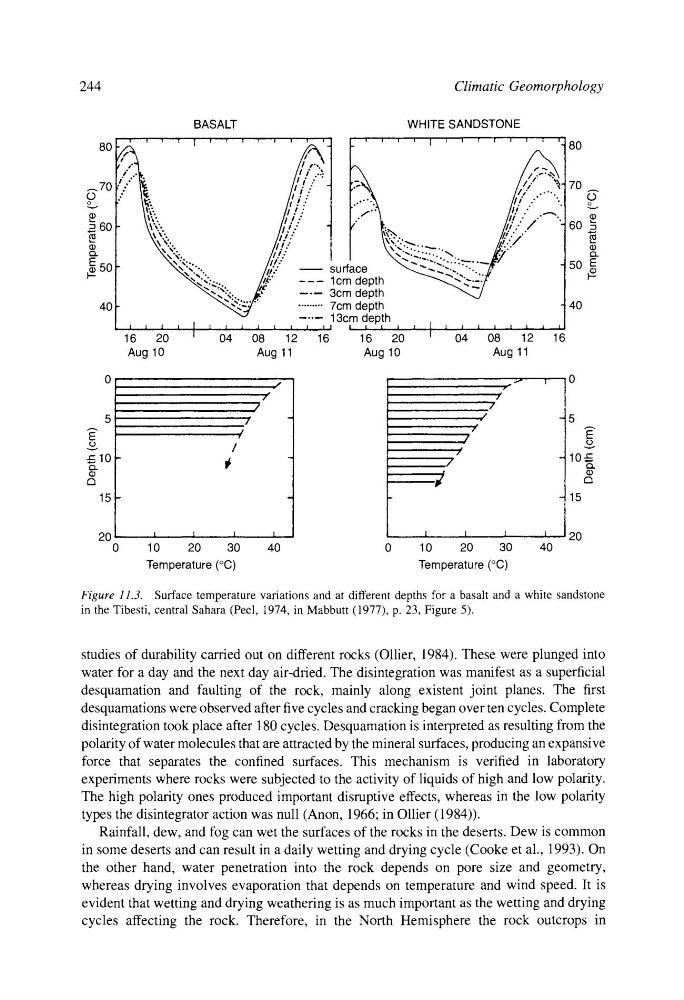
Figure 11.3. Surface temperature variations and at different depths for a basalt and a white sandstone
in the Tibesti, central Sahara (Peel, 1974, in Mabbutt (1977), p. 23, Figure 5).
studies of durability carried out on different rocks (Ollier, 1984). These were plunged into
water for a day and the next day air-dried. The disintegration was manifest as a superficial
desquamation and faulting of the rock, mainly along existent joint planes. The first
desquamations were observed after five cycles and cracking began over ten cycles. Complete
disintegration took place after 180 cycles. Desquamation is interpreted as resulting from the
polarity of water molecules that are attracted by the mineral surfaces, producing an expansive
force that separates the confined surfaces. This mechanism is verified in laboratory
experiments where rocks were subjected to the activity of liquids of high and low polarity.
The high polarity ones produced important disruptive effects, whereas in the low polarity
types the disintegrator action was null (Anon, 1966; in Ollier (1984)).
Rainfall, dew, and fog can wet the surfaces of the rocks in the deserts. Dew is common
in some deserts and can result in a daily wetting and drying cycle (Cooke et al., 1993). On
the other hand, water penetration into the rock depends on pore size and geometry,
whereas drying involves evaporation that depends on temperature and wind speed. It is
evident that wetting and drying weathering is as much important as the wetting and drying
cycles affecting the rock. Therefore, in the North Hemisphere the rock outcrops in
Climatic Geomorphology
80
~70
O
o
v
60
i.=
0
e~
E
~. 5O
40
BASALT
WHITE SANDSTONE
*" , '
, ! ',
.......
'
'
'
'
1 '
'
'
' v ,
,
'-80
i
~- 70
/t" ..'"o
o~'
/"//i." ."
9
\~ ':"
li ! /
60
,,,::,
/;.,.1'
,I
\\'< '.',~,
%
""~
~
"o,~~
,,~,,
,
/,t'
_
\~'-'-.
ft...
__ surface
72-:,~:"-..
50 E
"~,~" ..
lcm depth
-""~'L.":.s
"~,~:<..
14c
_._
-,,~L<.~ ..~.- ....
3cm depth
-
", .'~.'""
9 ........ 7cm depth
40
....
130m depth
16
20
I
04
08
12
16
16
20
I
04
08
12
16
Aug 10
Aug 11
Aug 10
Aug 11
5
E
O
v
~10
-
tm
15.r
/
,
,
,
,,i
./
/
9
,/
,/
/
/
20
~
~
A
~
I
1
1
0
10
20
30
40
0
10
20
30
Temperature (~
Temperature (~
t
1
r
,
,, f
/
/
5
E
O
v
10~
c~
tm
15
l
l
20
40
Figure 11.3. Surface temperature variations and at different depths for a basalt and a white sandstone
in the Tibesti, central Sahara (Peel, 1974, in Mabbutt (1977), p. 23, Figure 5).
studies of durability carried out on different rocks (Ollier, 1984). These were plunged into
water for a day and the next day air-dried. The disintegration was manifest as a superficial
desquamation and faulting of the rock, mainly along existent joint planes. The first
desquamations were observed after five cycles and cracking began over ten cycles. Complete
disintegration took place after 180 cycles. Desquamation is interpreted as resulting from the
polarity of water molecules that are attracted by the mineral surfaces, producing an expansive
force that separates the confined surfaces. This mechanism is verified in laboratory
experiments where rocks were subjected to the activity of liquids of high and low polarity.
The high polarity ones produced important disruptive effects, whereas in the low polarity
types the disintegrator action was null (Anon, 1966; in Ollier (1984)).
Rainfall, dew, and fog can wet the surfaces of the rocks in the deserts. Dew is common
in some deserts and can result in a daily wetting and drying cycle (Cooke et al., 1993). On
the other hand, water penetration into the rock depends on pore size and geometry,
whereas drying involves evaporation that depends on temperature and wind speed. It is
evident that wetting and drying weathering is as much important as the wetting and drying
cycles affecting the rock. Therefore, in the North Hemisphere the rock outcrops in