

234
Climatic Geomorphology
the Sahara, or Death Valley, as much as 58~ (Nicholson, 1993). As the sky at night stays
clear the temperatures diminish considerably by night-time irradiation and the thermal
diurnal oscillations can be about 22~ in deserts of high latitudes, although values of as
much as 56~ have been registered in Tucson, Arizona (Goudie and Wilkinson, 1977).
Annual oscillations are high and seasonal contrast increases with the increase of the
latitude. The temperature of the terrestrial surface is higher, having been measured at
83.5~ in the sands of Port-Sudan, at the Red Sea.
In coastal deserts the temperatures are less contrasted with low daily and seasonal
intervals, unlike the inland deserts in which oscillations are very marked. In the littoral
deserts affected by cold oceanic currents, the daily variations are some 11 ~ half of those
registered in the inland deserts, and the annual oscillations are about 18~ (Goudie and
Wilkinson, 1977).
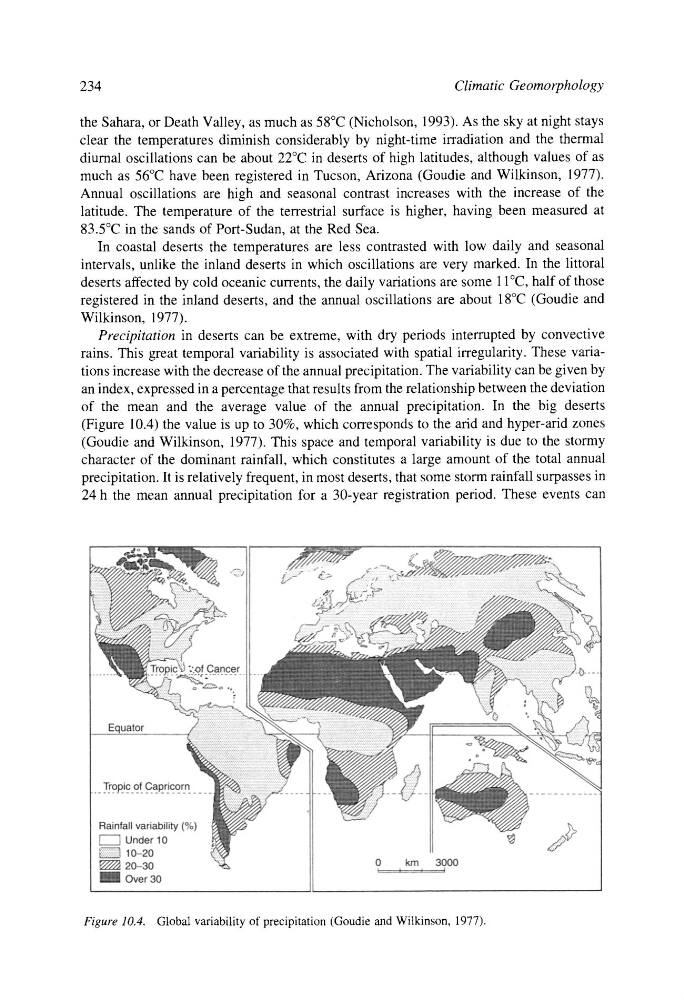
Precipitation in deserts can be extreme, with dry periods interrupted by convective
rains. This great temporal variability is associated with spatial irregularity. These variations increase with the decrease of the annual precipitation. The variability can be given by
an index, expressed in a percentage that results from the relationship between the deviation
of the mean and the average value of the annual precipitation. In the big deserts
(Figure 10.4) the value is up to 30%, which corresponds to the arid and hyper-arid zones
(Goudie and Wilkinson, 1977). This space and temporal variability is due to the stormy
character of the dominant rainfall, which constitutes a large amount of the total annual
precipitation. It is relatively frequent, in most deserts, that some storm rainfall surpasses in
24 h the mean annual precipitation for a 30-year registration period. These events can
Figure 10.4. Global variability of precipitation (Goudie and Wilkinson, 1977).
Climatic Geomorphology
the Sahara, or Death Valley, as much as 58~ (Nicholson, 1993). As the sky at night stays
clear the temperatures diminish considerably by night-time irradiation and the thermal
diurnal oscillations can be about 22~ in deserts of high latitudes, although values of as
much as 56~ have been registered in Tucson, Arizona (Goudie and Wilkinson, 1977).
Annual oscillations are high and seasonal contrast increases with the increase of the
latitude. The temperature of the terrestrial surface is higher, having been measured at
83.5~ in the sands of Port-Sudan, at the Red Sea.
In coastal deserts the temperatures are less contrasted with low daily and seasonal
intervals, unlike the inland deserts in which oscillations are very marked. In the littoral
deserts affected by cold oceanic currents, the daily variations are some 11 ~ half of those
registered in the inland deserts, and the annual oscillations are about 18~ (Goudie and
Wilkinson, 1977).
Precipitation in deserts can be extreme, with dry periods interrupted by convective
rains. This great temporal variability is associated with spatial irregularity. These variations increase with the decrease of the annual precipitation. The variability can be given by
an index, expressed in a percentage that results from the relationship between the deviation
of the mean and the average value of the annual precipitation. In the big deserts
(Figure 10.4) the value is up to 30%, which corresponds to the arid and hyper-arid zones
(Goudie and Wilkinson, 1977). This space and temporal variability is due to the stormy
character of the dominant rainfall, which constitutes a large amount of the total annual
precipitation. It is relatively frequent, in most deserts, that some storm rainfall surpasses in
24 h the mean annual precipitation for a 30-year registration period. These events can
Figure 10.4. Global variability of precipitation (Goudie and Wilkinson, 1977).