

The arid zones
235
reach extraordinary values, such as a storm in 1925 that discharged 1524 mm in Lima in
the Desert of Peru, when in this area the mean annual precipitation is only 46 mm
(Nicholson, 1993). In the Atacama, Namib, and Sahara Deserts there can be periods of 10
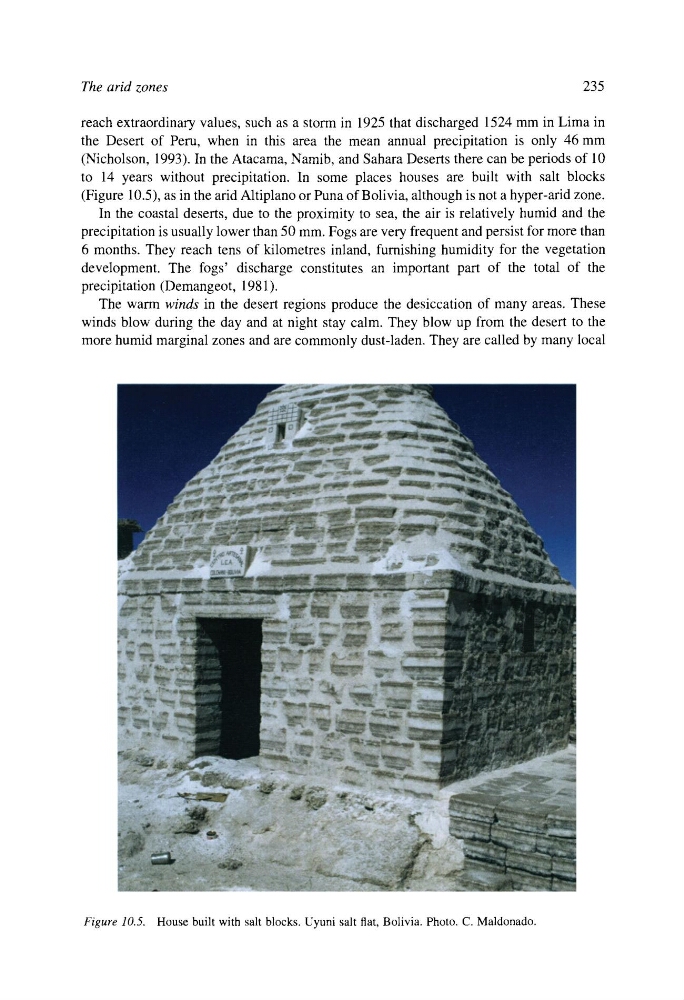
to 14 years without precipitation. In some places houses are built with salt blocks
(Figure 10.5), as in the arid Altiplano or Puna of Bolivia, although is not a hyper-arid zone.
In the coastal deserts, due to the proximity to sea, the air is relatively humid and the
precipitation is usually lower than 50 mm. Fogs are very frequent and persist for more than
6 months. They reach tens of kilometres inland, furnishing humidity for the vegetation
development. The fogs' discharge constitutes an important part of the total of the
precipitation (Demangeot, 1981).
The warm winds in the desert regions produce the desiccation of many areas. These
winds blow during the day and at night stay calm. They blow up from the desert to the
more humid marginal zones and are commonly dust-laden. They are called by many local
Figure 10.5. House built with salt blocks. Uyuni salt flat, Bolivia. Photo. C. Maldonado.
235
reach extraordinary values, such as a storm in 1925 that discharged 1524 mm in Lima in
the Desert of Peru, when in this area the mean annual precipitation is only 46 mm
(Nicholson, 1993). In the Atacama, Namib, and Sahara Deserts there can be periods of 10
to 14 years without precipitation. In some places houses are built with salt blocks
(Figure 10.5), as in the arid Altiplano or Puna of Bolivia, although is not a hyper-arid zone.
In the coastal deserts, due to the proximity to sea, the air is relatively humid and the
precipitation is usually lower than 50 mm. Fogs are very frequent and persist for more than
6 months. They reach tens of kilometres inland, furnishing humidity for the vegetation
development. The fogs' discharge constitutes an important part of the total of the
precipitation (Demangeot, 1981).
The warm winds in the desert regions produce the desiccation of many areas. These
winds blow during the day and at night stay calm. They blow up from the desert to the
more humid marginal zones and are commonly dust-laden. They are called by many local
Figure 10.5. House built with salt blocks. Uyuni salt flat, Bolivia. Photo. C. Maldonado.