

The arid zones
233
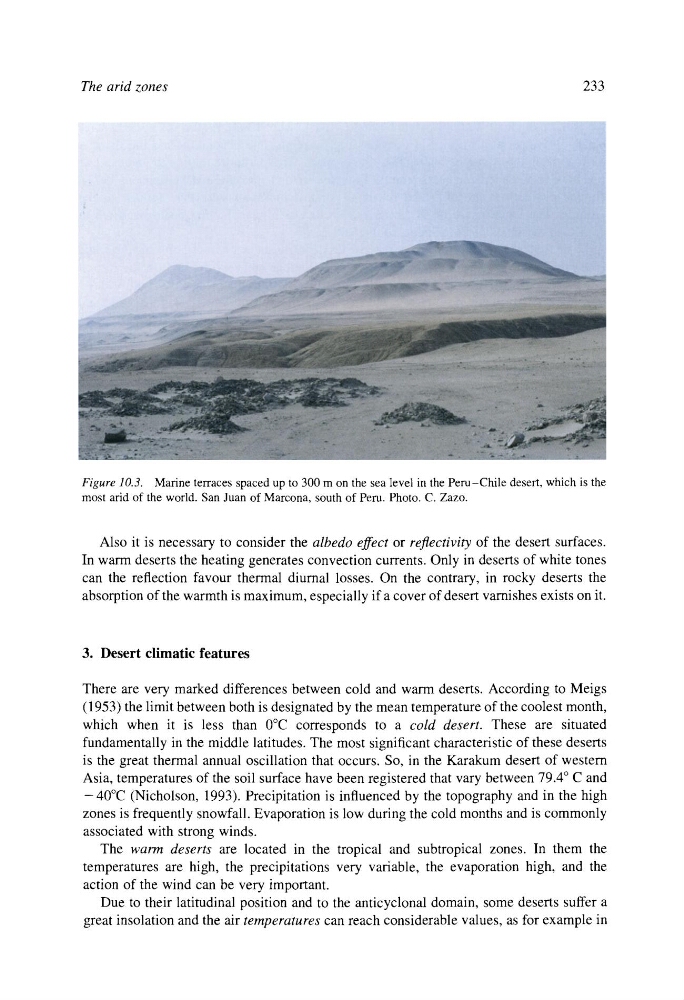
Figure 10.3. Marine terraces spaced up to 300 m on the sea level in the Peru-Chile desert, which is the
most arid of the world. San Juan of Marcona, south of Peru. Photo. C. Zazo.
Also it is necessary to consider the albedo effect or reflectivity of the desert surfaces.
In warm deserts the heating generates convection currents. Only in deserts of white tones
can the reflection favour thermal diurnal losses. On the contrary, in rocky deserts the
absorption of the warmth is maximum, especially if a cover of desert varnishes exists on it.
3. Desert climatic features
There are very marked differences between cold and warm deserts. According to Meigs
(1953) the limit between both is designated by the mean temperature of the coolest month,
which when it is less than 0~ corresponds to a cold desert. These are situated
fundamentally in the middle latitudes. The most significant characteristic of these deserts
is the great thermal annual oscillation that occurs. So, in the Karakum desert of western
Asia, temperatures of the soil surface have been registered that vary between 79.4 ~ C and
-40~ (Nicholson, 1993). Precipitation is influenced by the topography and in the high
zones is frequently snowfall. Evaporation is low during the cold months and is commonly
associated with strong winds.
The warm deserts are located in the tropical and subtropical zones. In them the
temperatures are high, the precipitations very variable, the evaporation high, and the
action of the wind can be very important.
Due to their latitudinal position and to the anticyclonal domain, some deserts suffer a
great insolation and the air temperatures can reach considerable values, as for example in
233
Figure 10.3. Marine terraces spaced up to 300 m on the sea level in the Peru-Chile desert, which is the
most arid of the world. San Juan of Marcona, south of Peru. Photo. C. Zazo.
Also it is necessary to consider the albedo effect or reflectivity of the desert surfaces.
In warm deserts the heating generates convection currents. Only in deserts of white tones
can the reflection favour thermal diurnal losses. On the contrary, in rocky deserts the
absorption of the warmth is maximum, especially if a cover of desert varnishes exists on it.
3. Desert climatic features
There are very marked differences between cold and warm deserts. According to Meigs
(1953) the limit between both is designated by the mean temperature of the coolest month,
which when it is less than 0~ corresponds to a cold desert. These are situated
fundamentally in the middle latitudes. The most significant characteristic of these deserts
is the great thermal annual oscillation that occurs. So, in the Karakum desert of western
Asia, temperatures of the soil surface have been registered that vary between 79.4 ~ C and
-40~ (Nicholson, 1993). Precipitation is influenced by the topography and in the high
zones is frequently snowfall. Evaporation is low during the cold months and is commonly
associated with strong winds.
The warm deserts are located in the tropical and subtropical zones. In them the
temperatures are high, the precipitations very variable, the evaporation high, and the
action of the wind can be very important.
Due to their latitudinal position and to the anticyclonal domain, some deserts suffer a
great insolation and the air temperatures can reach considerable values, as for example in