

232
Climatic Geomorphology
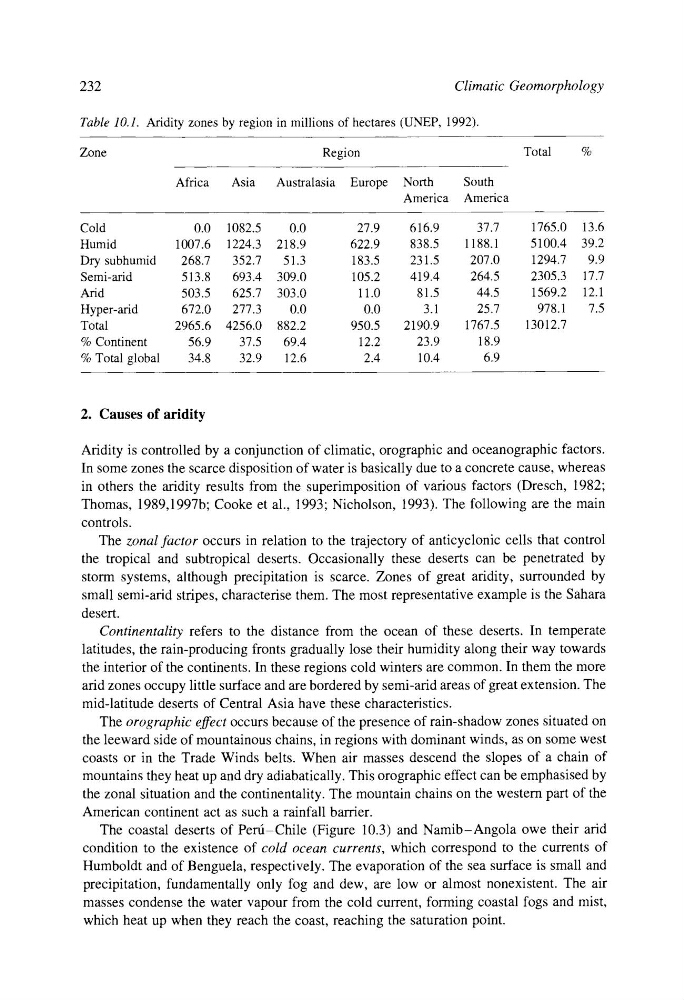
Table 10.1. Aridity zones by region in millions of hectares (UNEP, 1992).
Zone
Region
Total
Africa
Asia
Australasia Europe North
South
America America
%
Cold
0.0 1082.5
0.0
27.9
616.9
37.7
1765.0
Humid
1007.6 1224.3 218.9
622.9
838.5
1188.1
5100.4
Dry subhumid
268.7 352.7 51.3
183.5
231.5
207.0
1294.7
Semi-arid
513.8 693.4 309.0
105.2
419.4
264.5
2305.3
Arid
503.5 625.7 303.0
11.0
81.5
44.5
1569.2
Hyper-arid
672.0
277.3
0.0
0.0
3.1
25.7
978.1
Total
2965.6 4256.0 882.2
950.5
2190.9
1767.5 13012.7
% Continent
56.9
37.5
69.4
12.2
23.9
18.9
% Total global
34.8
32.9
12.6
2.4
10.4
6.9
13.6
39.2
9.9
17.7
12.1
7.5
2. Causes of aridity
Aridity is controlled by a conjunction of climatic, orographic and oceanographic factors.
In some zones the scarce disposition of water is basically due to a concrete cause, whereas
in others the aridity results from the superimposition of various factors (Dresch, 1982;
Thomas, 1989,1997b; Cooke et al., 1993; Nicholson, 1993). The following are the main
controls.
The zonal factor occurs in relation to the trajectory of anticyclonic cells that control
the tropical and subtropical deserts. Occasionally these deserts can be penetrated by
storm systems, although precipitation is scarce. Zones of great aridity, surrounded by
small semi-arid stripes, characterise them. The most representative example is the Sahara
desert.
Continentality refers to the distance from the ocean of these deserts. In temperate
latitudes, the rain-producing fronts gradually lose their humidity along their way towards
the interior of the continents. In these regions cold winters are common. In them the more
arid zones occupy little surface and are bordered by semi-arid areas of great extension. The
mid-latitude deserts of Central Asia have these characteristics.
The orographic effect occurs because of the presence of rain-shadow zones situated on
the leeward side of mountainous chains, in regions with dominant winds, as on some west
coasts or in the Trade Winds belts. When air masses descend the slopes of a chain of
mountains they heat up and dry adiabatically. This orographic effect can be emphasised by
the zonal situation and the continentality. The mountain chains on the western part of the
American continent act as such a rainfall barrier.
The coastal deserts of Perf-Chile (Figure 10.3) and Namib-Angola owe their arid
condition to the existence of cold ocean currents, which correspond to the currents of
Humboldt and of Benguela, respectively. The evaporation of the sea surface is small and
precipitation, fundamentally only fog and dew, are low or almost nonexistent. The air
masses condense the water vapour from the cold current, forming coastal fogs and mist,
which heat up when they reach the coast, reaching the saturation point.
Climatic Geomorphology
Table 10.1. Aridity zones by region in millions of hectares (UNEP, 1992).
Zone
Region
Total
Africa
Asia
Australasia Europe North
South
America America
%
Cold
0.0 1082.5
0.0
27.9
616.9
37.7
1765.0
Humid
1007.6 1224.3 218.9
622.9
838.5
1188.1
5100.4
Dry subhumid
268.7 352.7 51.3
183.5
231.5
207.0
1294.7
Semi-arid
513.8 693.4 309.0
105.2
419.4
264.5
2305.3
Arid
503.5 625.7 303.0
11.0
81.5
44.5
1569.2
Hyper-arid
672.0
277.3
0.0
0.0
3.1
25.7
978.1
Total
2965.6 4256.0 882.2
950.5
2190.9
1767.5 13012.7
% Continent
56.9
37.5
69.4
12.2
23.9
18.9
% Total global
34.8
32.9
12.6
2.4
10.4
6.9
13.6
39.2
9.9
17.7
12.1
7.5
2. Causes of aridity
Aridity is controlled by a conjunction of climatic, orographic and oceanographic factors.
In some zones the scarce disposition of water is basically due to a concrete cause, whereas
in others the aridity results from the superimposition of various factors (Dresch, 1982;
Thomas, 1989,1997b; Cooke et al., 1993; Nicholson, 1993). The following are the main
controls.
The zonal factor occurs in relation to the trajectory of anticyclonic cells that control
the tropical and subtropical deserts. Occasionally these deserts can be penetrated by
storm systems, although precipitation is scarce. Zones of great aridity, surrounded by
small semi-arid stripes, characterise them. The most representative example is the Sahara
desert.
Continentality refers to the distance from the ocean of these deserts. In temperate
latitudes, the rain-producing fronts gradually lose their humidity along their way towards
the interior of the continents. In these regions cold winters are common. In them the more
arid zones occupy little surface and are bordered by semi-arid areas of great extension. The
mid-latitude deserts of Central Asia have these characteristics.
The orographic effect occurs because of the presence of rain-shadow zones situated on
the leeward side of mountainous chains, in regions with dominant winds, as on some west
coasts or in the Trade Winds belts. When air masses descend the slopes of a chain of
mountains they heat up and dry adiabatically. This orographic effect can be emphasised by
the zonal situation and the continentality. The mountain chains on the western part of the
American continent act as such a rainfall barrier.
The coastal deserts of Perf-Chile (Figure 10.3) and Namib-Angola owe their arid
condition to the existence of cold ocean currents, which correspond to the currents of
Humboldt and of Benguela, respectively. The evaporation of the sea surface is small and
precipitation, fundamentally only fog and dew, are low or almost nonexistent. The air
masses condense the water vapour from the cold current, forming coastal fogs and mist,
which heat up when they reach the coast, reaching the saturation point.