

The arid zones
231
of the United Nations. Both are based on the degree of bioclimatic aridity that is defined
for the relationship between precipitation and potential evapotranspiration. They
distinguish four types of aridity: hyper-arid (P/ET < 0.05), arid (0.05 -< P/ET < 0.20),
semi-arid (0.20 -< P/ET < 0.50) and, finally, dry sub-humid between (0.50 -< P/ET <
0.65). Grove (1977) performed a simple differentiation, keeping precipitation exclusively
in mind, and distinguished semi-arid (200 to 500 mm), arid (25 to 200 mm) and hyper-arid
zones, in which a seasonal distribution of precipitation doesn't exist and where there are
periods over 12 months without measurable rain.
The area occupied by all the arid zones of the world varied according to the function of
the climatic classification utilised. According to the World Atlas of Desertification (1992)
and Middleton and Thomas (1997) 37.3% of the earth is occupied by arid zones,
corresponding to 17.7% for the semi-arid regions, 12.1% for the arid areas, and 7.5% for
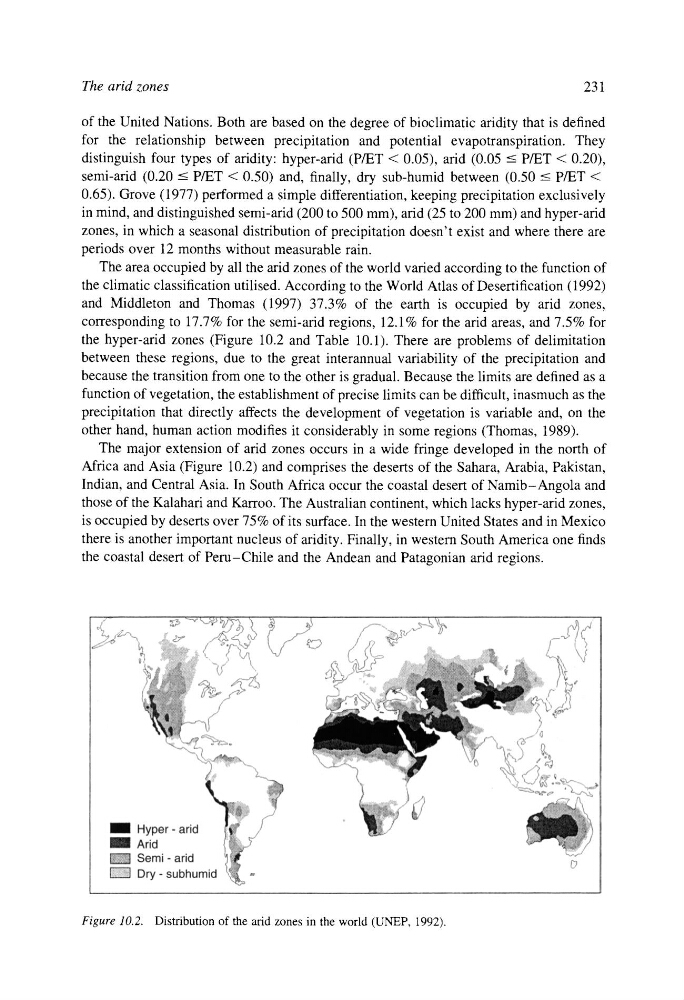
the hyper-arid zones (Figure 10.2 and Table 10.1). There are problems of delimitation
between these regions, due to the great interannual variability of the precipitation and
because the transition from one to the other is gradual. Because the limits are defined as a
function of vegetation, the establishment of precise limits can be difficult, inasmuch as the
precipitation that directly affects the development of vegetation is variable and, on the
other hand, human action modifies it considerably in some regions (Thomas, 1989).
The major extension of arid zones occurs in a wide fringe developed in the north of
Africa and Asia (Figure 10.2) and comprises the deserts of the Sahara, Arabia, Pakistan,
Indian, and Central Asia. In South Africa occur the coastal desert of Namib-Angola and
those of the Kalahari and Karroo. The Australian continent, which lacks hyper-arid zones,
is occupied by deserts over 75% of its surface. In the western United States and in Mexico
there is another important nucleus of aridity. Finally, in western South America one finds
the coastal desert of Peru-Chile and the Andean and Patagonian arid regions.
Figure 10.2. Distribution of the arid zones in the world (UNEP, 1992).
231
of the United Nations. Both are based on the degree of bioclimatic aridity that is defined
for the relationship between precipitation and potential evapotranspiration. They
distinguish four types of aridity: hyper-arid (P/ET < 0.05), arid (0.05 -< P/ET < 0.20),
semi-arid (0.20 -< P/ET < 0.50) and, finally, dry sub-humid between (0.50 -< P/ET <
0.65). Grove (1977) performed a simple differentiation, keeping precipitation exclusively
in mind, and distinguished semi-arid (200 to 500 mm), arid (25 to 200 mm) and hyper-arid
zones, in which a seasonal distribution of precipitation doesn't exist and where there are
periods over 12 months without measurable rain.
The area occupied by all the arid zones of the world varied according to the function of
the climatic classification utilised. According to the World Atlas of Desertification (1992)
and Middleton and Thomas (1997) 37.3% of the earth is occupied by arid zones,
corresponding to 17.7% for the semi-arid regions, 12.1% for the arid areas, and 7.5% for
the hyper-arid zones (Figure 10.2 and Table 10.1). There are problems of delimitation
between these regions, due to the great interannual variability of the precipitation and
because the transition from one to the other is gradual. Because the limits are defined as a
function of vegetation, the establishment of precise limits can be difficult, inasmuch as the
precipitation that directly affects the development of vegetation is variable and, on the
other hand, human action modifies it considerably in some regions (Thomas, 1989).
The major extension of arid zones occurs in a wide fringe developed in the north of
Africa and Asia (Figure 10.2) and comprises the deserts of the Sahara, Arabia, Pakistan,
Indian, and Central Asia. In South Africa occur the coastal desert of Namib-Angola and
those of the Kalahari and Karroo. The Australian continent, which lacks hyper-arid zones,
is occupied by deserts over 75% of its surface. In the western United States and in Mexico
there is another important nucleus of aridity. Finally, in western South America one finds
the coastal desert of Peru-Chile and the Andean and Patagonian arid regions.
Figure 10.2. Distribution of the arid zones in the world (UNEP, 1992).