

196
Climatic Geomorphology
than the fines that form part of the solifluction lobes. Equifinality can be the cause of many
difficulties in such interpretations (Steijn et al., 2002). Grazes lit6es are abundant in the
central Pyrenees, especially above heights of 600 to 800 m. It is thought that they have
formed during more than one phase although the main period corresponds to the
Late-Glacial (Pefia et al., 1998).
3.7. Nivation landforms
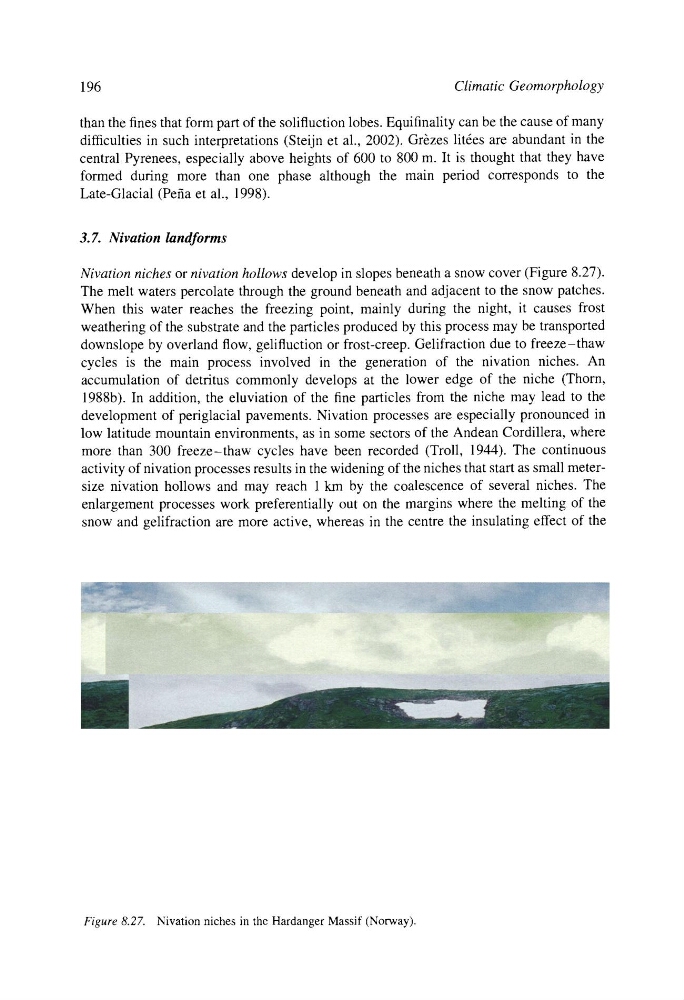
Nivation niches or nivation hollows develop in slopes beneath a snow cover (Figure 8.27).
The melt waters percolate through the ground beneath and adjacent to the snow patches.
When this water reaches the freezing point, mainly during the night, it causes frost
weathering of the substrate and the particles produced by this process may be transported
downslope by overland flow, gelifluction or frost-creep. Gelifraction due to freeze-thaw
cycles is the main process involved in the generation of the nivation niches. An
accumulation of detritus commonly develops at the lower edge of the niche (Thorn,
1988b). In addition, the eluviation of the fine particles from the niche may lead to the
development of periglacial pavements. Nivation processes are especially pronounced in
low latitude mountain environments, as in some sectors of the Andean Cordillera, where
more than 300 freeze-thaw cycles have been recorded (Troll, 1944). The continuous
activity of nivation processes results in the widening of the niches that start as small metersize nivation hollows and may reach 1 km by the coalescence of several niches. The
enlargement processes work preferentially out on the margins where the melting of the
snow and gelifraction are more active, whereas in the centre the insulating effect of the
Figure 8.27. Nivation niches in the Hardanger Massif (Norway).
Climatic Geomorphology
than the fines that form part of the solifluction lobes. Equifinality can be the cause of many
difficulties in such interpretations (Steijn et al., 2002). Grazes lit6es are abundant in the
central Pyrenees, especially above heights of 600 to 800 m. It is thought that they have
formed during more than one phase although the main period corresponds to the
Late-Glacial (Pefia et al., 1998).
3.7. Nivation landforms
Nivation niches or nivation hollows develop in slopes beneath a snow cover (Figure 8.27).
The melt waters percolate through the ground beneath and adjacent to the snow patches.
When this water reaches the freezing point, mainly during the night, it causes frost
weathering of the substrate and the particles produced by this process may be transported
downslope by overland flow, gelifluction or frost-creep. Gelifraction due to freeze-thaw
cycles is the main process involved in the generation of the nivation niches. An
accumulation of detritus commonly develops at the lower edge of the niche (Thorn,
1988b). In addition, the eluviation of the fine particles from the niche may lead to the
development of periglacial pavements. Nivation processes are especially pronounced in
low latitude mountain environments, as in some sectors of the Andean Cordillera, where
more than 300 freeze-thaw cycles have been recorded (Troll, 1944). The continuous
activity of nivation processes results in the widening of the niches that start as small metersize nivation hollows and may reach 1 km by the coalescence of several niches. The
enlargement processes work preferentially out on the margins where the melting of the
snow and gelifraction are more active, whereas in the centre the insulating effect of the
Figure 8.27. Nivation niches in the Hardanger Massif (Norway).