

Periglacial landforms
197
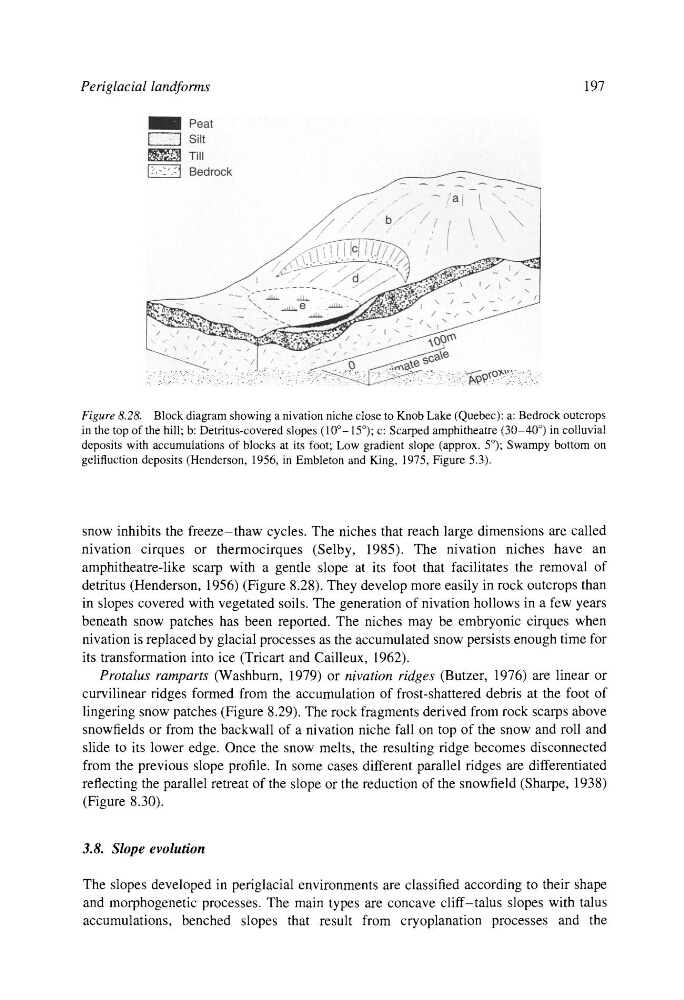
Figure 8.28. Block diagram showing a nivation niche close to Knob Lake (Quebec): a: Bedrock outcrops
in the top of the hill; b: Detritus-covered slopes (10 ~ 15~ c: Scarped amphitheatre (30-40 ~ in colluvial
deposits with accumulations of blocks at its foot; Low gradient slope (approx. 5~ Swampy bottom on
gelifluction deposits (Henderson, 1956, in Embleton and King, 1975, Figure 5.3).
snow inhibits the freeze-thaw cycles. The niches that reach large dimensions are called
nivation cirques or thermocirques (Selby, 1985). The nivation niches have an
amphitheatre-like scarp with a gentle slope at its foot that facilitates the removal of
detritus (Henderson, 1956) (Figure 8.28). They develop more easily in rock outcrops than
in slopes covered with vegetated soils. The generation of nivation hollows in a few years
beneath snow patches has been reported. The niches may be embryonic cirques when
nivation is replaced by glacial processes as the accumulated snow persists enough time for
its transformation into ice (Tricart and Cailleux, 1962).
Protalus ramparts (Washburn, 1979) or nivation ridges (Butzer, 1976) are linear or
curvilinear ridges formed from the accumulation of frost-shattered debris at the foot of
lingering snow patches (Figure 8.29). The rock fragments derived from rock scarps above
snowfields or from the backwall of a nivation niche fall on top of the snow and roll and
slide to its lower edge. Once the snow melts, the resulting ridge becomes disconnected
from the previous slope profile. In some cases different parallel ridges are differentiated
reflecting the parallel retreat of the slope or the reduction of the snowfield (Sharpe, 1938)
(Figure 8.30).
3.8. Slope evolution
The slopes developed in periglacial environments are classified according to their shape
and morphogenetic processes. The main types are concave cliff-talus slopes with talus
accumulations, benched slopes that result from cryoplanation processes and the
197
Figure 8.28. Block diagram showing a nivation niche close to Knob Lake (Quebec): a: Bedrock outcrops
in the top of the hill; b: Detritus-covered slopes (10 ~ 15~ c: Scarped amphitheatre (30-40 ~ in colluvial
deposits with accumulations of blocks at its foot; Low gradient slope (approx. 5~ Swampy bottom on
gelifluction deposits (Henderson, 1956, in Embleton and King, 1975, Figure 5.3).
snow inhibits the freeze-thaw cycles. The niches that reach large dimensions are called
nivation cirques or thermocirques (Selby, 1985). The nivation niches have an
amphitheatre-like scarp with a gentle slope at its foot that facilitates the removal of
detritus (Henderson, 1956) (Figure 8.28). They develop more easily in rock outcrops than
in slopes covered with vegetated soils. The generation of nivation hollows in a few years
beneath snow patches has been reported. The niches may be embryonic cirques when
nivation is replaced by glacial processes as the accumulated snow persists enough time for
its transformation into ice (Tricart and Cailleux, 1962).
Protalus ramparts (Washburn, 1979) or nivation ridges (Butzer, 1976) are linear or
curvilinear ridges formed from the accumulation of frost-shattered debris at the foot of
lingering snow patches (Figure 8.29). The rock fragments derived from rock scarps above
snowfields or from the backwall of a nivation niche fall on top of the snow and roll and
slide to its lower edge. Once the snow melts, the resulting ridge becomes disconnected
from the previous slope profile. In some cases different parallel ridges are differentiated
reflecting the parallel retreat of the slope or the reduction of the snowfield (Sharpe, 1938)
(Figure 8.30).
3.8. Slope evolution
The slopes developed in periglacial environments are classified according to their shape
and morphogenetic processes. The main types are concave cliff-talus slopes with talus
accumulations, benched slopes that result from cryoplanation processes and the