

Periglacial landforms
195
scarce or nonexistent vegetation cover (DeWolf, 1988). The stratification and sorting were
considered to be related to the action of melt waters from snow accumulations, responsible
for the sedimentation of the coarse material and the eluviation of the finer particles
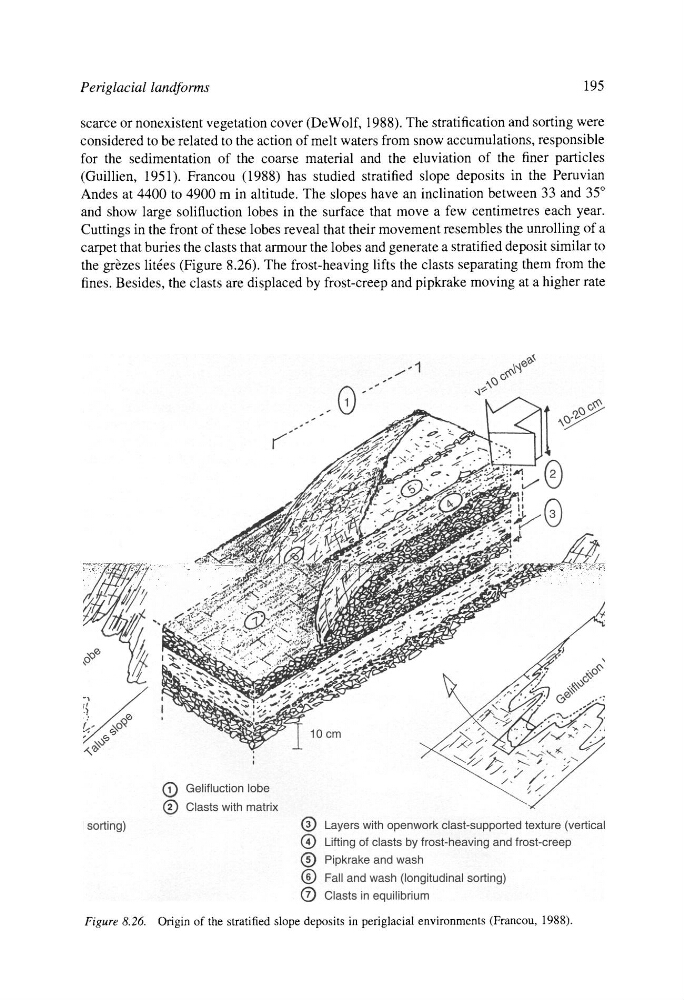
(Guillien, 1951). Francou (1988) has studied stratified slope deposits in the Peruvian
Andes at 4400 to 4900 m in altitude. The slopes have an inclination between 33 and 35 ~
and show large solifluction lobes in the surface that move a few centimetres each year.
Cuttings in the front of these lobes reveal that their movement resembles the unrolling of a
carpet that buries the clasts that armour the lobes and generate a stratified deposit similar to
the gr6zes lit6es (Figure 8.26). The frost-heaving lifts the clasts separating them from the
fines. Besides, the clasts are displaced by frost-creep and pipkrake moving at a higher rate
Figure 8.26. Origin of the stratified slope deposits in periglacial environments (Francou, 1988).
195
scarce or nonexistent vegetation cover (DeWolf, 1988). The stratification and sorting were
considered to be related to the action of melt waters from snow accumulations, responsible
for the sedimentation of the coarse material and the eluviation of the finer particles
(Guillien, 1951). Francou (1988) has studied stratified slope deposits in the Peruvian
Andes at 4400 to 4900 m in altitude. The slopes have an inclination between 33 and 35 ~
and show large solifluction lobes in the surface that move a few centimetres each year.
Cuttings in the front of these lobes reveal that their movement resembles the unrolling of a
carpet that buries the clasts that armour the lobes and generate a stratified deposit similar to
the gr6zes lit6es (Figure 8.26). The frost-heaving lifts the clasts separating them from the
fines. Besides, the clasts are displaced by frost-creep and pipkrake moving at a higher rate
Figure 8.26. Origin of the stratified slope deposits in periglacial environments (Francou, 1988).