

Periglacial landforms
187
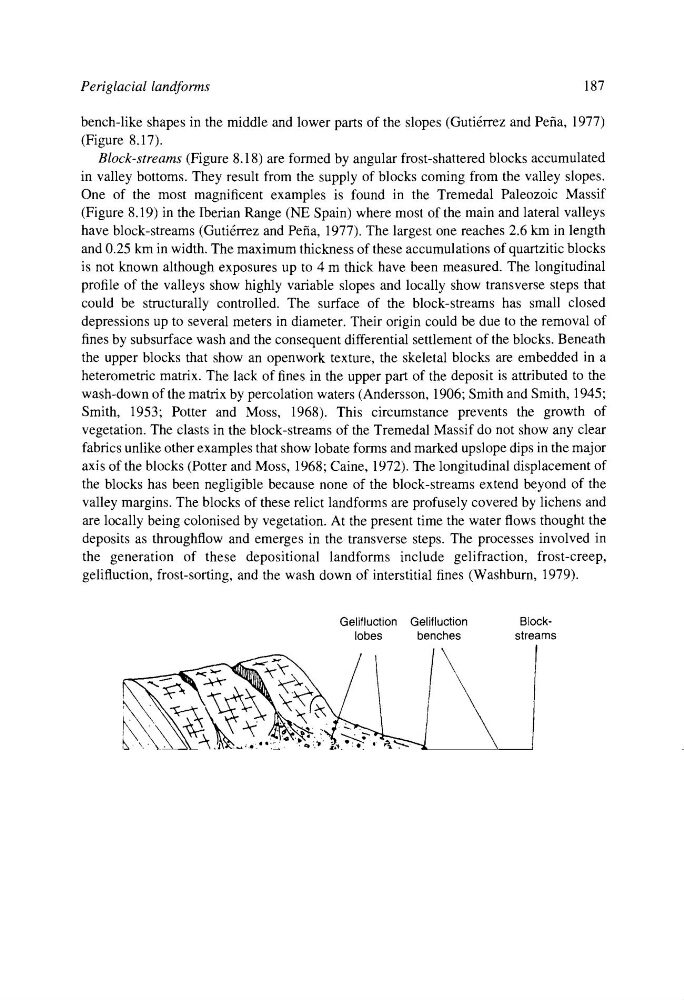
bench-like shapes in the middle and lower parts of the slopes (Gutirrrez and Pefia, 1977)
(Figure 8.17).
Block-streams (Figure 8.18) are formed by angular frost-shattered blocks accumulated
in valley bottoms. They result from the supply of blocks coming from the valley slopes.
One of the most magnificent examples is found in the Tremedal Paleozoic Massif
(Figure 8.19) in the Iberian Range (NE Spain) where most of the main and lateral valleys
have block-streams (Gutirrrez and Pefia, 1977). The largest one reaches 2.6 km in length
and 0.25 km in width. The maximum thickness of these accumulations of quartzitic blocks
is not known although exposures up to 4 m thick have been measured. The longitudinal
profile of the valleys show highly variable slopes and locally show transverse steps that
could be structurally controlled. The surface of the block-streams has small closed
depressions up to several meters in diameter. Their origin could be due to the removal of
fines by subsurface wash and the consequent differential settlement of the blocks. Beneath
the upper blocks that show an openwork texture, the skeletal blocks are embedded in a
heterometric matrix. The lack of fines in the upper part of the deposit is attributed to the
wash-down of the matrix by percolation waters (Andersson, 1906; Smith and Smith, 1945;
Smith, 1953; Potter and Moss, 1968). This circumstance prevents the growth of
vegetation. The clasts in the block-streams of the Tremedal Massif do not show any clear
fabrics unlike other examples that show lobate forms and marked upslope dips in the major
axis of the blocks (Potter and Moss, 1968; Caine, 1972). The longitudinal displacement of
the blocks has been negligible because none of the block-streams extend beyond of the
valley margins. The blocks of these relict landforms are profusely covered by lichens and
are locally being colonised by vegetation. At the present time the water flows thought the
deposits as throughflow and emerges in the transverse steps. The processes involved in
the generation of these depositional landforms include gelifraction, frost-creep,
gelifluction, frost-sorting, and the wash down of interstitial fines (Washburn, 1979).
Gelifluction Gelifluction
Blocklobes
benches
streams
i
~
9 ,
9 q
,
.
..
:
"' ,':'o.~
,"
,":'--~.~,"
~.'"
.
1
2
Figure 8.17. Block diagram showing depositional periglacial landforms in the slopes and valley bottoms
of the Tremedal Paleozoic Massif, Iberian Range, Teruel Province, NE Spain. 1: Lower Valentian
quartzites. 2: Valentian ampellitic shales (Gutirrrez and Pefia, 1977).
187
bench-like shapes in the middle and lower parts of the slopes (Gutirrrez and Pefia, 1977)
(Figure 8.17).
Block-streams (Figure 8.18) are formed by angular frost-shattered blocks accumulated
in valley bottoms. They result from the supply of blocks coming from the valley slopes.
One of the most magnificent examples is found in the Tremedal Paleozoic Massif
(Figure 8.19) in the Iberian Range (NE Spain) where most of the main and lateral valleys
have block-streams (Gutirrrez and Pefia, 1977). The largest one reaches 2.6 km in length
and 0.25 km in width. The maximum thickness of these accumulations of quartzitic blocks
is not known although exposures up to 4 m thick have been measured. The longitudinal
profile of the valleys show highly variable slopes and locally show transverse steps that
could be structurally controlled. The surface of the block-streams has small closed
depressions up to several meters in diameter. Their origin could be due to the removal of
fines by subsurface wash and the consequent differential settlement of the blocks. Beneath
the upper blocks that show an openwork texture, the skeletal blocks are embedded in a
heterometric matrix. The lack of fines in the upper part of the deposit is attributed to the
wash-down of the matrix by percolation waters (Andersson, 1906; Smith and Smith, 1945;
Smith, 1953; Potter and Moss, 1968). This circumstance prevents the growth of
vegetation. The clasts in the block-streams of the Tremedal Massif do not show any clear
fabrics unlike other examples that show lobate forms and marked upslope dips in the major
axis of the blocks (Potter and Moss, 1968; Caine, 1972). The longitudinal displacement of
the blocks has been negligible because none of the block-streams extend beyond of the
valley margins. The blocks of these relict landforms are profusely covered by lichens and
are locally being colonised by vegetation. At the present time the water flows thought the
deposits as throughflow and emerges in the transverse steps. The processes involved in
the generation of these depositional landforms include gelifraction, frost-creep,
gelifluction, frost-sorting, and the wash down of interstitial fines (Washburn, 1979).
Gelifluction Gelifluction
Blocklobes
benches
streams
i
~
9 ,
9 q
,
.
..
:
"' ,':'o.~
,"
,":'--~.~,"
~.'"
.
1
2
Figure 8.17. Block diagram showing depositional periglacial landforms in the slopes and valley bottoms
of the Tremedal Paleozoic Massif, Iberian Range, Teruel Province, NE Spain. 1: Lower Valentian
quartzites. 2: Valentian ampellitic shales (Gutirrrez and Pefia, 1977).