

188
Climatic Geomorphology
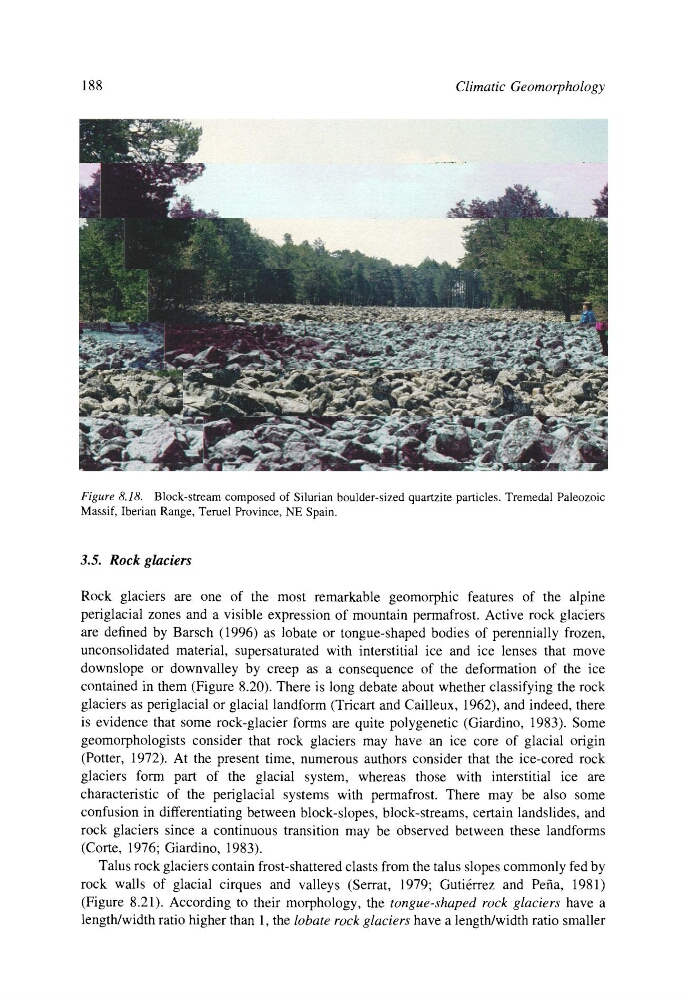
Figure 8.18. Block-stream composed of Silurian boulder-sized quartzite particles. Tremedal Paleozoic
Massif, Iberian Range, Teruel Province, NE Spain.
3.5. Rock glaciers
Rock glaciers are one of the most remarkable geomorphic features of the alpine
periglacial zones and a visible expression of mountain permafrost. Active rock glaciers
are defined by Barsch (1996) as lobate or tongue-shaped bodies of perennially frozen,
unconsolidated material, supersaturated with interstitial ice and ice lenses that move
downslope or downvalley by creep as a consequence of the deformation of the ice
contained in them (Figure 8.20). There is long debate about whether classifying the rock
glaciers as periglacial or glacial landform (Tricart and Cailleux, 1962), and indeed, there
is evidence that some rock-glacier forms are quite polygenetic (Giardino, 1983). Some
geomorphologists consider that rock glaciers may have an ice core of glacial origin
(Potter, 1972). At the present time, numerous authors consider that the ice-cored rock
glaciers form part of the glacial system, whereas those with interstitial ice are
characteristic of the periglacial systems with permafrost. There may be also some
confusion in differentiating between block-slopes, block-streams, certain landslides, and
rock glaciers since a continuous transition may be observed between these landforms
(Corte, 1976; Giardino, 1983).
Talus rock glaciers contain frost-shattered clasts from the talus slopes commonly fed by
rock walls of glacial cirques and valleys (Serrat, 1979; Guti6rrez and Pefia, 1981)
(Figure 8.21). According to their morphology, the tongue-shaped rock glaciers have a
length/width ratio higher than 1, the lobate rock glaciers have a length/width ratio smaller
Climatic Geomorphology
Figure 8.18. Block-stream composed of Silurian boulder-sized quartzite particles. Tremedal Paleozoic
Massif, Iberian Range, Teruel Province, NE Spain.
3.5. Rock glaciers
Rock glaciers are one of the most remarkable geomorphic features of the alpine
periglacial zones and a visible expression of mountain permafrost. Active rock glaciers
are defined by Barsch (1996) as lobate or tongue-shaped bodies of perennially frozen,
unconsolidated material, supersaturated with interstitial ice and ice lenses that move
downslope or downvalley by creep as a consequence of the deformation of the ice
contained in them (Figure 8.20). There is long debate about whether classifying the rock
glaciers as periglacial or glacial landform (Tricart and Cailleux, 1962), and indeed, there
is evidence that some rock-glacier forms are quite polygenetic (Giardino, 1983). Some
geomorphologists consider that rock glaciers may have an ice core of glacial origin
(Potter, 1972). At the present time, numerous authors consider that the ice-cored rock
glaciers form part of the glacial system, whereas those with interstitial ice are
characteristic of the periglacial systems with permafrost. There may be also some
confusion in differentiating between block-slopes, block-streams, certain landslides, and
rock glaciers since a continuous transition may be observed between these landforms
(Corte, 1976; Giardino, 1983).
Talus rock glaciers contain frost-shattered clasts from the talus slopes commonly fed by
rock walls of glacial cirques and valleys (Serrat, 1979; Guti6rrez and Pefia, 1981)
(Figure 8.21). According to their morphology, the tongue-shaped rock glaciers have a
length/width ratio higher than 1, the lobate rock glaciers have a length/width ratio smaller