

186
Climatic Geomorphology
3.4. Block-fields, block-slopes and block-streams
These accumulations of large angular particles develop on or below outcrops of hard rocks
affected by systems of discontinuity planes with a dominantly decimetric and metric
spacing. In periglacial environments, the weathering processes acting on these materials,
mainly frost shattering caused by freeze-thaw cycles, give place to boulder-sized,
decimetric and metric clasts together with finer particles. These block accumulations may
have a finer interstitial matrix favouring the growth of vegetation. Where the matrix is
washed by interstitial water flows, the accumulation shows an openwork and clastsupported texture. Based on their topographic position, these accumulations are called
block-fields (felsenmeers), block-slopes or block-streams. The latter developed in valley
bottoms and incisions excavated in the slopes (Washburn, 1979). These accumulations are
usually found in high-latitude alpine zones.
Block-fields are extensive accumulations of angular blocks embedded in a fine-grained
matrix that cover more than half of the surface. They develop in flat or gently sloping
surfaces and reflect a strong frost-shattering activity. A limit of 5 ~ is established to
differentiate between block-fields and block-slopes (Smith, 1953; Dahl, 1966).
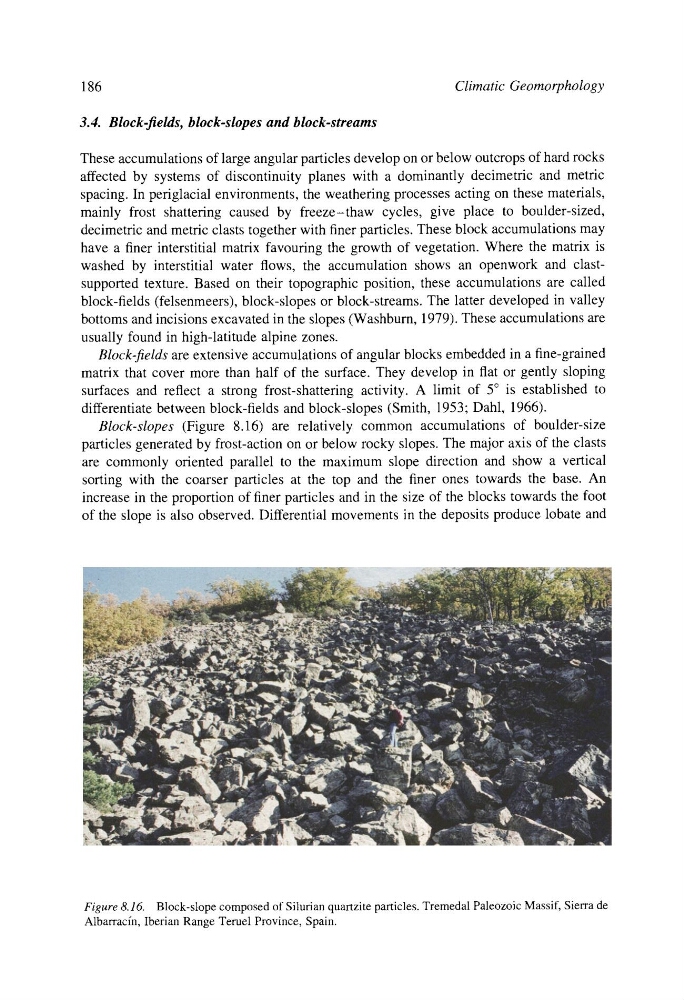
Block-slopes (Figure 8.16) are relatively common accumulations of boulder-size
particles generated by frost-action on or below rocky slopes. The major axis of the clasts
are commonly oriented parallel to the maximum slope direction and show a vertical
sorting with the coarser particles at the top and the finer ones towards the base. An
increase in the proportion of finer particles and in the size of the blocks towards the foot
of the slope is also observed. Differential movements in the deposits produce lobate and
Figure 8.16. Block-slope composed of Silurian quartzite particles. Tremedal Paleozoic Massif, Sierra de
Albarracfn, Iberian Range Teruel Province, Spain.
Climatic Geomorphology
3.4. Block-fields, block-slopes and block-streams
These accumulations of large angular particles develop on or below outcrops of hard rocks
affected by systems of discontinuity planes with a dominantly decimetric and metric
spacing. In periglacial environments, the weathering processes acting on these materials,
mainly frost shattering caused by freeze-thaw cycles, give place to boulder-sized,
decimetric and metric clasts together with finer particles. These block accumulations may
have a finer interstitial matrix favouring the growth of vegetation. Where the matrix is
washed by interstitial water flows, the accumulation shows an openwork and clastsupported texture. Based on their topographic position, these accumulations are called
block-fields (felsenmeers), block-slopes or block-streams. The latter developed in valley
bottoms and incisions excavated in the slopes (Washburn, 1979). These accumulations are
usually found in high-latitude alpine zones.
Block-fields are extensive accumulations of angular blocks embedded in a fine-grained
matrix that cover more than half of the surface. They develop in flat or gently sloping
surfaces and reflect a strong frost-shattering activity. A limit of 5 ~ is established to
differentiate between block-fields and block-slopes (Smith, 1953; Dahl, 1966).
Block-slopes (Figure 8.16) are relatively common accumulations of boulder-size
particles generated by frost-action on or below rocky slopes. The major axis of the clasts
are commonly oriented parallel to the maximum slope direction and show a vertical
sorting with the coarser particles at the top and the finer ones towards the base. An
increase in the proportion of finer particles and in the size of the blocks towards the foot
of the slope is also observed. Differential movements in the deposits produce lobate and
Figure 8.16. Block-slope composed of Silurian quartzite particles. Tremedal Paleozoic Massif, Sierra de
Albarracfn, Iberian Range Teruel Province, Spain.