

Periglacial landforms
185
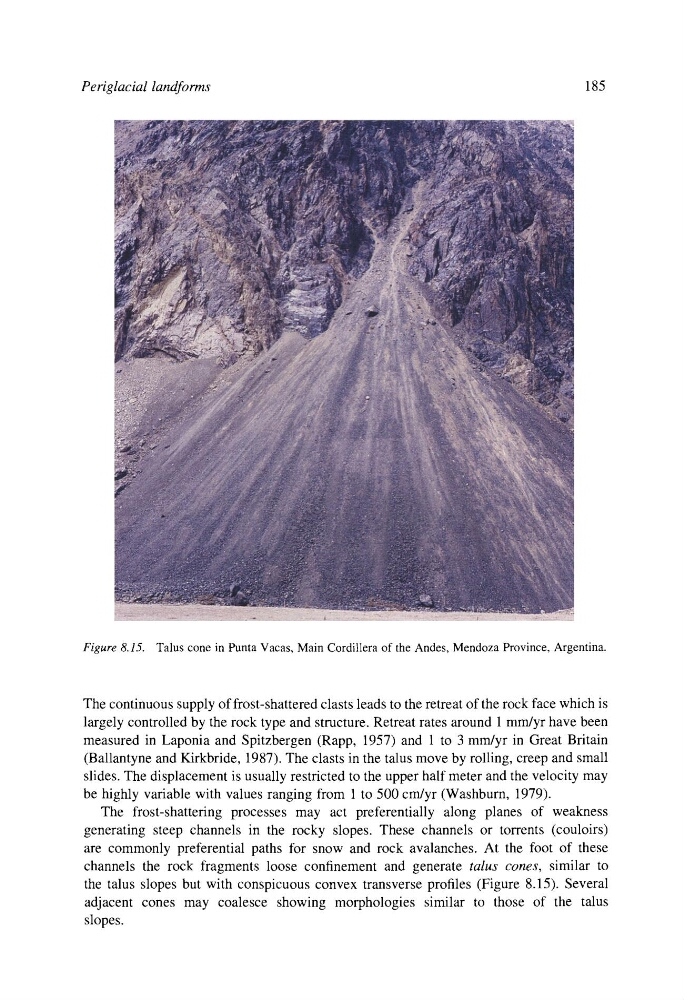
Figure 8.15. Talus cone in Punta Vacas, Main Cordillera of the Andes, Mendoza Province, Argentina.
The continuous supply of frost-shattered clasts leads to the retreat of the rock face which is
largely controlled by the rock type and structure. Retreat rates around 1 mm/yr have been
measured in Laponia and Spitzbergen (Rapp, 1957) and 1 to 3 mm/yr in Great Britain
(Ballantyne and Kirkbride, 1987). The clasts in the talus move by rolling, creep and small
slides. The displacement is usually restricted to the upper half meter and the velocity may
be highly variable with values ranging from 1 to 500 cm/yr (Washburn, 1979).
The frost-shattering processes may act preferentially along planes of weakness
generating steep channels in the rocky slopes. These channels or torrents (couloirs)
are commonly preferential paths for snow and rock avalanches. At the foot of these
channels the rock fragments loose confinement and generate talus cones, similar to
the talus slopes but with conspicuous convex transverse profiles (Figure 8.15). Several
adjacent cones may coalesce showing morphologies similar to those of the talus
slopes.
185
Figure 8.15. Talus cone in Punta Vacas, Main Cordillera of the Andes, Mendoza Province, Argentina.
The continuous supply of frost-shattered clasts leads to the retreat of the rock face which is
largely controlled by the rock type and structure. Retreat rates around 1 mm/yr have been
measured in Laponia and Spitzbergen (Rapp, 1957) and 1 to 3 mm/yr in Great Britain
(Ballantyne and Kirkbride, 1987). The clasts in the talus move by rolling, creep and small
slides. The displacement is usually restricted to the upper half meter and the velocity may
be highly variable with values ranging from 1 to 500 cm/yr (Washburn, 1979).
The frost-shattering processes may act preferentially along planes of weakness
generating steep channels in the rocky slopes. These channels or torrents (couloirs)
are commonly preferential paths for snow and rock avalanches. At the foot of these
channels the rock fragments loose confinement and generate talus cones, similar to
the talus slopes but with conspicuous convex transverse profiles (Figure 8.15). Several
adjacent cones may coalesce showing morphologies similar to those of the talus
slopes.