

The periglacial environment
157
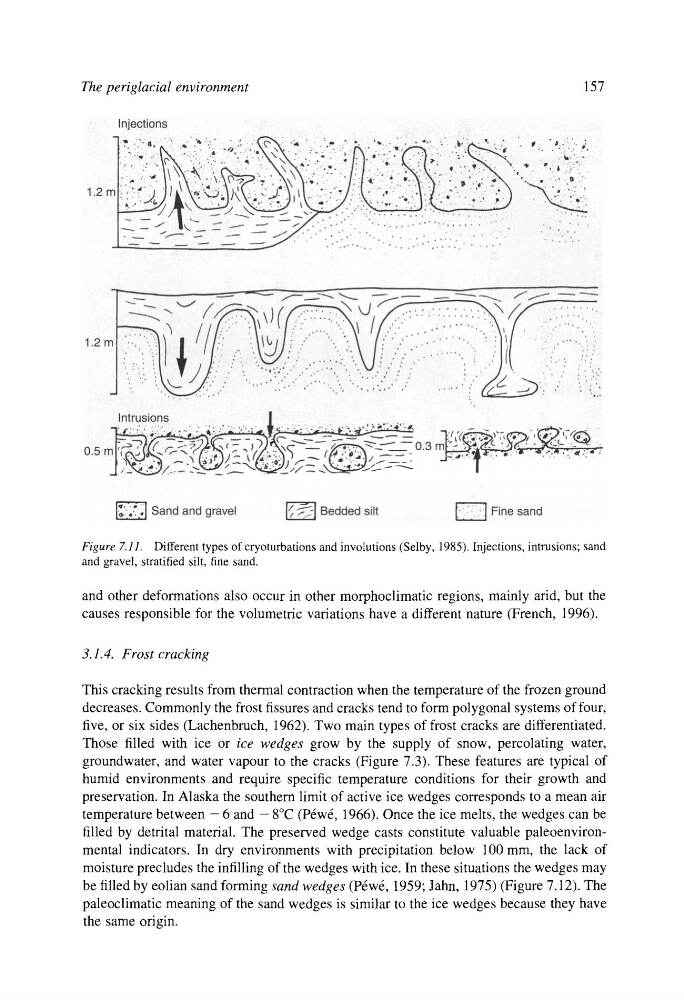
Figure 7.11. Different types of cryoturbations and involutions (Selby, 1985). Injections, intrusions; sand
and gravel, stratified silt, fine sand.
and other deformations also occur in other morphoclimatic regions, mainly arid, but the
causes responsible for the volumetric variations have a different nature (French, 1996).
3.1.4. Frost cracking
This cracking results from thermal contraction when the temperature of the frozen ground
decreases. Commonly the frost fissures and cracks tend to form polygonal systems of four,
five, or six sides (Lachenbruch, 1962). Two main types of frost cracks are differentiated.
Those filled with ice or ice wedges grow by the supply of snow, percolating water,
groundwater, and water vapour to the cracks (Figure 7.3). These features are typical of
humid environments and require specific temperature conditions for their growth and
preservation. In Alaska the southern limit of active ice wedges corresponds to a mean air
temperature between -6 and - 8~ (P~w~, 1966). Once the ice melts, the wedges can be
filled by detrital material. The preserved wedge casts constitute valuable paleoenvironmental indicators. In dry environments with precipitation below 100 mm, the lack of
moisture precludes the infilling of the wedges with ice. In these situations the wedges may
be filled by eolian sand forming sand wedges (P6w6, 1959; Jahn, 1975) (Figure 7.12). The
paleoclimatic meaning of the sand wedges is similar to the ice wedges because they have
the same origin.
157
Figure 7.11. Different types of cryoturbations and involutions (Selby, 1985). Injections, intrusions; sand
and gravel, stratified silt, fine sand.
and other deformations also occur in other morphoclimatic regions, mainly arid, but the
causes responsible for the volumetric variations have a different nature (French, 1996).
3.1.4. Frost cracking
This cracking results from thermal contraction when the temperature of the frozen ground
decreases. Commonly the frost fissures and cracks tend to form polygonal systems of four,
five, or six sides (Lachenbruch, 1962). Two main types of frost cracks are differentiated.
Those filled with ice or ice wedges grow by the supply of snow, percolating water,
groundwater, and water vapour to the cracks (Figure 7.3). These features are typical of
humid environments and require specific temperature conditions for their growth and
preservation. In Alaska the southern limit of active ice wedges corresponds to a mean air
temperature between -6 and - 8~ (P~w~, 1966). Once the ice melts, the wedges can be
filled by detrital material. The preserved wedge casts constitute valuable paleoenvironmental indicators. In dry environments with precipitation below 100 mm, the lack of
moisture precludes the infilling of the wedges with ice. In these situations the wedges may
be filled by eolian sand forming sand wedges (P6w6, 1959; Jahn, 1975) (Figure 7.12). The
paleoclimatic meaning of the sand wedges is similar to the ice wedges because they have
the same origin.