

158
Climatic Geomorphology
05
1.5
::
:::.::i!:.!
....~...
._
~
,,
"" ..0"*+
....
, ,~,,
.::. .... ...:.... ~ ..
::~, .::.'~ ...... 5
;i: : . ;.: -:. ."
9 ..~"':"" .. i "~':".'".~:
~',~...'...........?
9 . .... '.~.':,~.::...
,..
"';..
.....~
...
.
....
9
...~ ....?..
9 ...:,:'::.
"..
..... i"
.." ..... ~" "
::::: ......
.7...:::.'.. :::..:...,,,,~,...'..~:,....::"............."
.....
.... ::. .... ..:::~'.:::.-'..:..':... !" .....?.:: o ..',-~"': ...... :.. ..... .: ::.
....
. :'~ .......
.:. "...
".,,': ~ o .' ......
' ........
).o..
Or'~
*
...'
.
...
".o
"
".
,.
".*.
.0.,...
.
:~ :
.:
. ..
. o.;.,
....
..........
o ...... p ......... ~ .... '.~..'.
.. i:~':.*.'.'.':.': ::::;, : ~: ......'i
" ' .......
.~
....
. .....
.....,
....
,....
9 , .... ...';.'::'. ....... '":::'SL~I
' ..... "'::.:: .... ~ ..... ...o~
e~:
.......
Q ..::~.. "~'~.. ..... ' ...... " ' ....... :"
........
, ,,,,..,
, .............
9 .....
9 ,,~'."'o"
".
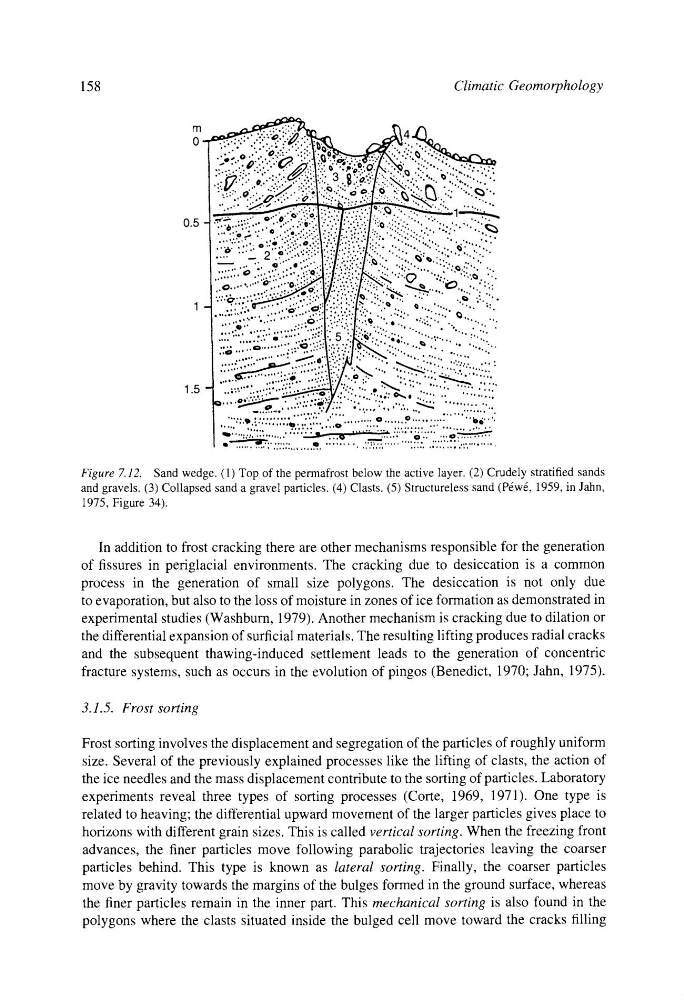
Figure 7.12. Sand wedge. (1) Top of the permafrost below the active layer. (2) Crudely stratified sands
and gravels. (3) Collapsed sand a gravel particles. (4) Clasts. (5) Structureless sand (Prwr, 1959, in Jahn,
1975, Figure 34).
In addition to frost cracking there are other mechanisms responsible for the generation
of fissures in periglacial environments. The cracking due to desiccation is a common
process in the generation of small size polygons. The desiccation is not only due
to evaporation, but also to the loss of moisture in zones of ice formation as demonstrated in
experimental studies (Washburn, 1979). Another mechanism is cracking due to dilation or
the differential expansion of surficial materials. The resulting lifting produces radial cracks
and the subsequent thawing-induced settlement leads to the generation of concentric
fracture systems, such as occurs in the evolution of pingos (Benedict, 1970; Jahn, 1975).
3.1.5. Frost sorting
Frost sorting involves the displacement and segregation of the particles of roughly uniform
size. Several of the previously explained processes like the lifting of clasts, the action of
the ice needles and the mass displacement contribute to the sorting of particles. Laboratory
experiments reveal three types of sorting processes (Corte, 1969, 1971). One type is
related to heaving; the differential upward movement of the larger particles gives place to
horizons with different grain sizes. This is called vertical sorting. When the freezing front
advances, the finer particles move following parabolic trajectories leaving the coarser
particles behind. This type is known as lateral sorting. Finally, the coarser particles
move by gravity towards the margins of the bulges formed in the ground surface, whereas
the finer particles remain in the inner part. This mechanical sorting is also found in the
polygons where the clasts situated inside the bulged cell move toward the cracks filling
Climatic Geomorphology
05
1.5
::
:::.::i!:.!
....~...
._
~
,,
"" ..0"*+
....
, ,~,,
.::. .... ...:.... ~ ..
::~, .::.'~ ...... 5
;i: : . ;.: -:. ."
9 ..~"':"" .. i "~':".'".~:
~',~...'...........?
9 . .... '.~.':,~.::...
,..
"';..
.....~
...
.
....
9
...~ ....?..
9 ...:,:'::.
"..
..... i"
.." ..... ~" "
::::: ......
.7...:::.'.. :::..:...,,,,~,...'..~:,....::"............."
.....
.... ::. .... ..:::~'.:::.-'..:..':... !" .....?.:: o ..',-~"': ...... :.. ..... .: ::.
....
. :'~ .......
.:. "...
".,,': ~ o .' ......
' ........
).o..
Or'~
*
...'
.
...
".o
"
".
,.
".*.
.0.,...
.
:~ :
.:
. ..
. o.;.,
....
..........
o ...... p ......... ~ .... '.~..'.
.. i:~':.*.'.'.':.': ::::;, : ~: ......'i
" ' .......
.~
....
. .....
.....,
....
,....
9 , .... ...';.'::'. ....... '":::'SL~I
' ..... "'::.:: .... ~ ..... ...o~
e~:
.......
Q ..::~.. "~'~.. ..... ' ...... " ' ....... :"
........
, ,,,,..,
, .............
9 .....
9 ,,~'."'o"
".
Figure 7.12. Sand wedge. (1) Top of the permafrost below the active layer. (2) Crudely stratified sands
and gravels. (3) Collapsed sand a gravel particles. (4) Clasts. (5) Structureless sand (Prwr, 1959, in Jahn,
1975, Figure 34).
In addition to frost cracking there are other mechanisms responsible for the generation
of fissures in periglacial environments. The cracking due to desiccation is a common
process in the generation of small size polygons. The desiccation is not only due
to evaporation, but also to the loss of moisture in zones of ice formation as demonstrated in
experimental studies (Washburn, 1979). Another mechanism is cracking due to dilation or
the differential expansion of surficial materials. The resulting lifting produces radial cracks
and the subsequent thawing-induced settlement leads to the generation of concentric
fracture systems, such as occurs in the evolution of pingos (Benedict, 1970; Jahn, 1975).
3.1.5. Frost sorting
Frost sorting involves the displacement and segregation of the particles of roughly uniform
size. Several of the previously explained processes like the lifting of clasts, the action of
the ice needles and the mass displacement contribute to the sorting of particles. Laboratory
experiments reveal three types of sorting processes (Corte, 1969, 1971). One type is
related to heaving; the differential upward movement of the larger particles gives place to
horizons with different grain sizes. This is called vertical sorting. When the freezing front
advances, the finer particles move following parabolic trajectories leaving the coarser
particles behind. This type is known as lateral sorting. Finally, the coarser particles
move by gravity towards the margins of the bulges formed in the ground surface, whereas
the finer particles remain in the inner part. This mechanical sorting is also found in the
polygons where the clasts situated inside the bulged cell move toward the cracks filling