

Glacial transport and sedimentation
101
0 Km
"5 sJ
"
I
"'
I .s
~
L
IP
"
",
t?
, "
9
9
'% 9
~ighway 7
_.~.
_
o 9 s.
~e
-~
,
s,
sod p
0 S ~
o
0
,r
' j, o~176 e, %' 9 ." oOl
,co t~
a Io
I
e
I~
9
, ,,,:', ',, ~ ..:. ";i
.,,;L ' ,,
t
'
'."
,.. ,,,....
9
,,,,, ., ,...z,,
I01
. . ,~OI
,
a o
~__~;
s
#
I Highway 7/~../,
9 .,
,,,
9
.,.
./,O ~ lpe/ "'*~
" L k
o
O
o
o#
,
r.~
O
a ,
115
P" I
,
9
el
,
,
I
o| e
y
oe !
,,,j . .' )
"- I
' .I
, 'O
sl
s]o f
s,
If",
"P'J "it" ,"
/J/ #let
- ,s
'a I# v . I
~,
I
it o. 'ot"
~,', ",
o.
/
%/I
,.' .-.
, 9
t "/
"
9
~
O
,
o
j I
9 ~
0 e
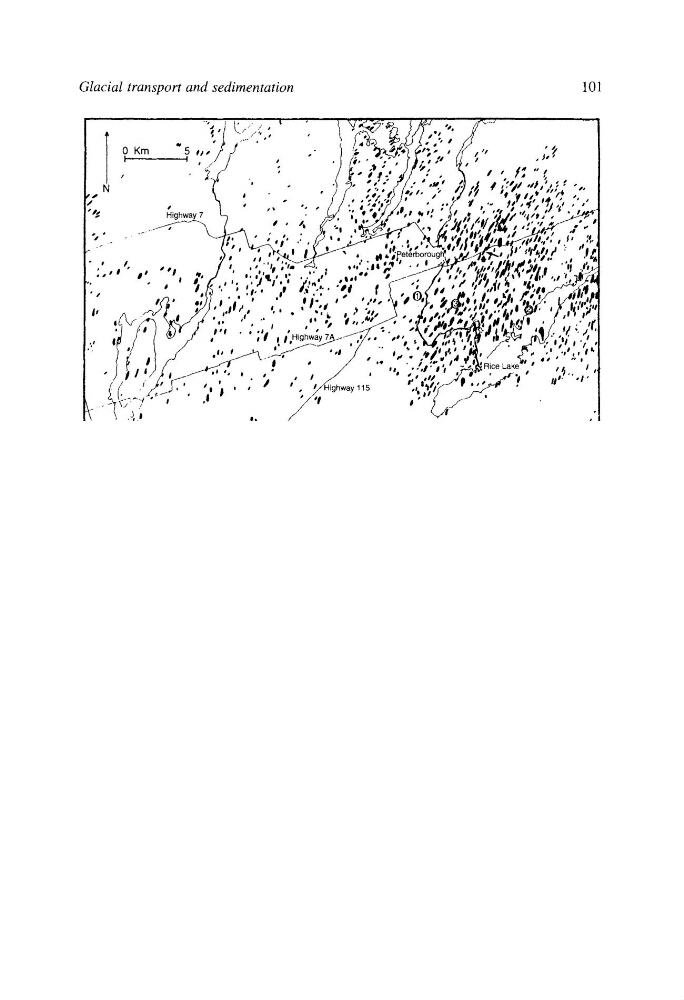
Figure 4.13. Peterborough drumlin field in Ontario, Canada (Sharpe, 1967, Figure 2a).
a pre-existing till mantle, whereas others suggest an accumulation of subglacial till in
streamlined forms. In the first case two glaciations or important advances of the ice masses
are necessary, in order to explain deposition and then erosion (Embleton and King, 1975).
The existence of rock or block thresholds suggests that they can develop by accretion
around these thresholds, because some drumlins show concentric layers. The initial stage
of their evolution would be the morphologies of a hill or crag and tail. The form of the
drumlin is related to the variations of basal pressure in a moving glacier, as the orientation
of clasts seems to indicate. The highest part of the drumlin is the area of low pressure
(Figure 4.14), and the particles are carried to these summit areas from the high-pressure,
low topographic areas (Evenson, 1971). This interpretation corroborates the fact that in the
drumlin fields the mantle of till is thinner in the areas between drumlins. Boulton (1987)
explained drumlins according to rheological properties of the subglacial sediments and
their water content. As a consequence of glacial stresses, the coarse materials are slightly
strained, and fines flow easily. Some interiors can be affected, showing a high degree of
deformation, unlike those with a stable nucleus.
The concentration of drumlins in certain areas seems to indicate that there are specific
conditions for their generation. Toward the margin of the glacier the ice becomes thinner,
and consequently a critical state of dilatancy can be reached in the subglacial till
(Figure 4.15a) (Smalley and Unwin, 1968). It occurs when the particles of the till subject
to stresses are displaced and disengaged with respect to the others. This process results in
an expansion or increase of volume, and a greater strength to shear stress. Not all tills are
dilatant materials, because a minimum proportion of blocks are required. Such compact
tills resist posterior stresses, in such a manner that the rest of the till flows around it. The
C stress is critical for the generation of drumlins (Figure 4.15b). If it is greater than (a),
101
0 Km
"5 sJ
"
I
"'
I .s
~
L
IP
"
",
t?
, "
9
9
'% 9
~ighway 7
_.~.
_
o 9 s.
~e
-~
,
s,
sod p
0 S ~
o
0
,r
' j, o~176 e, %' 9 ." oOl
,co t~
a Io
I
e
I~
9
, ,,,:', ',, ~ ..:. ";i
.,,;L ' ,,
t
'
'."
,.. ,,,....
9
,,,,, ., ,...z,,
I01
. . ,~OI
,
a o
~__~;
s
#
I Highway 7/~../,
9 .,
,,,
9
.,.
./,O ~ lpe/ "'*~
" L k
o
O
o
o#
,
r.~
O
a ,
115
P" I
,
9
el
,
,
I
o| e
y
oe !
,,,j . .' )
"- I
' .I
, 'O
sl
s]o f
s,
If",
"P'J "it" ,"
/J/ #let
- ,s
'a I# v . I
~,
I
it o. 'ot"
~,', ",
o.
/
%/I
,.' .-.
, 9
t "/
"
9
~
O
,
o
j I
9 ~
0 e
Figure 4.13. Peterborough drumlin field in Ontario, Canada (Sharpe, 1967, Figure 2a).
a pre-existing till mantle, whereas others suggest an accumulation of subglacial till in
streamlined forms. In the first case two glaciations or important advances of the ice masses
are necessary, in order to explain deposition and then erosion (Embleton and King, 1975).
The existence of rock or block thresholds suggests that they can develop by accretion
around these thresholds, because some drumlins show concentric layers. The initial stage
of their evolution would be the morphologies of a hill or crag and tail. The form of the
drumlin is related to the variations of basal pressure in a moving glacier, as the orientation
of clasts seems to indicate. The highest part of the drumlin is the area of low pressure
(Figure 4.14), and the particles are carried to these summit areas from the high-pressure,
low topographic areas (Evenson, 1971). This interpretation corroborates the fact that in the
drumlin fields the mantle of till is thinner in the areas between drumlins. Boulton (1987)
explained drumlins according to rheological properties of the subglacial sediments and
their water content. As a consequence of glacial stresses, the coarse materials are slightly
strained, and fines flow easily. Some interiors can be affected, showing a high degree of
deformation, unlike those with a stable nucleus.
The concentration of drumlins in certain areas seems to indicate that there are specific
conditions for their generation. Toward the margin of the glacier the ice becomes thinner,
and consequently a critical state of dilatancy can be reached in the subglacial till
(Figure 4.15a) (Smalley and Unwin, 1968). It occurs when the particles of the till subject
to stresses are displaced and disengaged with respect to the others. This process results in
an expansion or increase of volume, and a greater strength to shear stress. Not all tills are
dilatant materials, because a minimum proportion of blocks are required. Such compact
tills resist posterior stresses, in such a manner that the rest of the till flows around it. The
C stress is critical for the generation of drumlins (Figure 4.15b). If it is greater than (a),