

102
Climatic Geomorphology
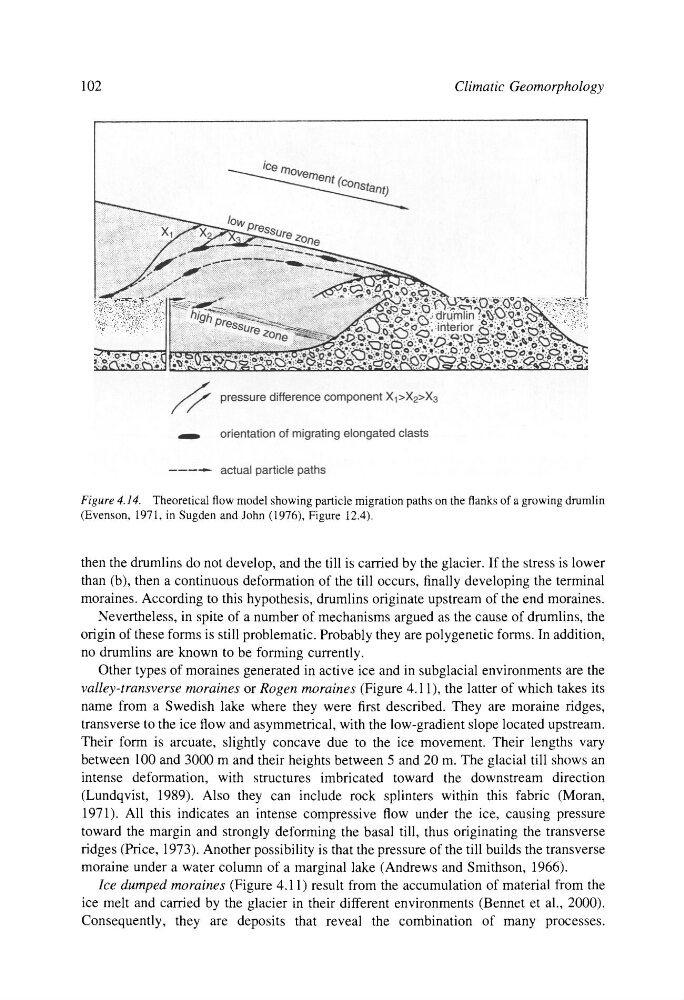
Figure 4.14. Theoretical flow model showing particle migration paths on the flanks of a growing drumlin
(Evenson, 1971, in Sugden and John (1976), Figure 12.4).
then the drumlins do not develop, and the till is carried by the glacier. If the stress is lower
than (b), then a continuous deformation of the till occurs, finally developing the terminal
moraines. According to this hypothesis, drumlins originate upstream of the end moraines.
Nevertheless, in spite of a number of mechanisms argued as the cause of drumlins, the
origin of these forms is still problematic. Probably they are polygenetic forms. In addition,
no drumlins are known to be forming currently.
Other types of moraines generated in active ice and in subglacial environments are the
valley-transverse moraines or Rogen moraines (Figure 4.11), the latter of which takes its
name from a Swedish lake where they were first described. They are moraine ridges,
transverse to the ice flow and asymmetrical, with the low-gradient slope located upstream.
Their form is arcuate, slightly concave due to the ice movement. Their lengths vary
between 100 and 3000 m and their heights between 5 and 20 m. The glacial till shows an
intense deformation, with structures imbricated toward the downstream direction
(Lundqvist, 1989). Also they can include rock splinters within this fabric (Moran,
1971). All this indicates an intense compressive flow under the ice, causing pressure
toward the margin and strongly deforming the basal till, thus originating the transverse
ridges (Price, 1973). Another possibility is that the pressure of the till builds the transverse
moraine under a water column of a marginal lake (Andrews and Smithson, 1966).
Ice dumped moraines (Figure 4.11) result from the accumulation of material from the
ice melt and carried by the glacier in their different environments (Bennet et al., 2000).
Consequently, they are deposits that reveal the combination of many processes.
Climatic Geomorphology
Figure 4.14. Theoretical flow model showing particle migration paths on the flanks of a growing drumlin
(Evenson, 1971, in Sugden and John (1976), Figure 12.4).
then the drumlins do not develop, and the till is carried by the glacier. If the stress is lower
than (b), then a continuous deformation of the till occurs, finally developing the terminal
moraines. According to this hypothesis, drumlins originate upstream of the end moraines.
Nevertheless, in spite of a number of mechanisms argued as the cause of drumlins, the
origin of these forms is still problematic. Probably they are polygenetic forms. In addition,
no drumlins are known to be forming currently.
Other types of moraines generated in active ice and in subglacial environments are the
valley-transverse moraines or Rogen moraines (Figure 4.11), the latter of which takes its
name from a Swedish lake where they were first described. They are moraine ridges,
transverse to the ice flow and asymmetrical, with the low-gradient slope located upstream.
Their form is arcuate, slightly concave due to the ice movement. Their lengths vary
between 100 and 3000 m and their heights between 5 and 20 m. The glacial till shows an
intense deformation, with structures imbricated toward the downstream direction
(Lundqvist, 1989). Also they can include rock splinters within this fabric (Moran,
1971). All this indicates an intense compressive flow under the ice, causing pressure
toward the margin and strongly deforming the basal till, thus originating the transverse
ridges (Price, 1973). Another possibility is that the pressure of the till builds the transverse
moraine under a water column of a marginal lake (Andrews and Smithson, 1966).
Ice dumped moraines (Figure 4.11) result from the accumulation of material from the
ice melt and carried by the glacier in their different environments (Bennet et al., 2000).
Consequently, they are deposits that reveal the combination of many processes.