

Glacial transport and sedimentation
95
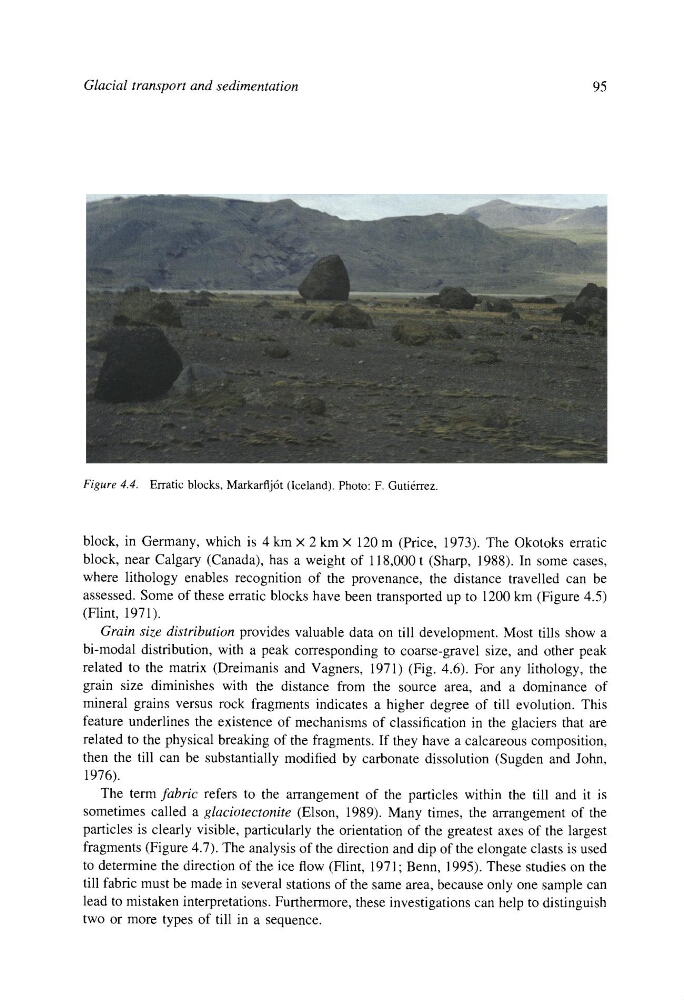
Figure 4.4. Erratic blocks, Markarflj6t (Iceland). Photo: F. Guti6rrez.
block, in Germany, which is 4 km x 2 km x 120 m (Price, 1973). The Okotoks erratic
block, near Calgary (Canada), has a weight of 118,000 t (Sharp, 1988). In some cases,
where lithology enables recognition of the provenance, the distance travelled can be
assessed. Some of these erratic blocks have been transported up to 1200 km (Figure 4.5)
(Flint, 1971).
Grain size distribution provides valuable data on till development. Most tills show a
bi-modal distribution, with a peak corresponding to coarse-gravel size, and other peak
related to the matrix (Dreimanis and Vagners, 1971) (Fig. 4.6). For any lithology, the
grain size diminishes with the distance from the source area, and a dominance of
mineral grains versus rock fragments indicates a higher degree of till evolution. This
feature underlines the existence of mechanisms of classification in the glaciers that are
related to the physical breaking of the fragments. If they have a calcareous composition,
then the till can be substantially modified by carbonate dissolution (Sugden and John,
1976).
The term fabric refers to the arrangement of the particles within the till and it is
sometimes called a glaciotectonite (Elson, 1989). Many times, the arrangement of the
particles is clearly visible, particularly the orientation of the greatest axes of the largest
fragments (Figure 4.7). The analysis of the direction and dip of the elongate clasts is used
to determine the direction of the ice flow (Flint, 1971; Benn, 1995). These studies on the
till fabric must be made in several stations of the same area, because only one sample can
lead to mistaken interpretations. Furthermore, these investigations can help to distinguish
two or more types of till in a sequence.
95
Figure 4.4. Erratic blocks, Markarflj6t (Iceland). Photo: F. Guti6rrez.
block, in Germany, which is 4 km x 2 km x 120 m (Price, 1973). The Okotoks erratic
block, near Calgary (Canada), has a weight of 118,000 t (Sharp, 1988). In some cases,
where lithology enables recognition of the provenance, the distance travelled can be
assessed. Some of these erratic blocks have been transported up to 1200 km (Figure 4.5)
(Flint, 1971).
Grain size distribution provides valuable data on till development. Most tills show a
bi-modal distribution, with a peak corresponding to coarse-gravel size, and other peak
related to the matrix (Dreimanis and Vagners, 1971) (Fig. 4.6). For any lithology, the
grain size diminishes with the distance from the source area, and a dominance of
mineral grains versus rock fragments indicates a higher degree of till evolution. This
feature underlines the existence of mechanisms of classification in the glaciers that are
related to the physical breaking of the fragments. If they have a calcareous composition,
then the till can be substantially modified by carbonate dissolution (Sugden and John,
1976).
The term fabric refers to the arrangement of the particles within the till and it is
sometimes called a glaciotectonite (Elson, 1989). Many times, the arrangement of the
particles is clearly visible, particularly the orientation of the greatest axes of the largest
fragments (Figure 4.7). The analysis of the direction and dip of the elongate clasts is used
to determine the direction of the ice flow (Flint, 1971; Benn, 1995). These studies on the
till fabric must be made in several stations of the same area, because only one sample can
lead to mistaken interpretations. Furthermore, these investigations can help to distinguish
two or more types of till in a sequence.