

94
Climatic Geomorphology
direction of ice movement
|
_
_
......
1
0
mm
50
major shear planes with slickensides
~/
major foliation planes
contained clasts
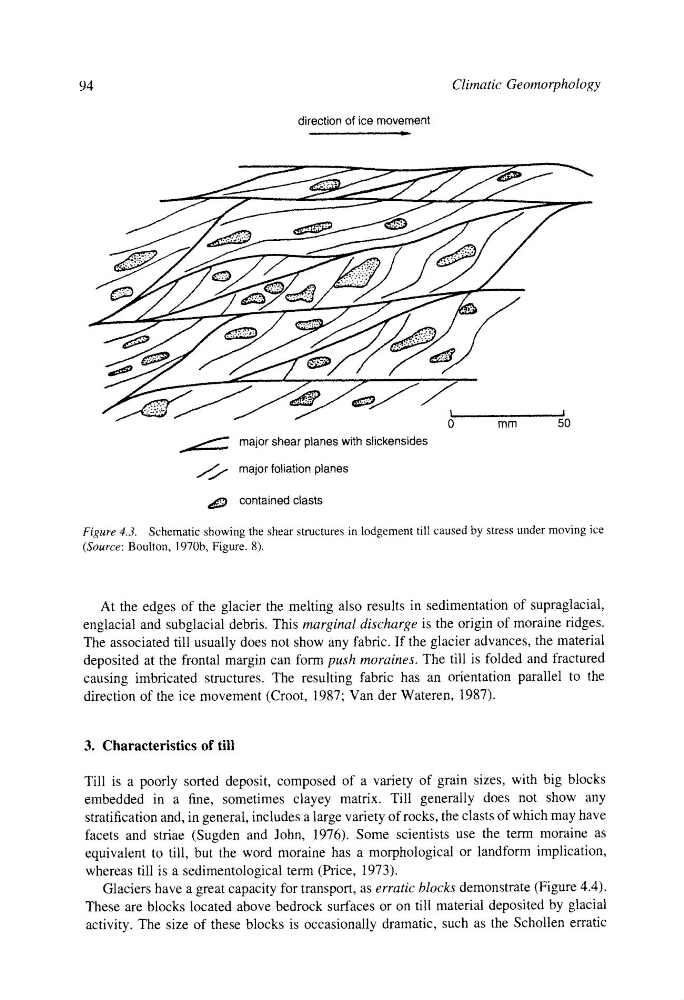
Figure 4.3. Schematic showing the shear structures in lodgement till caused by stress under moving ice
(Source: Boulton, 1970b, Figure. 8).
At the edges of the glacier the melting also results in sedimentation of supraglacial,
englacial and subglacial debris. This marginal discharge is the origin of moraine ridges.
The associated till usually does not show any fabric. If the glacier advances, the material
deposited at the frontal margin can form push moraines. The till is folded and fractured
causing imbricated structures. The resulting fabric has an orientation parallel to the
direction of the ice movement (Croot, 1987; Van der Wateren, 1987).
3. Characteristics of till
Till is a poorly sorted deposit, composed of a variety of grain sizes, with big blocks
embedded in a fine, sometimes clayey matrix. Till generally does not show any
stratification and, in general, includes a large variety of rocks, the clasts of which may have
facets and striae (Sugden and John, 1976). Some scientists use the term moraine as
equivalent to till, but the word moraine has a morphological or landform implication,
whereas till is a sedimentological term (Price, 1973).
Glaciers have a great capacity for transport, as erratic blocks demonstrate (Figure 4.4).
These are blocks located above bedrock surfaces or on till material deposited by glacial
activity. The size of these blocks is occasionally dramatic, such as the Schollen erratic
Climatic Geomorphology
direction of ice movement
|
_
_
......
1
0
mm
50
major shear planes with slickensides
~/
major foliation planes
contained clasts
Figure 4.3. Schematic showing the shear structures in lodgement till caused by stress under moving ice
(Source: Boulton, 1970b, Figure. 8).
At the edges of the glacier the melting also results in sedimentation of supraglacial,
englacial and subglacial debris. This marginal discharge is the origin of moraine ridges.
The associated till usually does not show any fabric. If the glacier advances, the material
deposited at the frontal margin can form push moraines. The till is folded and fractured
causing imbricated structures. The resulting fabric has an orientation parallel to the
direction of the ice movement (Croot, 1987; Van der Wateren, 1987).
3. Characteristics of till
Till is a poorly sorted deposit, composed of a variety of grain sizes, with big blocks
embedded in a fine, sometimes clayey matrix. Till generally does not show any
stratification and, in general, includes a large variety of rocks, the clasts of which may have
facets and striae (Sugden and John, 1976). Some scientists use the term moraine as
equivalent to till, but the word moraine has a morphological or landform implication,
whereas till is a sedimentological term (Price, 1973).
Glaciers have a great capacity for transport, as erratic blocks demonstrate (Figure 4.4).
These are blocks located above bedrock surfaces or on till material deposited by glacial
activity. The size of these blocks is occasionally dramatic, such as the Schollen erratic