

Glacial transport and sedimentation
93
affected by the gradient, roughness and water percentage. Flows of several metres per
minute have been recorded, and the debris mobilized can be displaced for tens or even
hundreds of metres (Sugden and John, 1976).
Three heat sources can act in subglacial melting: geothermal heat flow, frictional heat
due to sliding of the ice, and that resulting from an increase of pressure due to the
obstructions of an irregular substrate (Embleton, 1979). All this calorific supply results
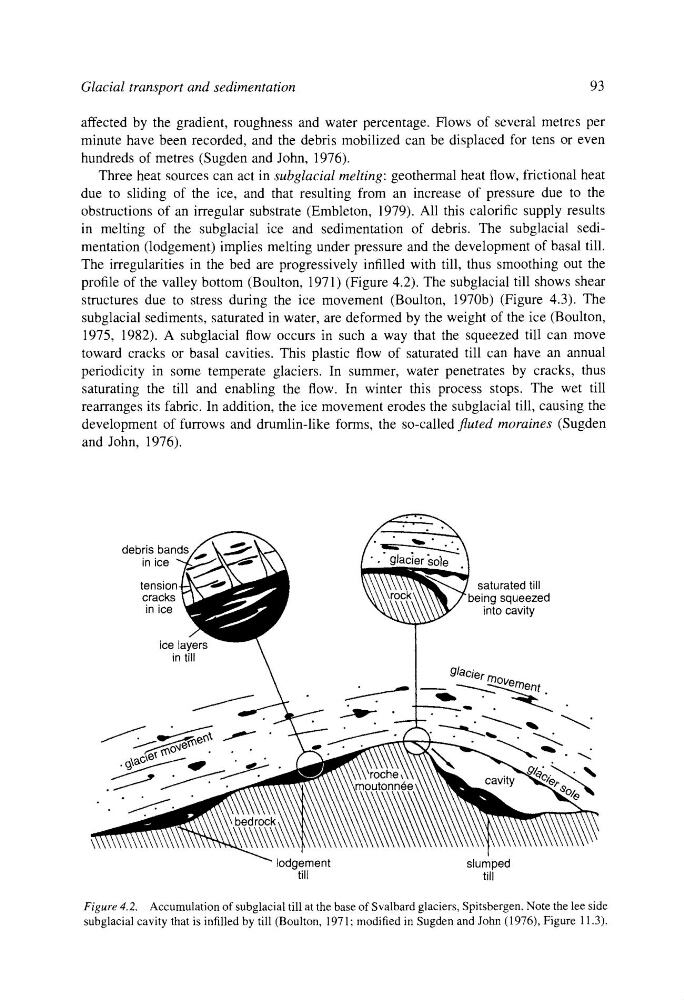
in melting of the subglacial ice and sedimentation of debris. The subglacial sedimentation (lodgement) implies melting under pressure and the development of basal till.
The irregularities in the bed are progressively infilled with till, thus smoothing out the
profile of the valley bottom (Boulton, 1971) (Figure 4.2). The subglacial till shows shear
structures due to stress during the ice movement (Boulton, 1970b) (Figure 4.3). The
subglacial sediments, saturated in water, are deformed by the weight of the ice (Boulton,
1975, 1982). A subglacial flow occurs in such a way that the squeezed till can move
toward cracks or basal cavities. This plastic flow of saturated till can have an annual
periodicity in some temperate glaciers. In summer, water penetrates by cracks, thus
saturating the till and enabling the flow. In winter this process stops. The wet till
rearranges its fabric. In addition, the ice movement erodes the subglacial till, causing the
development of furrows and drumlin-like forms, the so-called fluted moraines (Sugden
and John, 1976).
/
debris bands
~
in ice
9 9 glacier ~;o1~
cracks
in ice
ice layers
in till
.~
.
9
.
r saturated till
being squeezed
into cavity
~~
cavity
lodgement
slumped
till
till
Figure 4.2. Accumulation of subglacial till at the base of Svalbard glaciers, Spitsbergen. Note the lee side
subglacial cavity that is infilled by till (Boulton, 1971" modifed in Sugden and John (1976), Figure 11.3).
93
affected by the gradient, roughness and water percentage. Flows of several metres per
minute have been recorded, and the debris mobilized can be displaced for tens or even
hundreds of metres (Sugden and John, 1976).
Three heat sources can act in subglacial melting: geothermal heat flow, frictional heat
due to sliding of the ice, and that resulting from an increase of pressure due to the
obstructions of an irregular substrate (Embleton, 1979). All this calorific supply results
in melting of the subglacial ice and sedimentation of debris. The subglacial sedimentation (lodgement) implies melting under pressure and the development of basal till.
The irregularities in the bed are progressively infilled with till, thus smoothing out the
profile of the valley bottom (Boulton, 1971) (Figure 4.2). The subglacial till shows shear
structures due to stress during the ice movement (Boulton, 1970b) (Figure 4.3). The
subglacial sediments, saturated in water, are deformed by the weight of the ice (Boulton,
1975, 1982). A subglacial flow occurs in such a way that the squeezed till can move
toward cracks or basal cavities. This plastic flow of saturated till can have an annual
periodicity in some temperate glaciers. In summer, water penetrates by cracks, thus
saturating the till and enabling the flow. In winter this process stops. The wet till
rearranges its fabric. In addition, the ice movement erodes the subglacial till, causing the
development of furrows and drumlin-like forms, the so-called fluted moraines (Sugden
and John, 1976).
/
debris bands
~
in ice
9 9 glacier ~;o1~
cracks
in ice
ice layers
in till
.~
.
9
.
r saturated till
being squeezed
into cavity
~~
cavity
lodgement
slumped
till
till
Figure 4.2. Accumulation of subglacial till at the base of Svalbard glaciers, Spitsbergen. Note the lee side
subglacial cavity that is infilled by till (Boulton, 1971" modifed in Sugden and John (1976), Figure 11.3).