

92
Climatic Geomorphology
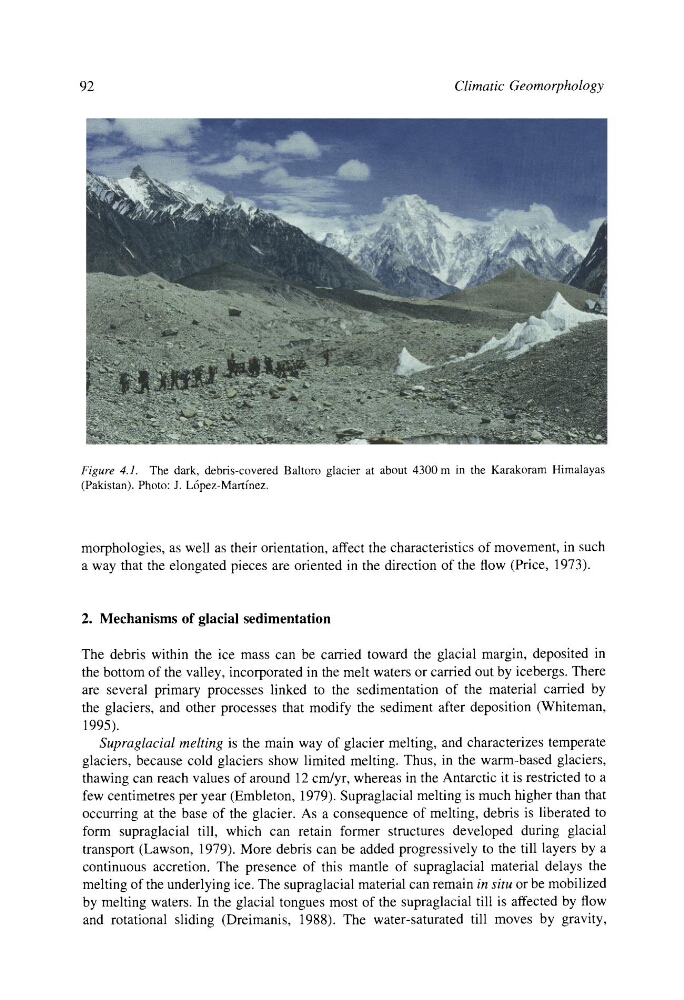
Figure 4.1. The dark, debris-covered Baltoro glacier at about 4300 m in the Karakoram Himalayas
(Pakistan). Photo: J. L6pez-Martfnez.
morphologies, as well as their orientation, affect the characteristics of movement, in such
a way that the elongated pieces are oriented in the direction of the flow (Price, 1973).
2. Mechanisms of glacial sedimentation
The debris within the ice mass can be carried toward the glacial margin, deposited in
the bottom of the valley, incorporated in the melt waters or carried out by icebergs. There
are several primary processes linked to the sedimentation of the material carried by
the glaciers, and other processes that modify the sediment after deposition (Whiteman,
1995).
Supraglacial melting is the main way of glacier melting, and characterizes temperate
glaciers, because cold glaciers show limited melting. Thus, in the warm-based glaciers,
thawing can reach values of around 12 cm/yr, whereas in the Antarctic it is restricted to a
few centimetres per year (Embleton, 1979). Supraglacial melting is much higher than that
occurring at the base of the glacier. As a consequence of melting, debris is liberated to
form supraglacial till, which can retain former structures developed during glacial
transport (Lawson, 1979). More debris can be added progressively to the till layers by a
continuous accretion. The presence of this mantle of supraglacial material delays the
melting of the underlying ice. The supraglacial material can remain in situ or be mobilized
by melting waters. In the glacial tongues most of the supraglacial till is affected by flow
and rotational sliding (Dreimanis, 1988). The water-saturated till moves by gravity,
Climatic Geomorphology
Figure 4.1. The dark, debris-covered Baltoro glacier at about 4300 m in the Karakoram Himalayas
(Pakistan). Photo: J. L6pez-Martfnez.
morphologies, as well as their orientation, affect the characteristics of movement, in such
a way that the elongated pieces are oriented in the direction of the flow (Price, 1973).
2. Mechanisms of glacial sedimentation
The debris within the ice mass can be carried toward the glacial margin, deposited in
the bottom of the valley, incorporated in the melt waters or carried out by icebergs. There
are several primary processes linked to the sedimentation of the material carried by
the glaciers, and other processes that modify the sediment after deposition (Whiteman,
1995).
Supraglacial melting is the main way of glacier melting, and characterizes temperate
glaciers, because cold glaciers show limited melting. Thus, in the warm-based glaciers,
thawing can reach values of around 12 cm/yr, whereas in the Antarctic it is restricted to a
few centimetres per year (Embleton, 1979). Supraglacial melting is much higher than that
occurring at the base of the glacier. As a consequence of melting, debris is liberated to
form supraglacial till, which can retain former structures developed during glacial
transport (Lawson, 1979). More debris can be added progressively to the till layers by a
continuous accretion. The presence of this mantle of supraglacial material delays the
melting of the underlying ice. The supraglacial material can remain in situ or be mobilized
by melting waters. In the glacial tongues most of the supraglacial till is affected by flow
and rotational sliding (Dreimanis, 1988). The water-saturated till moves by gravity,